
Free Safe Operating Procedure (Cable Blower) Template
Establish a clear, safe system of work for operating cable blowers.
Free Safe Operating Procedure (Cable Blower) Template
DOCX • 126 KB + PDF
Updated Oct 2026
No signup required
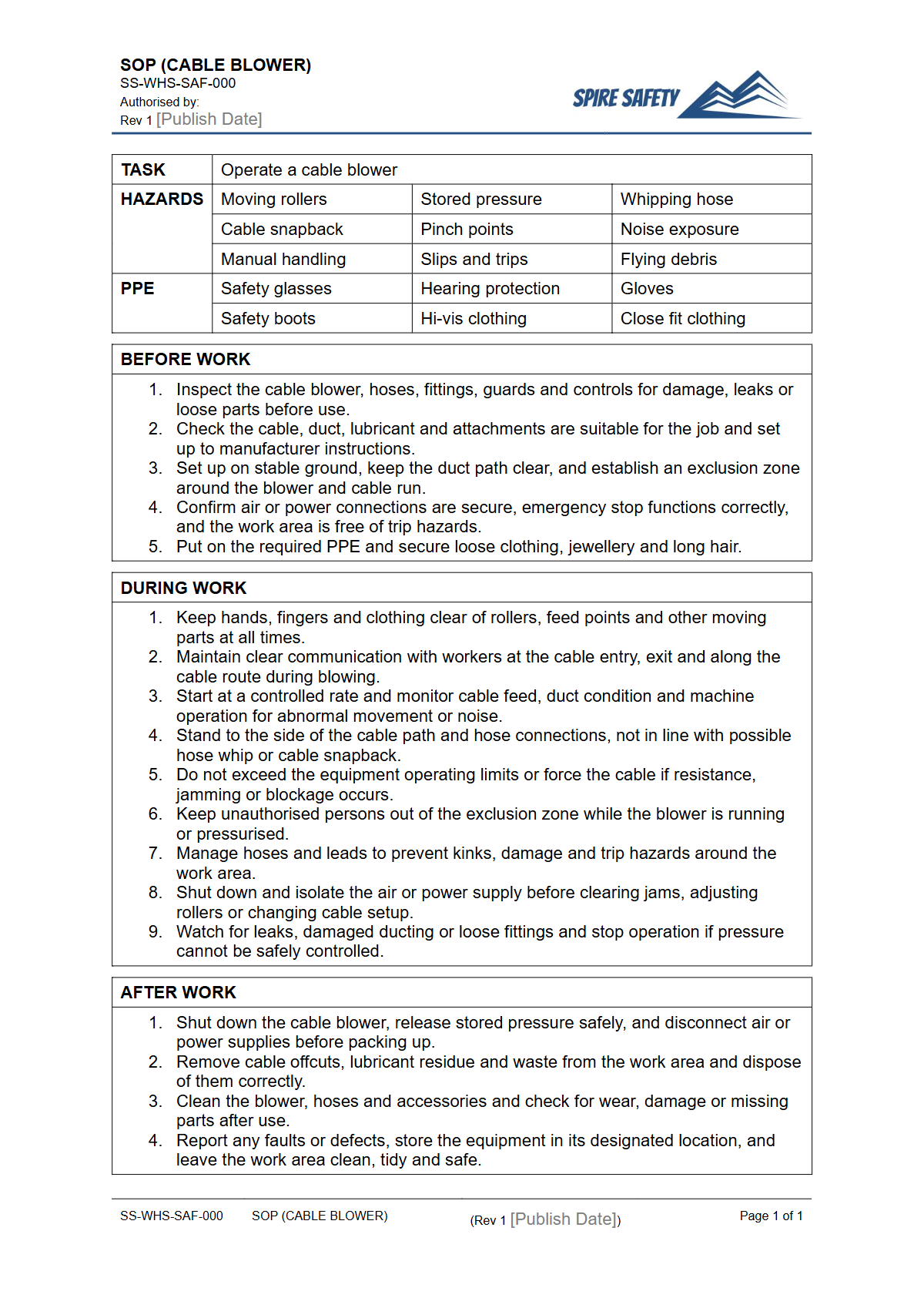
Purpose of the Free Safe Operating Procedure (Cable Blower) Template
Operating a cable blower involves significant risks, including high-pressure air, ergonomic strains, and potential for equipment failure. A documented Safe Operating Procedure (SOP) is a fundamental tool for any Person Conducting a Business or Undertaking (PCBU) to ensure tasks are performed safely and consistently.
This Free Safe Operating Procedure (Cable Blower) Template provides a structured framework to help your organisation meet its primary duty of care under Australian WHS laws.
The primary purpose of an SOP is to provide clear, step-by-step instructions that guide workers through a task from start to finish. By standardising the process for operating a cable blower, you can minimise human error, reduce the likelihood of incidents, and provide a clear baseline for training and competency assessment. This document is crucial for managing hazards specific to civil and telecommunications work, which often involves coordinating multiple high-risk activities, such as excavation work detailed in our free Trencher SOP template.
Video walkthrough
How to use the Free Safe Operating Procedure (Cable Blower) Template
This template is provided in both DOCX and PDF formats for your convenience. The DOCX version is fully editable, allowing you to tailor the content to the specific needs of your workplace.
To use it effectively, you should work through each section and populate it with information relevant to your equipment, personnel, and operational environment.
Important Customisation Note
This document is a template, not a finished product. For it to be effective and support your safety obligations, we stress that you must customise it. This involves incorporating details from your own risk assessments, including the specific make and model of your cable blower, the types of cable being installed, site-specific hazards, and the names or roles of responsible personnel.
Integrating this SOP into your broader safety framework is a key step; for businesses looking to formalise their approach, developing comprehensive WHS management systems provides a robust structure for managing all safety documentation and processes.
Key Elements of a Cable Blower Safe Operating Procedure
A robust SOP for high-pressure equipment should be comprehensive and easy to understand. Our template is structured to guide you through the essential components required for a safe system of work. Key sections you will need to customise include:
- Required Personal Protective Equipment (PPE): Specify the exact PPE required, such as safety glasses or goggles, hearing protection, steel-capped boots, and high-visibility clothing.
- Pre-Operational Checks: Detail the visual inspections and function tests operators must perform before every use. This includes checking hoses for damage, verifying pressure gauges are functional, and ensuring all guards are in place. Many cable blowers are powered by external equipment, so procedures may need to align with a free Air Compressor SOP.
- Step-by-Step Operating Instructions: This is the core of the SOP. It should break down the entire process into sequential, manageable steps, from setting up the equipment and proving the duct to performing the blow and shutting down safely.
- Emergency Procedures: Clearly outline the steps for an emergency shutdown, what to do in case of a hose failure (hose whip), and how to respond to an injury.
When to Use This Safe Operating Procedure
The Cable Blower SOP is a critical reference document that should be used in several situations. It is not a 'set and forget' document left in a folder.
It must be readily accessible to workers performing the task.
Its primary use is as a direct guide for operators before and during the cable installation process. It also serves as a foundational document for conducting task-specific training for new employees and for refresher training for existing workers.
Furthermore, the SOP is an essential reference during incident investigations and when conducting workplace inspections or safety audits. The effectiveness of your SOPs can be verified through regular WHS compliance auditing, which helps identify gaps between documented procedures and actual work practices.
Who Should Use It
This SOP is intended for a range of personnel within an organisation. Direct users include:
- Equipment Operators: The primary audience, who must follow the procedure to ensure their own safety and the safety of others.
- Supervisors and Team Leaders: Responsible for ensuring workers are trained on the SOP and adhere to it during operations. They use it as a tool for monitoring and instruction.
- WHS Managers and Advisors: Use the SOP as part of the overall risk management framework, for training development, and as a benchmark during safety audits.
- Maintenance Personnel: Refer to shutdown and isolation procedures within the SOP before commencing any maintenance or repair work on the cable blower.
Ultimately, anyone involved with the cable blowing task must be aware of and competent in the procedure. For other heavy equipment used on site, consistent documentation like our FREE Dozer SOP Template helps build a comprehensive and understandable safety system.
You can explore our full range of templates in our free WHS resources library to standardise safety across all your operations.
Common mistakes
Common mistakes to avoid
- Failing to match the cable, seal, and duct sizes, leading to air leaks and inefficient blowing.
- Neglecting to clean and prove the duct before starting the installation, causing blockages and cable damage.
- Using incompatible or excessive lubricant, which can degrade the cable jacket over time.
- Poor communication between the feeding and receiving ends of the duct run, resulting in overruns or damage.
Legal references
Legal considerations
The following legal requirements may be relevant to this type of work.
- Work Health and Safety Act (Harmonised) — Provides the primary duties for protecting workers and other people from work health and safety risks.
- Work Health and Safety Regulations (Harmonised) — Sets out requirements supporting the management of workplace hazards and risks.
The following codes may be relevant to this type of work.
- Managing WHS Risks Code of Practice — Provides practical guidance on identifying hazards, assessing risks and applying effective controls.
- Work Health and Safety Consultation, Cooperation and Coordination Code of Practice — Provides practical guidance on consulting workers and coordinating with other duty holders.
- Managing the Work Environment and Facilities Code of Practice — Provides practical guidance on safe work environments, workplace facilities and related controls.
Did you know
High-Speed Installation
Modern cable blowers, also known as cable jetting machines, can install fibre optic cables at speeds of over 100 metres per minute, significantly faster than traditional pulling methods.
The Power of Air
The air pressure used in cable blowing is substantial, often ranging from 10 to 15 bar (145 to 217 psi). This pressure is enough to propel the cable through ducts over several kilometres in a single run.
FAQ
Frequently asked questions
01What are the main hazards associated with operating a cable blower?
02How often should our Safe Operating Procedure for a cable blower be reviewed?
03Does this template include maintenance and cleaning steps?
04Is a Verification of Competency (VOC) required to use a cable blower?
Share this resource
Free Safe Operating Procedure (Cable Blower) Template
Browse Categories
How To Use It
- 1Download and open in Word or PDF.
- 2Replace the placeholders with your business details.
- 3Get it reviewed by a WHS specialist before rollout.
Need it customised?
Our WHS consultants can adapt this template to your site, run a gap analysis, or audit what you already have in place.
Book a Free Consultation WHS consulting servicesor call 1300 156 382
Related templates
- Free Safe Operating Procedure (Cable Crimper) Template
- Free Safe Operating Procedure (Cable Cutter) Template
- Free Safe Operating Procedure (Cable Drum Jack) Template
- Free Safe Operating Procedure (Cable Drum Stand) Template
- Free Safe Operating Procedure (Cable Jetting) Template
- Free Safe Operating Procedure (Cable Jointing) Template