
Free Safe Operating Procedure (Cable Cutter) Template
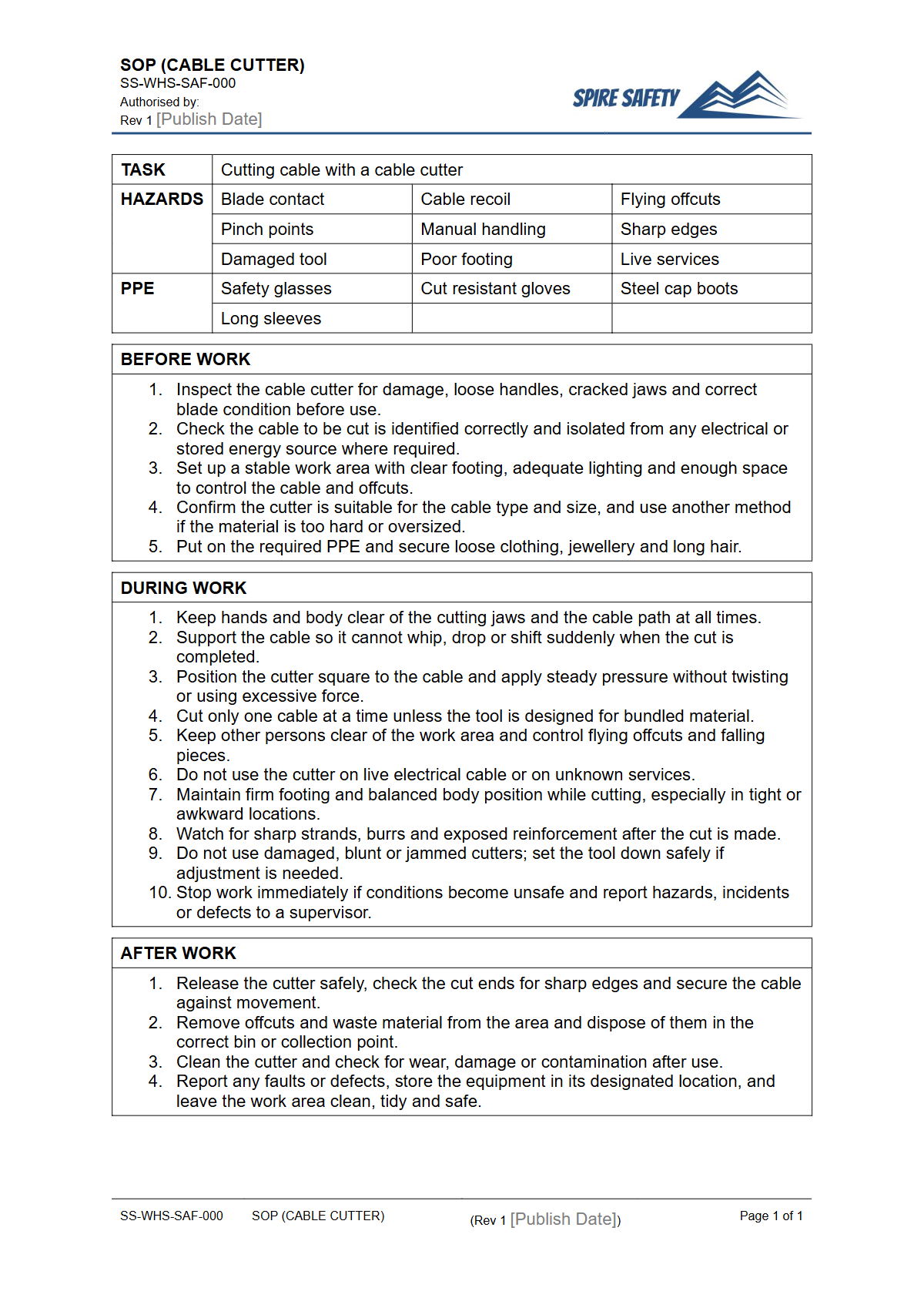
Download our free Safe Operating Procedure (Cable Cutter) template. This DOCX & PDF resource helps document safe work practices for cutting electrical cables.
Free Safe Operating Procedure (Cable Cutter) Template
DOCX • 126 KB + PDF
Updated Oct 2026
No signup required
Purpose of the Free Safe Operating Procedure (Cable Cutter) Template
Using cable cutters, whether manual, battery-powered, or hydraulic, presents significant workplace risks. This Free Safe Operating Procedure (Cable Cutter) Template provides a structured starting point for your organisation to document the required process for safely operating this equipment.
A well-drafted SOP is a critical tool for managing hazards such as electric shock, lacerations, musculoskeletal injuries from repetitive use, and injuries from flying debris. By implementing a clear SOP, you standardise your work methods, provide clear instructions to workers, and demonstrate a key component of your safety management system.
This document helps identify the necessary personal protective equipment (PPE), pre-start checks, and step-by-step instructions to minimise risk. It also considers associated tasks that might introduce other hazards, such as working at heights, which would require procedures detailed in a step ladder SOP. Adopting this procedure helps meet your duty of care under Australian WHS legislation by providing and maintaining a safe system of work.
Video walkthrough
How to use the Free Safe Operating Procedure (Cable Cutter) Template
This template is provided as a fully editable DOCX file, with a PDF version also available for easy printing and distribution. To use it effectively, you must adapt it to the specific context of your workplace.
This includes adding your company branding, specifying the exact models of cable cutters in use, and detailing the unique environmental conditions of your worksite. You should also integrate it with your broader comprehensive WHS management systems to ensure consistency and effectiveness.
Important: This is a template only. We have provided a framework based on common industry practice, but it is not a complete, ready-to-use document.
You MUST consult with your workers and customise this Safe Operating Procedure to reflect the specific hazards, risks, and control measures relevant to your equipment and your operational environment before use.
When to use it
A Safe Operating Procedure for cable cutters should be developed, implemented, and reviewed before any worker is permitted to use the equipment. It forms a crucial part of the worker induction and training process.
The SOP should be readily available at the point of work for easy reference. It is particularly vital during high-risk activities such as electrical fit-outs, demolition projects, data and communications cabling, and routine industrial maintenance. The SOP should be a live document, reviewed and updated regularly, especially after an incident, when new equipment is introduced, or as part of your scheduled regular WHS compliance audits.
Who should use it
This SOP is intended for all workers who are required to operate cable cutters as part of their job. This includes licensed electricians, electrical apprentices, maintenance fitters, linespersons, and data technicians.
Supervisors and managers also have a responsibility to use this document to ensure work is being conducted safely, provide training, and verify worker competency. It's essential that anyone using cable cutters is deemed competent to do so, understanding not just the operation of the tool but also the associated electrical risks. This SOP can be used as a basis for training and competency assessment, alongside procedures for other common tools, like those outlined in our circular saw SOP.
Beyond cable cutters, your worksite likely involves numerous pieces of equipment that require documented safe work procedures. You can create a consistent safety approach by using similar templates for other tools, such as a plasma cutter SOP template for metal fabrication tasks.
You can explore our complete free resources library to find more templates to support your safety management efforts.
Common mistakes
Common mistakes to avoid
- Failing to positively identify and de-energise the correct cable before cutting.
- Using a cutter that is not rated for the type or diameter of the cable (e.g., using standard cutters on hardened or armoured cable).
- Neglecting to wear appropriate PPE, particularly insulated gloves and approved safety glasses.
- Using damaged or poorly maintained cutters with dull blades, cracked handles, or faulty mechanisms.
Legal references
Legal considerations
The following legal requirements may be relevant to this type of work.
- Work Health and Safety Act (Harmonised) — Provides the primary duties for protecting workers and other people from work health and safety risks.
- Work Health and Safety Regulations (Harmonised) — Sets out requirements supporting the management of workplace hazards and risks.
The following codes may be relevant to this type of work.
- Managing WHS Risks Code of Practice — Provides practical guidance on identifying hazards, assessing risks and applying effective controls.
- Work Health and Safety Consultation, Cooperation and Coordination Code of Practice — Provides practical guidance on consulting workers and coordinating with other duty holders.
- Managing the Work Environment and Facilities Code of Practice — Provides practical guidance on safe work environments, workplace facilities and related controls.
Did you know
Silent Danger
Contact with electricity is one of the top five causes of traumatic workplace fatalities in Australia. A robust Lockout-Tagout (LOTO) procedure, documented within an SOP, is the most effective defence against this.
Ergonomic Strain
Using manual cable cutters, especially on larger gauge wires, can require significant force. Repetitive use is a leading cause of musculoskeletal disorders like Carpal Tunnel Syndrome for electricians and technicians.
FAQ
Frequently asked questions
01What are the main hazards when using a cable cutter?
02Is a Safe Operating Procedure a legal requirement for cable cutters in Australia?
03How often should an SOP for a cable cutter be reviewed?
04Can I use this template for hydraulic or battery-powered cable cutters?
Share this resource
Free Safe Operating Procedure (Cable Cutter) Template
Browse Categories
How To Use It
- 1Download and open in Word or PDF.
- 2Replace the placeholders with your business details.
- 3Get it reviewed by a WHS specialist before rollout.
Need it customised?
Our WHS consultants can adapt this template to your site, run a gap analysis, or audit what you already have in place.
Book a Free Consultation WHS consulting servicesor call 1300 156 382
Related templates
- Free Safe Operating Procedure (Cable Drum Jack) Template
- Free Safe Operating Procedure (Cable Drum Stand) Template
- Free Safe Operating Procedure (Cable Jetting) Template
- Free Safe Operating Procedure (Cable Jointing) Template
- Free Safe Operating Procedure (Cable Locator) Template
- Free Safe Operating Procedure (Cable Puller) Template