
Free Safe Operating Procedure (Cable Crimper) Template
Download our free Safe Operating Procedure (Cable Crimper) Template.
Free Safe Operating Procedure (Cable Crimper) Template
DOCX • 126 KB + PDF
Updated Oct 2026
No signup required
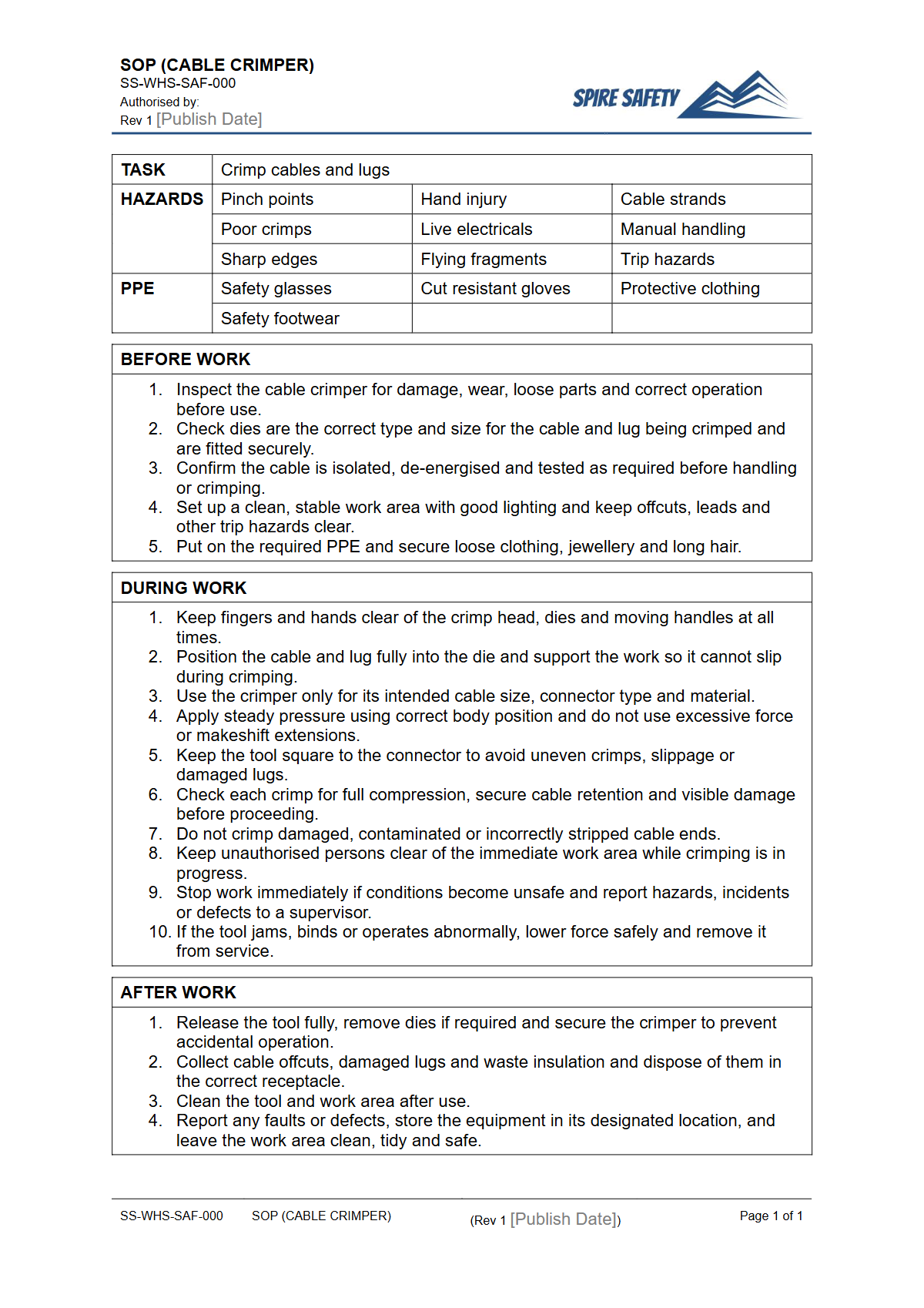
Purpose of the Free Safe Operating Procedure (Cable Crimper) Template
Effectively managing workshop and site risks requires clear, documented processes for all plant and equipment. Our Free Safe Operating Procedure (Cable Crimper) Template provides a structured foundation for outlining the required steps to operate manual, battery-powered, or hydraulic cable crimpers safely.
This document is designed to help you formalise a safe system of work, identify foreseeable hazards, and implement robust control measures. Using a dedicated Safe Operating Procedure helps any Person Conducting a Business or Undertaking (PCBU) meet their primary duty of care by providing workers with clear information and instruction.
Key Elements of a Cable Crimper Safe Operating Procedure
A comprehensive SOP for a cable crimper should be more than just a list of steps. It is a critical risk management tool that should include:
- Required Personal Protective Equipment (PPE): Specifies necessary PPE such as safety glasses, gloves, and any other gear required for the task.
- Pre-operational Checks: A checklist of actions a worker must perform before using the tool. This includes inspecting the tool for damage, ensuring dies are correct and secure, and checking battery charge or hydraulic line integrity.
- Operating Sequence: A logical, step-by-step guide to performing the crimping task safely, from preparing the cable to completing the crimp. This is the core of the SOP.
- Post-operational Tasks: Details the process for cleaning, maintaining, and correctly storing the tool. Procedures for other tools, like those in our free Circular Saw SOP, also highlight the importance of proper shutdown and storage.
- Emergency Procedures: Clear instructions on what to do in case of electric shock, equipment failure, or injury.
Video walkthrough
How to use the Free Safe Operating Procedure (Cable Crimper) Template
This template is provided in both DOCX and PDF formats for your convenience. The DOCX file is fully editable, allowing for extensive customisation to reflect the specific realities of your workplace.
To effectively implement this Safe Operating Procedure:
- Download the DOCX template.
- Thoroughly review the content and identify all sections that require site-specific information.
- Edit the document to include details about the exact make and model of the cable crimpers used on your site.
- Incorporate your organisation's specific procedures, emergency contacts, and required PPE.
- Consult with workers who actually use the equipment to ensure the procedure is practical, accurate, and reflects how the work is done.
Important: This is a template only. We have provided a structured starting point, but you must customise this document with your own site-specific details, machinery, and processes to ensure it is suitable for your operations.
An SOP should be a living document within your broader WHS management systems, reviewed and updated regularly.
When to use it
A Safe Operating Procedure for a cable crimper should be used as a primary reference document in several key scenarios. It is essential for inducting and training new employees, ensuring they understand the approved method for using the tool from day one.
It also serves as a critical tool for refresher training for existing staff, reinforcing safe work habits. The SOP should be readily accessible in the work area for quick reference.
Furthermore, in the event of an incident or near miss involving the equipment, the SOP becomes a benchmark for investigation to determine if procedures were followed and if they remain adequate.
Implementing SOPs across all relevant equipment, not just crimpers, creates a consistent approach to safety. For example, a similar process would be followed when introducing a Plasma Cutter SOP template for fabrication tasks.
Who should use it
The responsibility for using and maintaining a Safe Operating Procedure is shared across different levels of an organisation. Workers are the primary users who must follow the documented steps to ensure their own safety and the safety of others.
They have a responsibility to operate equipment in accordance with the training and instruction provided.
Supervisors and Managers are responsible for ensuring that workers are trained on the SOP and that they follow it consistently. They must also enforce the procedures and initiate reviews or updates when necessary.
During formal processes like a WHS compliance auditing program, the existence and effective implementation of SOPs will be scrutinised.
Finally, the PCBU holds the ultimate responsibility for ensuring a safe work environment, which includes providing and maintaining safe systems of work like SOPs. Even seemingly simple tasks require documented procedures, whether it's for operating a power tool or using a step ladder Safe Operating Procedure for work at height.
This proactive approach is fundamental to a strong safety culture.
Explore our complete free WHS resources library for more templates to support your safety management system.
Common mistakes
Common mistakes to avoid
- Using the incorrect die set for the specific cable and terminal size, resulting in a weak connection.
- Failing to perform pre-operational checks, such as inspecting for tool damage or wear.
- Neglecting to de-energise and lock out electrical circuits before starting work.
- Using a generic SOP without customising it for the specific tool, task, and workplace environment.
Legal references
Legal considerations
The following legal requirements may be relevant to this type of work.
- Work Health and Safety Act (Harmonised) — Provides the primary duties for protecting workers and other people from work health and safety risks.
- Work Health and Safety Regulations (Harmonised) — Sets out requirements supporting the management of workplace hazards and risks.
The following codes may be relevant to this type of work.
- Managing WHS Risks Code of Practice — Provides practical guidance on identifying hazards, assessing risks and applying effective controls.
- Work Health and Safety Consultation, Cooperation and Coordination Code of Practice — Provides practical guidance on consulting workers and coordinating with other duty holders.
- Managing the Work Environment and Facilities Code of Practice — Provides practical guidance on safe work environments, workplace facilities and related controls.
Did you know
The Cost of a Bad Crimp
A poorly executed electrical crimp can create high resistance, leading to overheating, power loss, and in severe cases, electrical fires. A proper crimp forms a mechanically strong and electrically sound connection, essential for safety and reliability.
Ergonomic Design
Modern cable crimpers often feature ergonomic designs with padded handles and optimised pivot points to reduce the force required by the operator. This helps to mitigate the risk of Repetitive Strain Injuries (RSIs) during frequent use.
FAQ
Frequently asked questions
01What are the main hazards of using a cable crimper?
02Is a Safe Operating Procedure a legal requirement in Australia?
03How often should an SOP for a cable crimper be reviewed?
04Can this template be used for hydraulic and manual crimpers?
Share this resource
Free Safe Operating Procedure (Cable Crimper) Template
Browse Categories
How To Use It
- 1Download and open in Word or PDF.
- 2Replace the placeholders with your business details.
- 3Get it reviewed by a WHS specialist before rollout.
Need it customised?
Our WHS consultants can adapt this template to your site, run a gap analysis, or audit what you already have in place.
Book a Free Consultation WHS consulting servicesor call 1300 156 382
Related templates
- Free Safe Operating Procedure (Cable Cutter) Template
- Free Safe Operating Procedure (Cable Drum Jack) Template
- Free Safe Operating Procedure (Cable Drum Stand) Template
- Free Safe Operating Procedure (Cable Jetting) Template
- Free Safe Operating Procedure (Cable Jointing) Template
- Free Safe Operating Procedure (Cable Locator) Template