
Free Safe Operating Procedure (Cable Avoidance Tool) Template
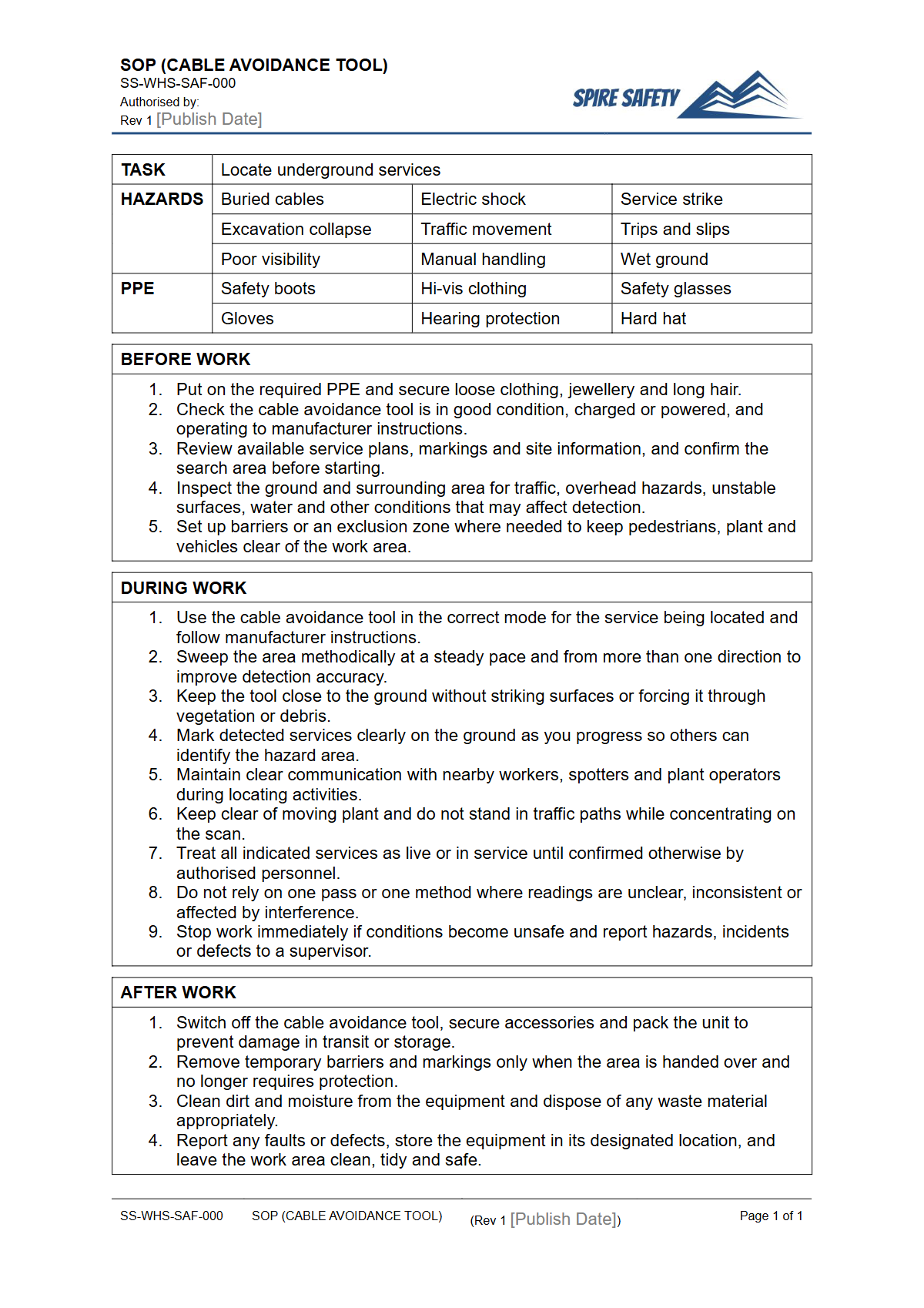
Download our free Safe Operating Procedure (Cable Avoidance Tool) template. This DOCX and PDF resource provides a structured starting point for your workplace.
Free Safe Operating Procedure (Cable Avoidance Tool) Template
DOCX • 126 KB + PDF
Updated Oct 2026
No signup required
Purpose of the Free Safe Operating Procedure (Cable Avoidance Tool) Template
Striking underground services like electrical cables, gas lines, or water mains can lead to catastrophic consequences, including severe injury, fatalities, and extensive project delays. This Free Safe Operating Procedure (Cable Avoidance Tool) Template provides a structured framework for safely locating and identifying buried assets before any ground-penetrating work begins.
Its primary purpose is to formalise a step-by-step process that operators must follow, significantly reducing the risk of service strikes. By documenting the required checks, search patterns, and safety controls, this SOP serves as a critical tool in your site's overall risk management plan.
A documented procedure ensures a consistent and methodical approach is taken every time, regardless of the operator. It helps your organisation meet its duty of care by providing clear instructions on how to use equipment safely.
This process is fundamental for tasks like trenching, where the risk of encountering buried assets is high. For related excavation tasks, you might also find our free Trencher SOP template useful.
Video walkthrough
How to use the Free Safe Operating Procedure (Cable Avoidance Tool) Template
This downloadable document is provided in both DOCX and PDF formats for your convenience. The DOCX file is fully editable, allowing you to adapt the content to the specific requirements of your worksite and the particular model of cable avoidance tool (CAT) and signal generator (Genny) in use.
It is crucial to review and modify every section to ensure it accurately reflects your operational context.
IMPORTANT: This document is a template and must be customised to suit the specific equipment, environment, and procedures of your workplace. We are not responsible for your WHS compliance; this resource is a starting point, not a complete solution.
A single SOP is effective, but its true value is realised when it's part of a comprehensive WHS management system that covers training, supervision, and incident reporting.
When to use a Cable Avoidance Tool SOP
This Safe Operating Procedure should be implemented before any activity that disturbs the ground surface. It is a mandatory pre-start requirement for all excavation and ground-penetrating works. This includes, but is not limited to, activities such as:
- Excavating trenches for pipes or foundations
- Drilling, boring, or piling
- Driving posts, stakes, or pegs into the ground
- Landscaping and earthworks
- Grading or scraping surfaces
The SOP should be used in conjunction with Dial Before You Dig (DBYD) or Before You Dig Australia (BYDA) plans. While these plans provide information on where services are located, the CAT and Genny are used to physically verify their position and depth on-site.
This SOP should be consulted before any ground-disturbing work, whether using hand tools or heavy machinery. For example, an operator would reference both this procedure and a machine-specific document like the SOP for a dozer before breaking ground.
Who should use this SOP
This Safe Operating Procedure is intended for all personnel involved in detecting and avoiding underground services. Key users include:
- Trained and Competent Operators: Individuals who have received specific training on the use of CAT and Genny equipment. They are the primary users who will follow the step-by-step procedure.
- Supervisors and Site Managers: Personnel responsible for overseeing work and ensuring that safety procedures are being correctly followed before authorising any excavation.
- WHS/HSE Officers: Safety professionals who may use the SOP for worker inductions, training sessions, and workplace inspections.
Competency is paramount. Simply reading the SOP is not a substitute for hands-on training and a verified understanding of how the equipment works.
Ensuring personnel are competent is a key responsibility for any PCBU. If you need assistance developing competency frameworks or training plans, consider engaging specialist WHS consulting to guide your process.
Key Elements of a Cable Avoidance SOP
A robust SOP for cable avoidance should detail the entire process from planning to completion. This template guides you through several critical stages:
- Planning and Preparation: Outlines the need to obtain and review all relevant service plans (e.g., DBYD/BYDA) before arriving on site.
- Equipment and PPE: Lists the required personal protective equipment (PPE) and specifies checks for the CAT and Genny, including battery tests and daily function checks.
- Safe Work Method: Details the systematic process for sweeping the area. This includes using the different detection modes (Power, Radio, Genny) and the correct sweep patterns (e.g., a grid search) to ensure full coverage.
- Marking and Reporting: Defines the procedure for clearly marking located services on the ground using paint or stakes, and how to report findings.
- Emergency Response: Provides clear instructions on the immediate actions to take in the event of an accidental service strike.
Regularly reviewing your procedures through WHS compliance audits ensures they remain effective and aligned with current standards and site practices. For procedures covering other high-risk plant and equipment, you can explore our free WHS resources library for more templates.
Common mistakes
Common mistakes to avoid
- Relying solely on 'Power' mode and neglecting to use the Genny to find other metallic services.
- Swinging the CAT too quickly during a sweep, which can cause the tool to miss weaker signals.
- Forgetting to perform a daily function test to ensure the tool and generator are working together correctly.
- Assuming DBYD/BYDA plans are 100% accurate and failing to scan the entire work area.
Legal references
Legal considerations
The following legal requirements may be relevant to this type of work.
- Work Health and Safety Act (Harmonised) — Provides the primary duties for protecting workers and other people from work health and safety risks.
- Work Health and Safety Regulations (Harmonised) — Sets out requirements supporting the management of workplace hazards and risks.
The following codes may be relevant to this type of work.
- Managing WHS Risks Code of Practice — Provides practical guidance on identifying hazards, assessing risks and applying effective controls.
- Work Health and Safety Consultation, Cooperation and Coordination Code of Practice — Provides practical guidance on consulting workers and coordinating with other duty holders.
- Managing the Work Environment and Facilities Code of Practice — Provides practical guidance on safe work environments, workplace facilities and related controls.
Did you know
Hidden Costs of Service Strikes
The indirect costs of an underground service strike, such as project delays, regulatory fines, and reputational damage, are often many times greater than the direct cost of the physical repair.
Signal Detection
Modern Cable Avoidance Tools are versatile, detecting passive signals from live power cables (Power mode) and radio signals from communication lines (Radio mode), as well as active signals from a Genny.
FAQ
Frequently asked questions
01Do I still need to use a CAT if I have Dial Before You Dig plans?
02What is the difference between a CAT and a Genny?
03How often should cable avoidance tools be calibrated?
04Is a Safe Operating Procedure a legal requirement for using a CAT?
Share this resource
Free Safe Operating Procedure (Cable Avoidance Tool) Template
Browse Categories
How To Use It
- 1Download and open in Word or PDF.
- 2Replace the placeholders with your business details.
- 3Get it reviewed by a WHS specialist before rollout.
Need it customised?
Our WHS consultants can adapt this template to your site, run a gap analysis, or audit what you already have in place.
Book a Free Consultation WHS consulting servicesor call 1300 156 382
Related templates
- Free Safe Operating Procedure (Cable Blower) Template
- Free Safe Operating Procedure (Cable Crimper) Template
- Free Safe Operating Procedure (Cable Cutter) Template
- Free Safe Operating Procedure (Cable Drum Jack) Template
- Free Safe Operating Procedure (Cable Drum Stand) Template
- Free Safe Operating Procedure (Cable Jetting) Template