
Free Safe Operating Procedure (Bus Shelter Cleaning) Template
Download our free Safe Operating Procedure (SOP) for bus shelter cleaning.
Free Safe Operating Procedure (Bus Shelter Cleaning) Template
DOCX • 126 KB + PDF
Updated Oct 2026
No signup required
Purpose of the Free Safe Operating Procedure (Bus Shelter Cleaning) Template
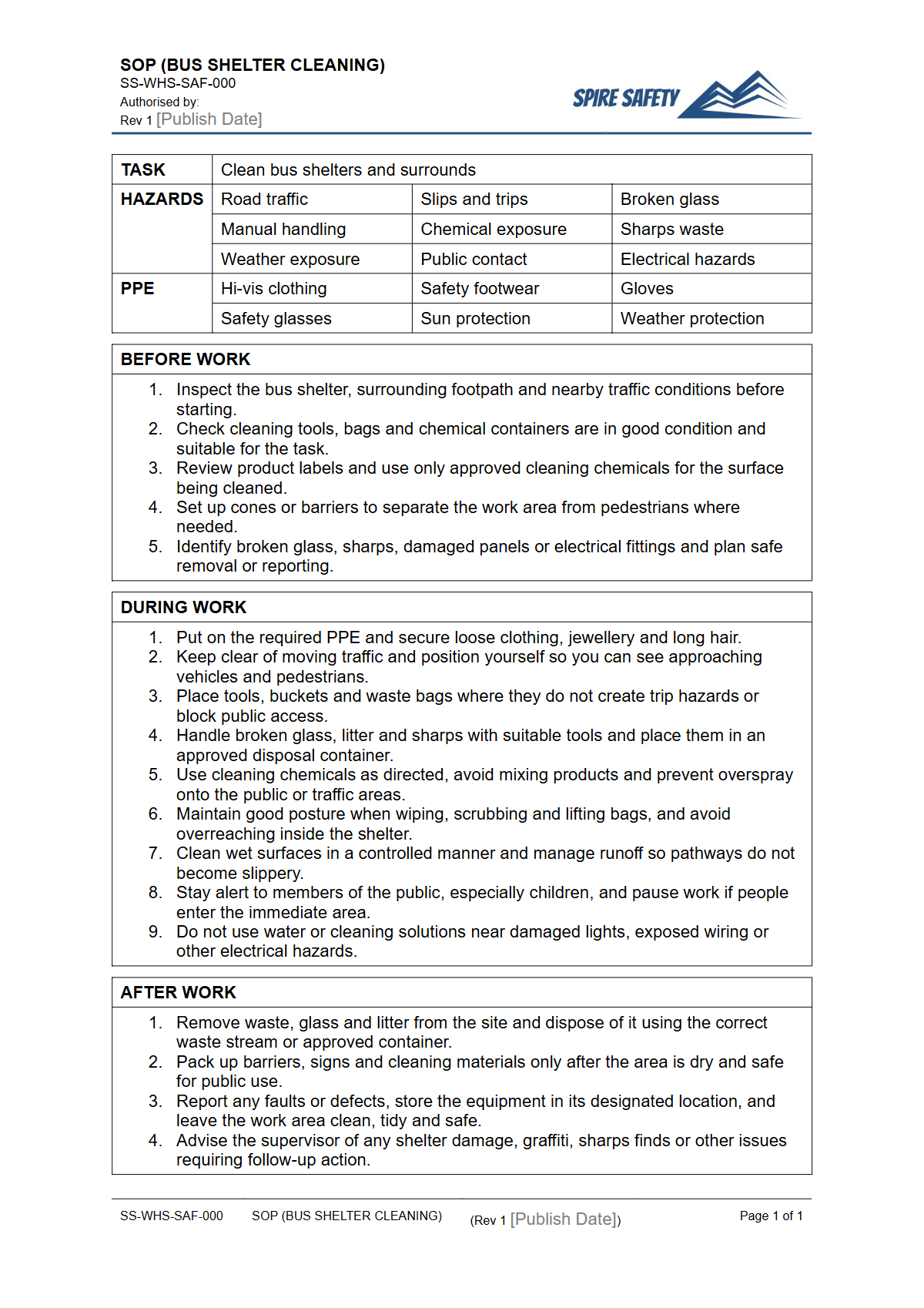
This free Safe Operating Procedure (Bus Shelter Cleaning) template provides a structured starting point for documenting the safety requirements for cleaning and maintaining public bus shelters. The task involves a unique combination of hazards, including working near traffic, public interaction, exposure to cleaning chemicals, manual handling, and potential biohazards.
A documented SOP ensures that a consistent, safe method is established and communicated to all workers involved.
Developing a clear Safe Operating Procedure helps your organisation meet its primary duty of care under WHS legislation. It serves as a critical tool for worker training, competency assessment, and risk management.
By formally outlining the required controls—from setting up exclusion zones to selecting the correct Personal Protective Equipment (PPE)—this SOP helps minimise the risk of injury or illness associated with bus shelter cleaning.
Video walkthrough
How to use the Free Safe Operating Procedure (Bus Shelter Cleaning) Template
This Safe Operating Procedure template is available for download in both DOCX and PDF formats. The DOCX file is fully editable, allowing you to tailor it to your specific operational context.
The PDF version is a convenient, ready-to-print reference.
Important: This document is a template and must be customised to your workplace. We have provided a framework based on common industry practices, but you must adapt it to reflect the specific equipment (e.g., pressure washers, ladders, cleaning carts), chemicals, work environments, and staff roles within your organisation.
To ensure the SOP is practical and effective, it is essential to consult with the workers who will be performing the task during the drafting and review process.
Key Hazards in Bus Shelter Cleaning
Bus shelter cleaning presents several significant health and safety risks that must be managed. A thorough risk assessment should inform the final content of your SOP. Key hazards include:
- Traffic and Pedestrians: Workers are often positioned close to live traffic and pedestrian walkways. Controls include high-visibility clothing, traffic cones, and designated exclusion zones.
- Chemical Exposure: Cleaning agents can cause skin irritation, respiratory issues, or eye damage if handled improperly. Your SOP must reference Safety Data Sheets (SDS), specify required PPE (e.g., gloves, safety glasses), and detail correct dilution and application methods.
- Slips, Trips, and Falls: Wet surfaces, trailing hoses, and uneven ground are common trip hazards. When cleaning glass panels or roofs, workers may need to work at height. Using a step ladder requires specific precautions, which can be detailed with support from a FREE Step Ladder SOP Template.
- Manual Tasks: Lifting heavy water buckets, carrying equipment, and performing repetitive scrubbing or wiping motions can lead to musculoskeletal injuries.
- Sharps and Biohazards: Shelters may contain discarded needles, broken glass, or biological waste. Your procedure must include steps for safely identifying and handling such hazards.
What's Included in this Safe Operating Procedure
Our template provides a comprehensive structure to guide your documentation process. It includes dedicated sections for:
- Defining the scope of the work.
- Listing necessary Personal Protective Equipment (PPE).
- Outlining pre-operational safety checks for equipment and the work area.
- A step-by-step guide to performing the cleaning task safely.
- Controls for specific hazards like removing graffiti, for which a FREE Scraper SOP (Safe Operating Procedure) Template might also be a useful reference.
- Emergency response procedures.
- Post-task cleanup and equipment storage requirements.
- A section for review and sign-off.
When to use it
A Safe Operating Procedure for bus shelter cleaning should be used consistently as a core part of your daily operations. It is particularly important in the following situations:
- As a Training Document: Use it to induct and train new employees or contractors on the established safe work method.
- For Pre-Start Briefings: Review the SOP with the work crew before commencing a job, especially at a new or unfamiliar location.
- During Safety Audits: The SOP serves as the benchmark against which actual work practices are measured during safety observations or formal audits.
- After an Incident: Following a near miss or incident, the SOP should be reviewed and updated to incorporate any learnings and prevent recurrence.
Who should use it
This SOP template is designed for use by a range of personnel within organisations responsible for public amenity maintenance, such as local councils, transport authorities, and cleaning contractors. Key users include:
- WHS Managers and Advisors: To establish a baseline safety standard and integrate it into the broader safety management system.
- Supervisors and Team Leaders: To manage daily tasks, conduct training, and ensure workers are following the prescribed safety measures. For teams that travel between sites, a FREE Body Truck SOP (Safe Operating Procedure) Template may also be necessary to manage vehicle-related risks.
- Workers: As a practical guide and reference to perform their duties safely and consistently.
Integrating SOPs into Your WHS Framework
An SOP is a powerful tool, but it is most effective when it is part of a complete safety system. Simply having a document is not enough; it must be actively used, monitored, and reviewed. Developing and maintaining these documents is a core component of effective WHS management systems.
Your organisation's safety framework should also include processes for risk assessment, incident reporting, worker consultation, and training management. Regularly reviewing your procedures is essential for ongoing improvement. A formal WHS compliance auditing process can identify gaps in your SOPs and ensure they remain relevant and effective over time. For more templates to support your safety activities, browse our complete free WHS resources library.
Common mistakes
Common mistakes to avoid
- Failing to adequately secure the work area from vehicle traffic and pedestrians.
- Using incorrect dilution rates for cleaning chemicals, reducing effectiveness or increasing risk.
- Neglecting to consult Safety Data Sheets (SDS) before using a new chemical product.
- Not performing a pre-work area inspection for hazards like broken glass, needles, or biohazards.
Legal references
Legal considerations
The following legal requirements may be relevant to this type of work.
- Work Health and Safety Act (Harmonised) — Provides the primary duties for protecting workers and other people from work health and safety risks.
- Work Health and Safety Regulations (Harmonised) — Sets out requirements supporting the management of workplace hazards and risks.
The following codes may be relevant to this type of work.
- Managing WHS Risks Code of Practice — Provides practical guidance on identifying hazards, assessing risks and applying effective controls.
- Work Health and Safety Consultation, Cooperation and Coordination Code of Practice — Provides practical guidance on consulting workers and coordinating with other duty holders.
- Managing the Work Environment and Facilities Code of Practice — Provides practical guidance on safe work environments, workplace facilities and related controls.
Did you know
Slips, Trips, and Falls
Slips, trips and falls are a leading cause of serious injuries in the Australian cleaning industry. Most are preventable and often caused by wet or contaminated surfaces and obstructions in walkways.
Chemical Safety
According to Safe Work Australia, exposure to hazardous chemicals is a significant risk for cleaners. Incorrectly mixing chemicals, such as bleach and ammonia-based cleaners, can create toxic chlorine gas.
FAQ
Frequently asked questions
01What PPE is generally required for bus shelter cleaning?
02How do you manage risks from the public while cleaning a bus shelter?
03Is this SOP template suitable for all types of cleaning chemicals?
04How often should a Safe Operating Procedure be reviewed?
Share this resource
Free Safe Operating Procedure (Bus Shelter Cleaning) Template
Browse Categories
How To Use It
- 1Download and open in Word or PDF.
- 2Replace the placeholders with your business details.
- 3Get it reviewed by a WHS specialist before rollout.
Need it customised?
Our WHS consultants can adapt this template to your site, run a gap analysis, or audit what you already have in place.
Book a Free Consultation WHS consulting servicesor call 1300 156 382
Related templates
- Free Safe Operating Procedure (Busbar Bender) Template
- Free Safe Operating Procedure (Busbar Cutter) Template
- Free Safe Operating Procedure (Cabin Supply Loading) Template
- Free Safe Operating Procedure (Cable Avoidance Tool) Template
- Free Safe Operating Procedure (Cable Blower) Template
- Free Safe Operating Procedure (Cable Crimper) Template