
Free Safe Operating Procedure (Busbar Bender) Template
Download our Free Safe Operating Procedure (Busbar Bender) Template. This user-friendly DOCX and PDF helps outline steps for safe equipment use.
Free Safe Operating Procedure (Busbar Bender) Template
DOCX • 126 KB + PDF
Updated Oct 2026
No signup required
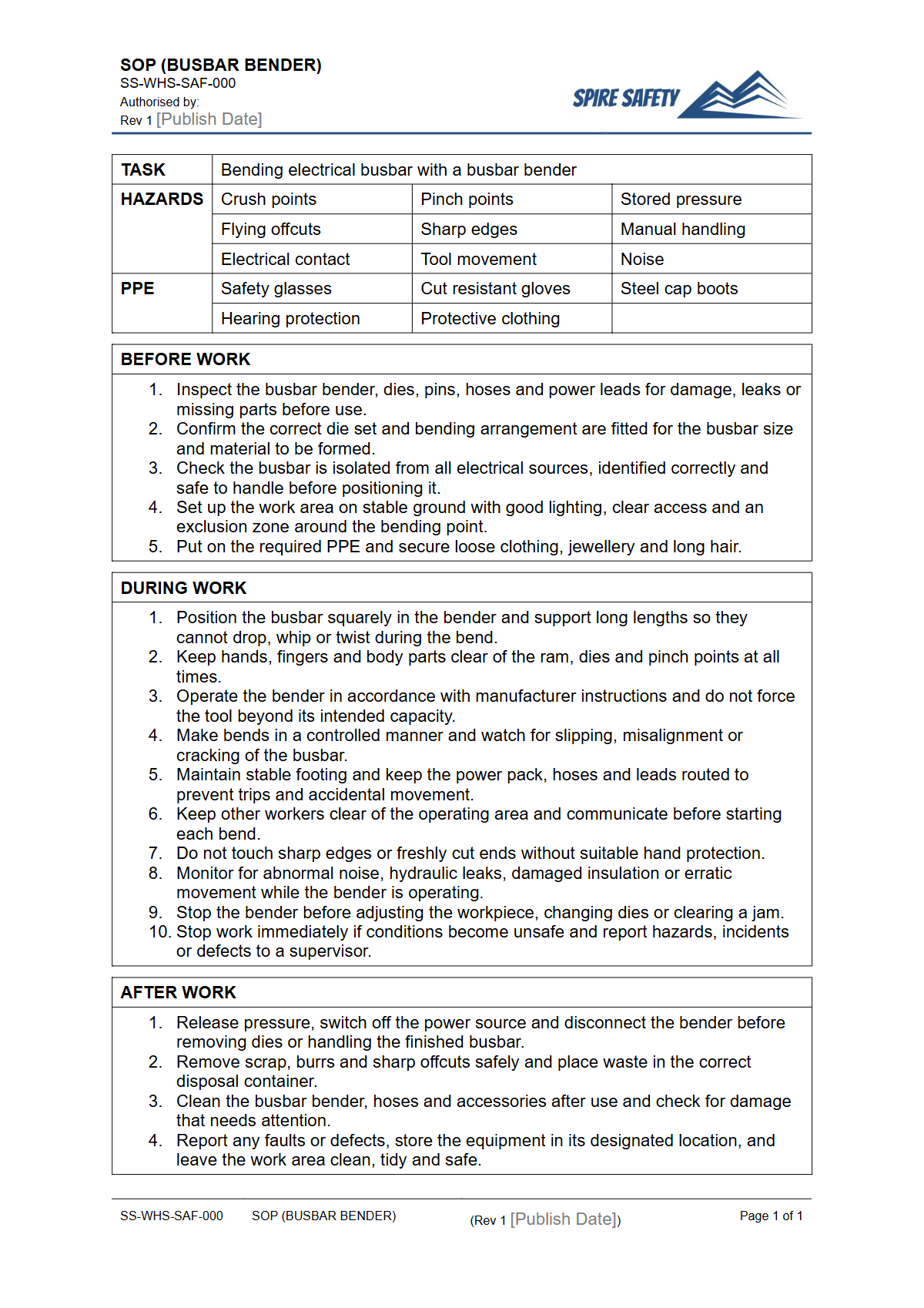
Purpose of the Free Safe Operating Procedure (Busbar Bender) Template
A busbar bender is specialised equipment used to accurately bend copper and aluminium bars for electrical switchboards and enclosures. Due to the high hydraulic forces and the critical nature of the finished product, a documented procedure is essential for safe and effective operation.
This Safe Operating Procedure for a Busbar Bender provides a structured framework to help you manage risks and standardise operator conduct.
The purpose of this document is to guide PCBUs (Persons Conducting a Business or Undertaking), managers, and operators in establishing a formal process. It helps identify hazards such as crushing and pinch points, hydraulic fluid injection, manual handling strains, and electrical risks.
By documenting pre-operational checks, step-by-step instructions, and shutdown protocols, this SOP serves as a critical tool for training, risk assessment, and daily operational safety. The principles of managing high-force equipment are similar across different machinery, as seen in our free Brake Press SOP template.
Video walkthrough
How to use the Free Safe Operating Procedure (Busbar Bender) Template
This template is provided in both DOCX and PDF formats. The DOCX file is fully editable, allowing you to tailor the content to your specific operational context.
It is crucial to adapt the document to the make and model of your busbar bender, the specific tasks performed, and the environment in which it is used.
IMPORTANT: This is a template only. We have provided a structured starting point, but you must adapt it to the specific make and model of your equipment, the unique environment of your workshop, and your existing safety protocols.
A generic document is not sufficient for compliance; it must reflect your actual workplace conditions and risks. This SOP should be a component of your overall safety framework, integrated with your existing WHS management systems to ensure a holistic approach to workplace safety.
Customising Your Safe Operating Procedure
To make this template effective, you must conduct a site-specific risk assessment and incorporate the findings. Key areas to customise include:
- Equipment Specifics: List the exact make, model, and serial number of the busbar bender.
- Personal Protective Equipment (PPE): Specify the mandatory PPE, such as high-impact safety glasses, steel-capped boots, and task-appropriate gloves.
- Pre-start Checks: Detail the daily inspection process, including checking hydraulic hoses for leaks or damage, verifying guard functionality, and ensuring the work area is clear.
- Step-by-Step Instructions: Break down the entire bending process, from selecting the correct die set and positioning the busbar to activating the hydraulic pump and completing the bend. The fabrication process often involves multiple stages, so consider developing procedures for related equipment, such as our free Plasma Cutter SOP.
- Emergency Procedures: Outline the steps to take in case of an emergency, including the location of emergency stops and first aid facilities.
The document should also detail any associated equipment used in the process. Many workshops rely on compressed air for cleaning or powering other tools, making an Air Compressor SOP template another valuable resource to standardise.
When to Use This Safe Operating Procedure
An SOP is a dynamic document used throughout the lifecycle of the equipment in your workplace. It should be used for:
- Operator Training: As a primary training document for new and inexperienced workers.
- Refresher Training: For periodic review with experienced operators to prevent complacency.
- Pre-Task Planning: As a reference before starting a non-routine or complex bending task.
- Incident Investigation: To review whether established procedures were followed after an incident or near miss.
- Audits and Reviews: As evidence of a safe system of work during safety inspections or a formal WHS compliance audit.
Who Should Use This Safe Operating Procedure
Various roles within an organisation have a responsibility to use and maintain this document:
- Operators: To understand and follow the safe steps required to perform their work.
- Supervisors and Managers: To conduct training, verify competency, and ensure procedures are consistently followed.
- WHS/HSE Personnel: To assist with risk assessments, procedure development, and periodic reviews.
- Maintenance Staff: To understand the safe isolation and shutdown procedures required before conducting maintenance or repairs.
By implementing and maintaining a specific SOP for your busbar bender, you create a safer, more organised, and more efficient work environment. This template is just one of many tools available in our comprehensive free WHS resources library, designed to support Australian businesses in managing their safety obligations.
Common mistakes
Common mistakes to avoid
- Failing to inspect hydraulic hoses for leaks or wear before operation.
- Using an incorrect die set for the material type or dimensions, leading to equipment stress.
- Placing hands or fingers near the bending mechanism while the machine is powered.
- Not ensuring the work area is clear of personnel and obstructions before starting a bend.
Legal references
Legal considerations
The following legal requirements may be relevant to this type of work.
- Work Health and Safety Act (Harmonised) — Provides the primary duties for protecting workers and other people from work health and safety risks.
- Work Health and Safety Regulations (Harmonised) — Sets out requirements supporting the management of workplace hazards and risks.
The following codes may be relevant to this type of work.
- Managing WHS Risks Code of Practice — Provides practical guidance on identifying hazards, assessing risks and applying effective controls.
- Work Health and Safety Consultation, Cooperation and Coordination Code of Practice — Provides practical guidance on consulting workers and coordinating with other duty holders.
- Managing the Work Environment and Facilities Code of Practice — Provides practical guidance on safe work environments, workplace facilities and related controls.
Did you know
Hydraulic Power
Hydraulic busbar benders can exert immense force, often over 15 tonnes, to bend solid copper or aluminium bars. This power is why guards and clear exclusion zones are non-negotiable safety features.
The Importance of the Die
Using the correct die set for the specific thickness and width of the busbar is critical. An incorrect die can not only damage the bar but can also cause component failure under pressure, creating a serious safety hazard.
FAQ
Frequently asked questions
01What are the main hazards of using a busbar bender?
02Is an SOP a legal requirement for a busbar bender in Australia?
03How often should a Busbar Bender SOP be reviewed?
04What training is required to use a busbar bender?
Share this resource
Free Safe Operating Procedure (Busbar Bender) Template
Browse Categories
How To Use It
- 1Download and open in Word or PDF.
- 2Replace the placeholders with your business details.
- 3Get it reviewed by a WHS specialist before rollout.
Need it customised?
Our WHS consultants can adapt this template to your site, run a gap analysis, or audit what you already have in place.
Book a Free Consultation WHS consulting servicesor call 1300 156 382
Related templates
- Free Safe Operating Procedure (Busbar Cutter) Template
- Free Safe Operating Procedure (Cabin Supply Loading) Template
- Free Safe Operating Procedure (Cable Avoidance Tool) Template
- Free Safe Operating Procedure (Cable Blower) Template
- Free Safe Operating Procedure (Cable Crimper) Template
- Free Safe Operating Procedure (Cable Cutter) Template