
Free Safe Operating Procedure (Bulk Ingredient Storage) Template
Download our free Safe Operating Procedure (SOP) template for bulk ingredient storage. This DOCX & PDF resource helps you outline safe work practices.
Free Safe Operating Procedure (Bulk Ingredient Storage) Template
DOCX • 126 KB + PDF
Updated Oct 2026
No signup required
Purpose of the Free Safe Operating Procedure (Bulk Ingredient Storage) Template
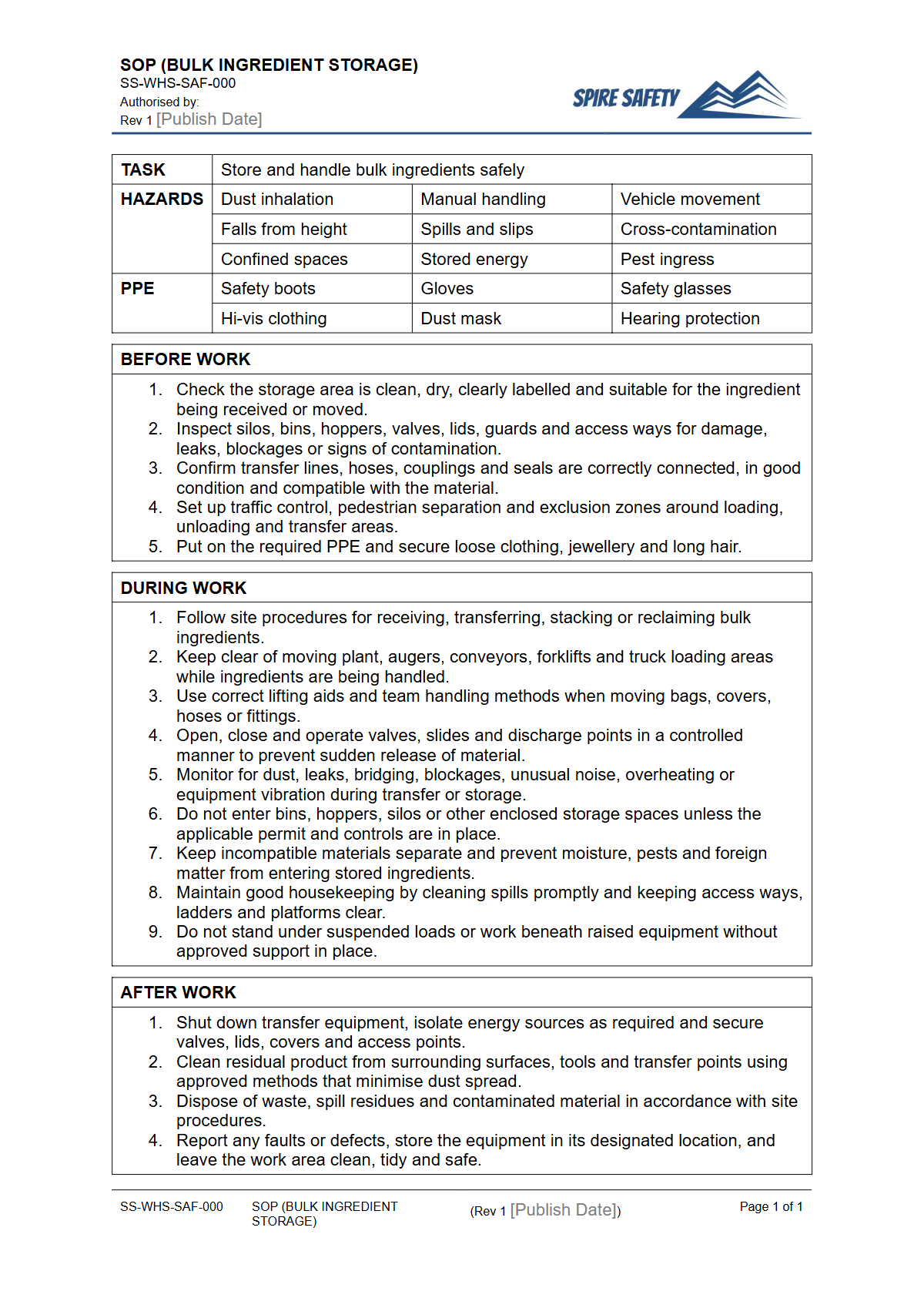
This Free Safe Operating Procedure (Bulk Ingredient Storage) Template provides a structured starting point for businesses to document the safe handling, storage, and movement of bulk materials like grains, flours, powders, and liquids. Its purpose is to standardise procedures and minimise risks associated with these tasks.
Proper management of bulk ingredients is critical in sectors like food manufacturing, agriculture, and logistics to prevent injuries, contamination, and equipment damage. The SOP outlines key safety considerations, from initial receival and storage in silos or hoppers to transfer and use in production.
Developing a clear procedure helps control common hazards such as musculoskeletal injuries from manual handling, respiratory issues from dust inhalation, and severe incidents like engulfment in silos or dust explosions. It establishes a repeatable, safe method of work that can be used for training and operational consistency.
This document is aligned with Australian WHS principles and is designed to be adapted to your specific site. For related agricultural processes, you may also find our free Grain Drill SOP template useful for outlining safe machinery operation.
Video walkthrough
How to use the Free Safe Operating Procedure (Bulk Ingredient Storage) Template
This Safe Operating Procedure is available for download as a DOCX file, allowing for easy customisation to fit your workplace's unique requirements. A PDF version is also provided for straightforward distribution and printing.
To use the template effectively, a Person Conducting a Business or Undertaking (PCBU) must methodically work through each section and populate it with information specific to the site's layout, equipment, types of ingredients, and existing control measures.
Important: This is a template only. You must customise it to reflect the specific hazards and control measures relevant to your workplace.
We strongly recommend consulting with your workers, supervisors, and health and safety representatives during the drafting and review process. Their direct experience is invaluable for creating a practical and effective SOP.
Integrating this procedure into your broader WHS management systems ensures it becomes part of a cohesive safety framework rather than a standalone document.
When to use a Bulk Ingredient Storage Safe Operating Procedure
A Safe Operating Procedure for bulk ingredient storage should be used as a primary reference document in several key situations. It forms the basis of all worker training and induction for tasks involving these materials, ensuring every team member understands the established safety protocols from day one.
It should be readily accessible in the work area for quick reference before starting a task, especially for non-routine or complex operations.
The SOP is also a critical tool during incident investigations, helping to identify deviations from prescribed safe work methods. It should be reviewed and updated regularly—at least annually, or whenever there is a change in equipment, processes, or the types of ingredients being handled.
Regular reviews are also a key component of formal safety assessments, such as those conducted during a WHS compliance audit, to verify that documented procedures are still relevant and effective.
Who should use this Safe Operating Procedure
This SOP is intended for a range of personnel within an organisation. WHS managers and advisors will use it as a foundational document to build and formalise risk management processes.
Site managers and team leaders are responsible for implementing the procedure, training their teams, and ensuring adherence on a daily basis. Most importantly, operators and workers who directly handle, transport, or work near bulk ingredients must use the SOP as their guide for performing tasks safely.
This includes forklift operators, production line workers, silo operators, and maintenance staff. For example, if ingredients are moved using mobile plant, operators would use this SOP in conjunction with equipment-specific procedures, such as those outlined in a FREE Telehandler SOP Template. The document ensures everyone, regardless of their role, has a clear and consistent understanding of the risks and the required safety controls. It's also a valuable resource when managing deliveries, which can be further detailed using a procedure like our FREE Body Truck SOP Template.
Key elements covered in the template
Our template provides a comprehensive structure to guide your documentation. Key sections you will need to customise include:
- Required Personal Protective Equipment (PPE): Specify necessary PPE such as respiratory protection, safety glasses, gloves, and high-visibility clothing.
- Pre-operational Checks: Detail inspections for equipment like conveyors, augers, and storage vessels before use. For tasks involving work at height, reference specific procedures like those in a FREE Step Ladder SOP Template.
- Step-by-Step Operating Sequence: A logical flow of the task from start to finish, with safety controls noted at each stage.
- Emergency Procedures: Instructions for responding to incidents like spills, fires, or medical emergencies.
- Training and Competency Requirements: Outline the necessary training for workers to be deemed competent for the task.
By thoroughly completing these sections, you create a robust procedure that actively contributes to a safer working environment. For more templates and safety resources, browse our complete free WHS resources library.
Common mistakes
Common mistakes to avoid
- Using the generic template without customising it for site-specific equipment and ingredients.
- Failing to adequately train all relevant workers on the finalised SOP.
- Not making the SOP easily accessible to workers in their work area.
- Forgetting to review and update the procedure after a process change or near miss.
Legal references
Legal considerations
The following legal requirements may be relevant to this type of work.
- Work Health and Safety Act (Harmonised) — Provides the primary duties for protecting workers and other people from work health and safety risks.
- Work Health and Safety Regulations (Harmonised) — Sets out requirements supporting the management of workplace hazards and risks.
The following codes may be relevant to this type of work.
- Managing WHS Risks Code of Practice — Provides practical guidance on identifying hazards, assessing risks and applying effective controls.
- Work Health and Safety Consultation, Cooperation and Coordination Code of Practice — Provides practical guidance on consulting workers and coordinating with other duty holders.
- Managing the Work Environment and Facilities Code of Practice — Provides practical guidance on safe work environments, workplace facilities and related controls.
Did you know
Combustible Dust
Fine particles of dust from materials like flour, sugar, and grain can be highly explosive when suspended in air in a confined space and exposed to an ignition source.
Engulfment Risk
A worker can be engulfed in flowing grain in less than five seconds and completely submerged in under thirty seconds, making silo and hopper safety procedures life-critical.
FAQ
Frequently asked questions
01What are the main hazards in bulk ingredient storage?
02Does this SOP template cover confined space entry for silos?
03How often should a Safe Operating Procedure be reviewed?
04Can I use this template for storing hazardous chemicals?
Share this resource
Free Safe Operating Procedure (Bulk Ingredient Storage) Template
Browse Categories
How To Use It
- 1Download and open in Word or PDF.
- 2Replace the placeholders with your business details.
- 3Get it reviewed by a WHS specialist before rollout.
Need it customised?
Our WHS consultants can adapt this template to your site, run a gap analysis, or audit what you already have in place.
Book a Free Consultation WHS consulting servicesor call 1300 156 382
Related templates
- Free Safe Operating Procedure (Bulk Seed Handling) Template
- Free Safe Operating Procedure (Bulk Waste Transfer) Template
- Free Safe Operating Procedure (Bus Shelter Cleaning) Template
- Free Safe Operating Procedure (Busbar Bender) Template
- Free Safe Operating Procedure (Busbar Cutter) Template
- Free Safe Operating Procedure (Cabin Supply Loading) Template