
Free Safe Operating Procedure (Bulk Seed Handling) Template
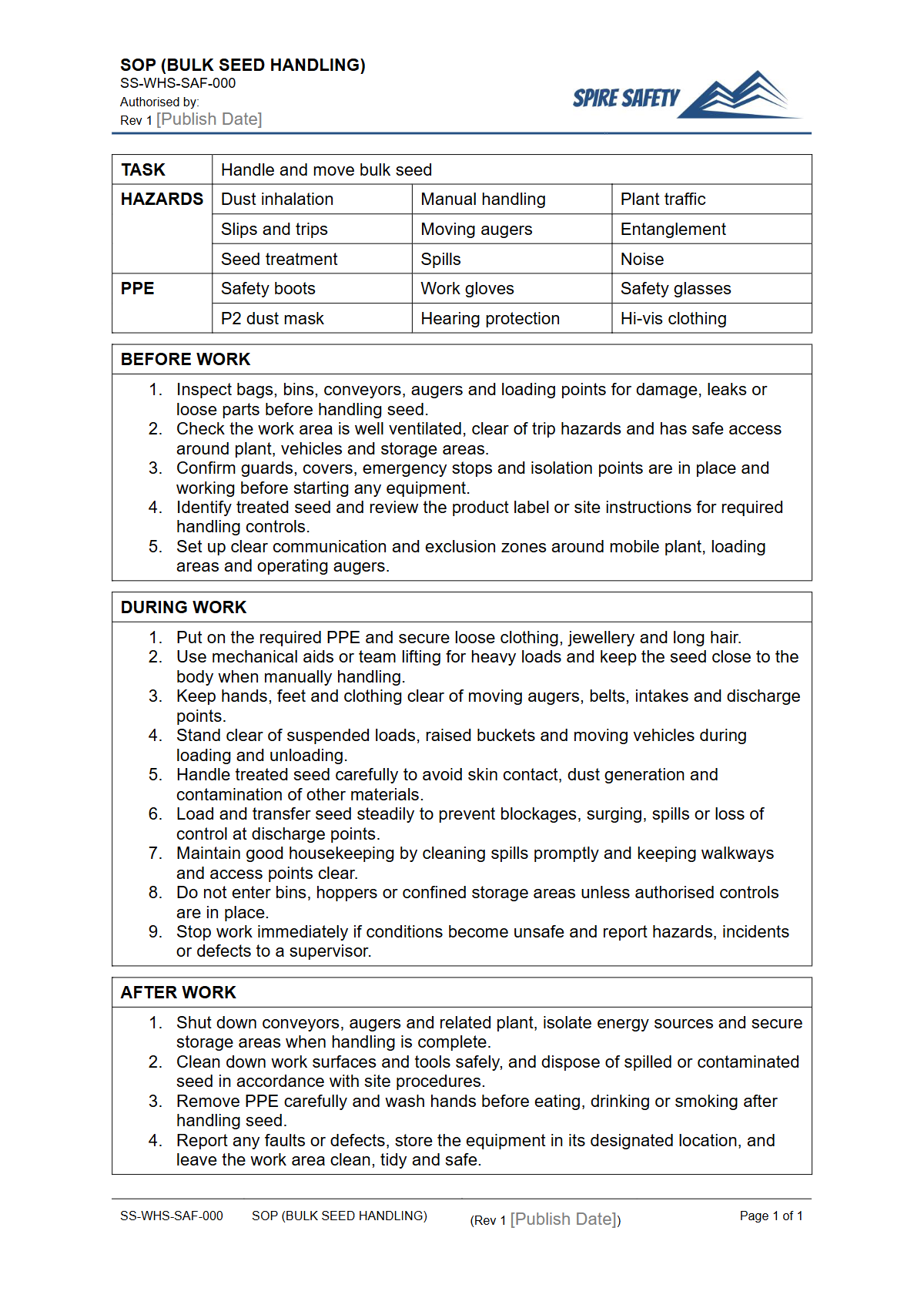
Download our free Safe Operating Procedure (Bulk Seed Handling) template. This structured document helps manage agricultural risks like dust and machinery.
Free Safe Operating Procedure (Bulk Seed Handling) Template
DOCX • 126 KB + PDF
Updated Oct 2026
No signup required
Purpose of the Free Safe Operating Procedure (Bulk Seed Handling) Template
Effectively managing work health and safety in agricultural settings requires clear, documented processes for high-risk tasks. This free Safe Operating Procedure (Bulk Seed Handling) Template provides a structured starting point for your organisation to formalise its safety protocols.
Handling bulk seed, whether in bags, bins, or silos, presents significant hazards, including respiratory issues from dust, musculoskeletal injuries from manual tasks, and life-threatening incidents involving machinery like augers and conveyors.
A well-developed Safe Operating Procedure (SOP) is a key administrative control that outlines a step-by-step, logical sequence for performing a task safely. It identifies potential hazards at each stage and specifies the control measures required to eliminate or minimise the risk of injury.
This template is designed to guide you through documenting these critical safety measures, from pre-operational checks to task completion and cleanup. It forms a crucial component of your overall safety framework, integrating with broader WHS management systems to ensure a consistent approach to risk management across your operations.
Video walkthrough
How to use the Free Safe Operating Procedure (Bulk Seed Handling) Template
This document is a template, not a finished procedure. To be effective and assist with your safety obligations, it must be customised to reflect the specific circumstances of your workplace.
The hazards and controls will vary depending on the type of seed, the equipment used, the storage facilities, and the layout of your site. For example, the process for moving bulk bags with a telehandler will require different steps and checks than decanting 25kg bags into a hopper.
Important Customisation Steps
Before implementing this SOP, you must:
- Consult with your workers and any health and safety representatives who perform or supervise the task. Their direct experience is invaluable for identifying practical hazards and effective controls.
- Conduct a thorough risk assessment specific to your bulk seed handling activities and equipment.
- Insert details specific to your site, including the makes and models of machinery (e.g., augers, conveyors, silos), emergency contact information, and site-specific emergency procedures.
- Clearly specify the Personal Protective Equipment (PPE) required, such as P2-rated respiratory protection for dust, safety glasses, gloves, and hearing protection. If using treated seed, reference the Safety Data Sheet (SDS) for chemical-specific PPE.
- Incorporate details from manufacturer's operating manuals for all plant and equipment used.
- Review and approve the finalised document by a competent person within your organisation.
Remember, we have developed this template as a guide. It is the responsibility of the PCBU (Person Conducting a Business or Undertaking) to ensure the final document is suitable for their workplace and meets all relevant WHS duties.
When to use this Safe Operating Procedure
A Safe Operating Procedure for bulk seed handling should be used as a primary reference document for all related activities. It serves as a fundamental tool during the induction and training of new employees, ensuring they understand the established safe method of work before they begin.
It should also be used for regular refresher training with experienced workers to reinforce safe behaviour.
The SOP is also a critical document for operational planning and supervision. Supervisors can use it to conduct pre-start briefings and to monitor that work is being performed according to the agreed-upon safety standards.
Following any incident, near miss, or audit finding, the SOP should be formally reviewed to determine if any amendments are needed to prevent a recurrence. Regular checks, similar in principle to formal WHS compliance auditing, ensure the procedure remains relevant and effective.
Who should use it
This Safe Operating Procedure is intended for use by multiple groups within an agricultural business. Primarily, it is for the operators and farm workers who directly handle bulk seed.
They must be trained on its contents and follow the prescribed steps to protect themselves and their colleagues. Supervisors and farm managers must use the SOP to train their teams, provide instruction, and monitor compliance in the field.
WHS officers and business owners (PCBUs) should use the template as a tool to fulfil their duty of care. It provides a formal mechanism for documenting a safe system of work, which is a key requirement under Australian WHS law.
When handling seed with specific planting equipment, it should be used alongside other relevant documents, such as our FREE Grain Drill SOP (Safe Operating Procedure) Template, to ensure end-to-end safety. For transportation phases, procedures should align with vehicle-specific documents like a FREE Body Truck SOP (Safe Operating Procedure) Template. For more guides and checklists, browse our complete free WHS resources library.
Common mistakes
Common mistakes to avoid
- Using the template without customising it for specific site machinery and conditions.
- Failing to consult with workers who actually perform the handling tasks during drafting and review.
- Not providing adequate, practical training on the finalised SOP to all relevant personnel.
- Neglecting to specify the correct type and rating of PPE for dust or chemically treated seeds.
Legal references
Legal considerations
The following legal requirements may be relevant to this type of work.
- Work Health and Safety Act (Harmonised) — Provides the primary duties for protecting workers and other people from work health and safety risks.
- Work Health and Safety Regulations (Harmonised) — Sets out requirements supporting the management of workplace hazards and risks.
The following codes may be relevant to this type of work.
- Managing WHS Risks Code of Practice — Provides practical guidance on identifying hazards, assessing risks and applying effective controls.
- Work Health and Safety Consultation, Cooperation and Coordination Code of Practice — Provides practical guidance on consulting workers and coordinating with other duty holders.
- Managing the Work Environment and Facilities Code of Practice — Provides practical guidance on safe work environments, workplace facilities and related controls.
Did you know
Dust Dangers
Organic dust from grain and seed can be explosive when suspended in air within a confined space. It is also a primary cause of serious respiratory diseases like 'Farmer's Lung' (hypersensitivity pneumonitis).
Engulfment Risk
A worker can be completely engulfed in flowing grain in less than 20 seconds. Never enter a silo, bin, or grain truck while it is being loaded or unloaded, and always follow strict confined space entry procedures.
FAQ
Frequently asked questions
01What are the biggest WHS risks with bulk seed handling?
02Is a Safe Operating Procedure a legal requirement in Australia?
03How often should a Bulk Seed Handling SOP be reviewed?
04Can I use this template for seeds treated with chemicals?
Share this resource
Free Safe Operating Procedure (Bulk Seed Handling) Template
Browse Categories
How To Use It
- 1Download and open in Word or PDF.
- 2Replace the placeholders with your business details.
- 3Get it reviewed by a WHS specialist before rollout.
Need it customised?
Our WHS consultants can adapt this template to your site, run a gap analysis, or audit what you already have in place.
Book a Free Consultation WHS consulting servicesor call 1300 156 382
Related templates
- Free Safe Operating Procedure (Bulk Waste Transfer) Template
- Free Safe Operating Procedure (Bus Shelter Cleaning) Template
- Free Safe Operating Procedure (Busbar Bender) Template
- Free Safe Operating Procedure (Busbar Cutter) Template
- Free Safe Operating Procedure (Cabin Supply Loading) Template
- Free Safe Operating Procedure (Cable Avoidance Tool) Template