
Free Safe Operating Procedure (Bulk Bag Unloading) Template
Download our free SOP template for bulk bag unloading. Customise this DOCX & PDF to document procedures for safely handling and emptying bulk bags.
Free Safe Operating Procedure (Bulk Bag Unloading) Template
DOCX • 126 KB + PDF
Updated Oct 2026
No signup required
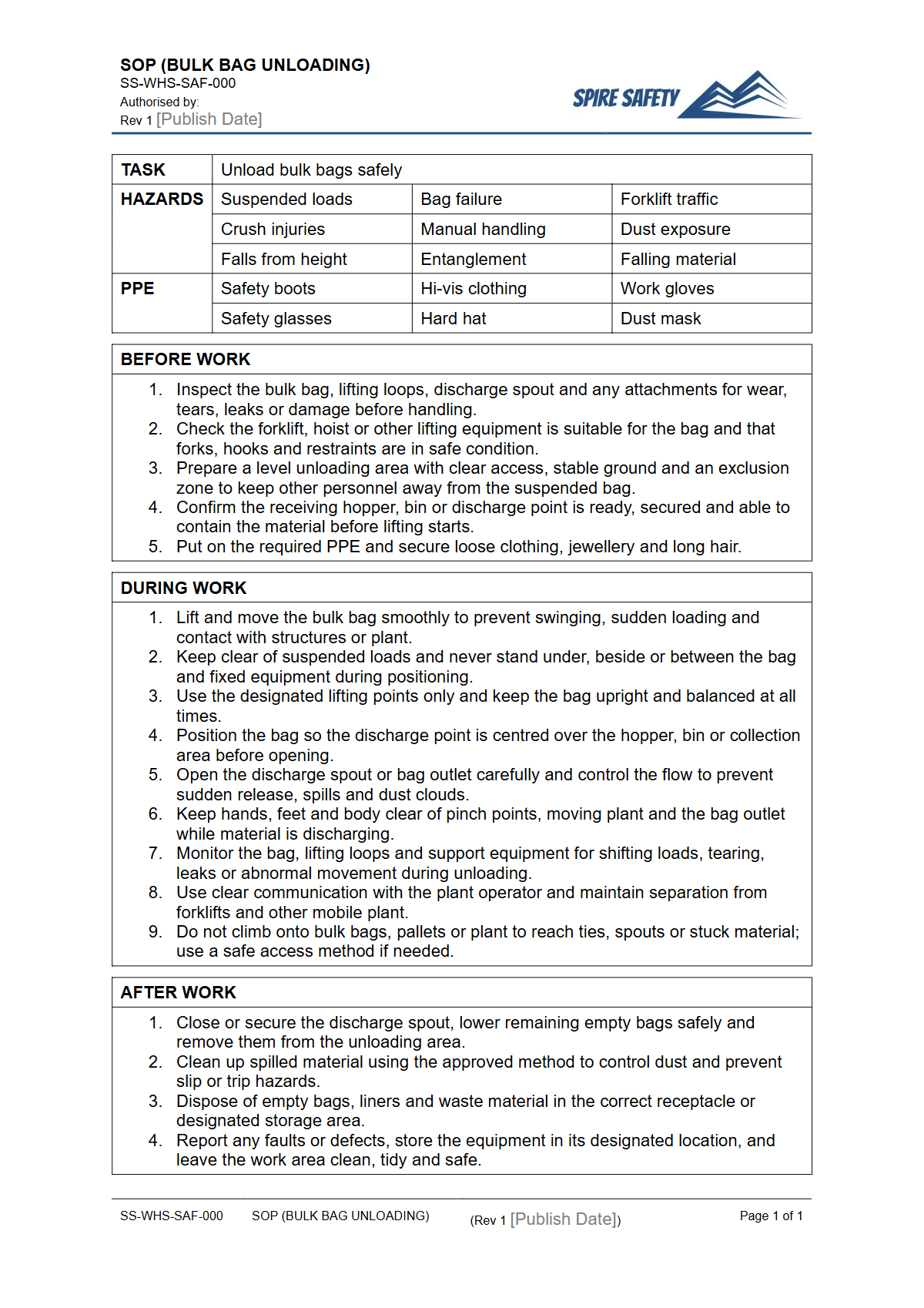
Purpose of the Free Safe Operating Procedure (Bulk Bag Unloading) Template
Effectively managing the risks associated with handling flexible intermediate bulk containers (FIBCs), or bulk bags, is a critical part of workplace safety in many industries, including construction, agriculture, and manufacturing. This Free Safe Operating Procedure (Bulk Bag Unloading) Template provides a structured starting point for your organisation to document the specific steps and controls required for this high-risk task.
Using a formal SOP helps ensure that every worker follows a consistent, pre-approved method, minimising exposure to hazards like being struck by a falling bag, engulfment, musculoskeletal injuries, and dust inhalation.
A well-drafted SOP is a fundamental tool for risk management. It serves as a clear training guide for new operators and a reference for experienced personnel.
By outlining the required personal protective equipment (PPE), pre-start checks, and emergency procedures, this template helps formalise your safety processes and demonstrates a commitment to a safer work environment. Implementing robust WHS management systems is crucial for integrating such procedures effectively across all operations.
Video walkthrough
How to use the Free Safe Operating Procedure (Bulk Bag Unloading) Template
This document is provided in both DOCX and PDF formats for your convenience. The DOCX file is fully editable, allowing you to adapt it to the unique circumstances of your workplace.
To use it effectively, you should methodically work through each section, replacing the placeholder text with information specific to your site's equipment, materials, personnel, and environment. This includes detailing the types of lifting machinery used (e.g., forklifts, cranes), the specific characteristics of the bulk bags being handled, and the control measures identified in your risk assessment.
Important: It is crucial to recognise that this is a template, not a finished, universally applicable document. We have included prompts and standard sections based on Australian WHS practice, but you must customise it thoroughly to reflect your actual workplace conditions.
The final responsibility for ensuring the SOP is accurate, adequate, and effectively implemented rests with your organisation. Once customised, the SOP should be used for training and regular operational guidance.
Many businesses find that a WHS compliance audit can help identify gaps in procedural documentation and implementation.
When to Use a Bulk Bag Unloading SOP
A Safe Operating Procedure for bulk bag unloading should be a living document, actively used in day-to-day operations. It is essential for training new employees or those unfamiliar with the task, ensuring they learn the correct, safe method from the outset.
It also serves as a critical tool for refresher training for existing staff to prevent complacency and reinforce safe work habits. The SOP should be readily accessible in the work area for quick reference.
Furthermore, it should be reviewed and updated whenever there is a change in process, equipment (such as introducing a new type of vehicle covered in a Body Truck SOP), or after any incident or near-miss to incorporate learnings.
Who Should Use This Safe Operating Procedure?
This SOP is intended for a range of personnel within an organisation. Primarily, it is for the workers who directly perform the task of unloading bulk bags, including forklift operators, crane operators, and general warehouse or site staff.
Supervisors and managers should also use the document to oversee the work, conduct safety observations, and ensure procedures are being followed correctly. WHS personnel and trainers will use the SOP as a foundational document for developing training programs and conducting risk assessments.
For tasks involving specific machinery like a telehandler, it's vital that operators are also familiar with the relevant Telehandler SOP to ensure all equipment-specific risks are controlled.
The collaborative development and review of this SOP should involve input from all these roles to ensure it is practical, comprehensive, and understood by everyone who needs to use it. Integrating it with procedures for other common site equipment, like an air compressor SOP, helps create a holistic safety culture. For more safety documentation, you can browse our complete free WHS resources library.
Common mistakes
Common mistakes to avoid
- Standing directly underneath a suspended bulk bag.
- Using damaged or frayed lifting loops or slings.
- Cutting bags open from the bottom with a knife while the bag is suspended and under tension.
- Failing to inspect the bag and its attachments before every lift.
Legal references
Legal considerations
The following legal requirements may be relevant to this type of work.
- Work Health and Safety Act (Harmonised) — Provides the primary duties for protecting workers and other people from work health and safety risks.
- Work Health and Safety Regulations (Harmonised) — Sets out requirements supporting the management of workplace hazards and risks.
The following codes may be relevant to this type of work.
- Managing WHS Risks Code of Practice — Provides practical guidance on identifying hazards, assessing risks and applying effective controls.
- Work Health and Safety Consultation, Cooperation and Coordination Code of Practice — Provides practical guidance on consulting workers and coordinating with other duty holders.
- Managing the Work Environment and Facilities Code of Practice — Provides practical guidance on safe work environments, workplace facilities and related controls.
Did you know
Weighty Risks
A standard bulk bag, also known as a Flexible Intermediate Bulk Container (FIBC), can hold between 500 kg and 2000 kg of material, posing significant crush and impact risks if not handled correctly.
Not Just Lifting
Musculoskeletal disorders are a major risk not just from lifting, but from the repetitive or awkward postures adopted when positioning, opening, and emptying bags.
FAQ
Frequently asked questions
01What are the main hazards when unloading bulk bags?
02Is a specific licence required to unload bulk bags?
03How often should an SOP for bulk bag unloading be reviewed?
04Can I use this SOP for any type of bulk bag?
Share this resource
Free Safe Operating Procedure (Bulk Bag Unloading) Template
Browse Categories
How To Use It
- 1Download and open in Word or PDF.
- 2Replace the placeholders with your business details.
- 3Get it reviewed by a WHS specialist before rollout.
Need it customised?
Our WHS consultants can adapt this template to your site, run a gap analysis, or audit what you already have in place.
Book a Free Consultation WHS consulting servicesor call 1300 156 382
Related templates
- Free Safe Operating Procedure (Bulk Food Handling) Template
- Free Safe Operating Procedure (Bulk Freight Staging) Template
- Free Safe Operating Procedure (Bulk Ingredient Storage) Template
- Free Safe Operating Procedure (Bulk Seed Handling) Template
- Free Safe Operating Procedure (Bulk Waste Transfer) Template
- Free Safe Operating Procedure (Bus Shelter Cleaning) Template