
Free Safe Operating Procedure (Bulk Food Handling) Template
Download our free Safe Operating Procedure for Bulk Food Handling.
Free Safe Operating Procedure (Bulk Food Handling) Template
DOCX • 126 KB + PDF
Updated Oct 2026
No signup required
Purpose of the Free Safe Operating Procedure (Bulk Food Handling) Template
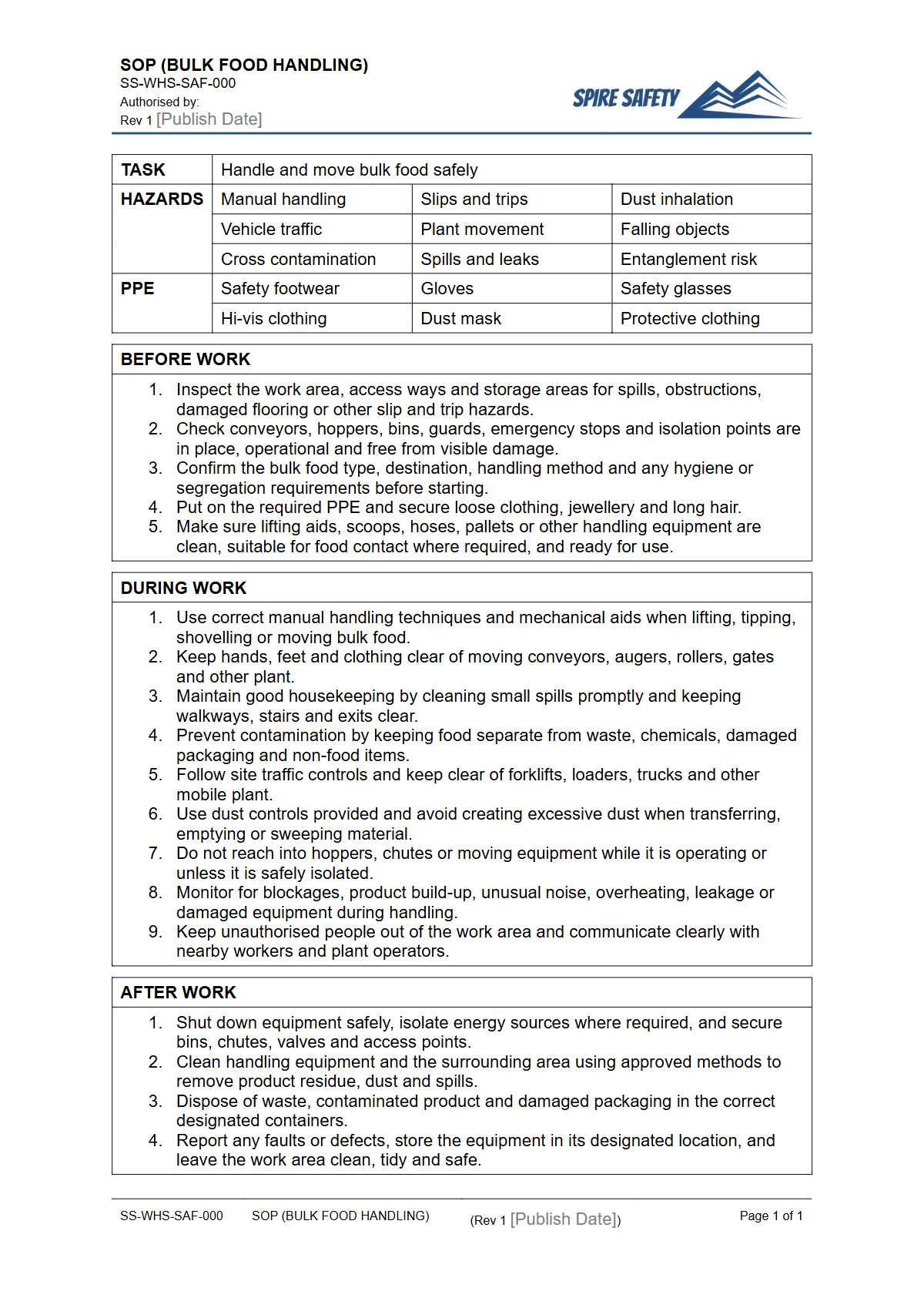
Handling bulk food items safely requires clear, consistent procedures. Our Free Safe Operating Procedure (Bulk Food Handling) Template provides a structured starting point for documenting the key safety steps involved.
This resource is designed to help businesses in the food processing, manufacturing, warehousing, and hospitality sectors manage risks associated with receiving, storing, moving, and despatching bulk ingredients. This template guides you in creating a Safe Operating Procedure for Bulk Food Handling that identifies specific hazards and outlines control measures.
Key risks in this area include musculoskeletal injuries from manual tasks, slips from spills, contamination from poor hygiene, and incidents involving equipment like forklifts or pallet jacks. A documented SOP ensures all workers follow the same safe method, reducing the likelihood of injury or illness and supporting food safety compliance.
A well-defined SOP is particularly critical during logistics operations like loading and unloading goods. These high-risk activities can be managed with specific procedures, such as a Body Truck SOP, to control vehicle and pedestrian interactions.
Video walkthrough
How to use the Free Safe Operating Procedure (Bulk Food Handling) Template
To get the most out of this Safe Operating Procedure template, download the DOCX file and adapt it to your specific workplace. You must review every section and add, remove, or change details to reflect your unique equipment, ingredients, facility layout, and risk controls.
The final document should be a practical tool used by your team, not just a document for compliance paperwork.
Important: We have created this template as a guide; it is your responsibility to ensure it is customised to be fully relevant to your site-specific risks and legal obligations.
An effective SOP is a foundational element that should be integrated into your organisation's broader safety framework. These procedures often form a critical part of comprehensive WHS management systems, linking operational tasks directly to your overall safety policy and objectives.
When to use this Safe Operating Procedure
A Safe Operating Procedure for Bulk Food Handling should be used as a core operational document in several key situations. It is essential for inducting new employees to ensure they understand the expected safety standards from day one.
It also serves as a critical tool for task-specific training, refresher courses, and competency assessments for existing staff.
After any incident or near-miss involving bulk food handling, the SOP must be reviewed and updated to incorporate any lessons learned. It is also a key reference document for pre-start meetings or toolbox talks to reinforce safe work practices.
When tasks involve mobile plant to move bulk goods, a specific procedure like our free Telehandler SOP Template should be used in conjunction with this document.
Who should use this document
This SOP is primarily for workers who directly handle bulk food products, providing them with clear, step-by-step instructions for performing their tasks safely. Supervisors and team leaders must use it to train staff, monitor work practices, and uphold safety standards on the floor.
WHS and Food Safety Managers will use the SOP as a key part of risk assessments, incident investigations, and compliance checks. Performing regular WHS compliance auditing helps verify that procedures are being effectively implemented and followed by all relevant personnel.
The SOP should detail the required Personal Protective Equipment (PPE), such as safety footwear, gloves, and high-visibility clothing. It should also cover emergency procedures, including what to do in case of a major spill, chemical exposure from cleaning agents, or equipment failure.
If items are stored on high shelving, procedures for safely accessing them are critical; our free Step Ladder SOP Template can provide guidance on this specific task.
By formalising your processes with clear, accessible documentation, you create a safer, more efficient, and more organised work environment. Explore our extensive free WHS resources library for more templates and guides to support your safety goals.
Common mistakes
Common mistakes to avoid
- Creating a generic SOP that isn't customised to the specific workplace, equipment, and ingredients.
- Failing to train workers on the SOP and verifying they understand and follow the procedures.
- Not reviewing or updating the SOP after an incident, near-miss, or change in process.
- Neglecting to include details on emergency procedures, such as managing large spills or equipment malfunctions.
Legal references
Legal considerations
The following legal requirements may be relevant to this type of work.
- Work Health and Safety Act (Harmonised) — Provides the primary duties for protecting workers and other people from work health and safety risks.
- Work Health and Safety Regulations (Harmonised) — Sets out requirements supporting the management of workplace hazards and risks.
The following codes may be relevant to this type of work.
- Managing WHS Risks Code of Practice — Provides practical guidance on identifying hazards, assessing risks and applying effective controls.
- Work Health and Safety Consultation, Cooperation and Coordination Code of Practice — Provides practical guidance on consulting workers and coordinating with other duty holders.
- Managing the Work Environment and Facilities Code of Practice — Provides practical guidance on safe work environments, workplace facilities and related controls.
Did you know
Manual Task Injuries
According to Safe Work Australia, injuries from manual tasks, such as lifting heavy bags or containers of food, are one of the most common causes of serious workers' compensation claims in the country.
The Two-Hour/Four-Hour Rule
A key principle in Australian food safety is the 2-hour/4-hour rule for potentially hazardous foods. This guides decisions on when food must be refrigerated, used immediately, or thrown out after being in the temperature danger zone (5°C - 60°C).
FAQ
Frequently asked questions
01What is a Safe Operating Procedure (SOP) in food handling?
02Does this template cover allergen management?
03Is an SOP a legal requirement in Australia for food handling?
04How often should we review our Bulk Food Handling SOP?
Share this resource
Free Safe Operating Procedure (Bulk Food Handling) Template
Browse Categories
How To Use It
- 1Download and open in Word or PDF.
- 2Replace the placeholders with your business details.
- 3Get it reviewed by a WHS specialist before rollout.
Need it customised?
Our WHS consultants can adapt this template to your site, run a gap analysis, or audit what you already have in place.
Book a Free Consultation WHS consulting servicesor call 1300 156 382
Related templates
- Free Safe Operating Procedure (Bulk Freight Staging) Template
- Free Safe Operating Procedure (Bulk Ingredient Storage) Template
- Free Safe Operating Procedure (Bulk Seed Handling) Template
- Free Safe Operating Procedure (Bulk Waste Transfer) Template
- Free Safe Operating Procedure (Bus Shelter Cleaning) Template
- Free Safe Operating Procedure (Busbar Bender) Template