
Free Safe Operating Procedure (Bulk Bag Lifting) Template
Download our free Safe Operating Procedure (Bulk Bag Lifting) template.
Free Safe Operating Procedure (Bulk Bag Lifting) Template
DOCX • 126 KB + PDF
Updated Oct 2026
No signup required
Purpose of the Free Safe Operating Procedure (Bulk Bag Lifting) Template
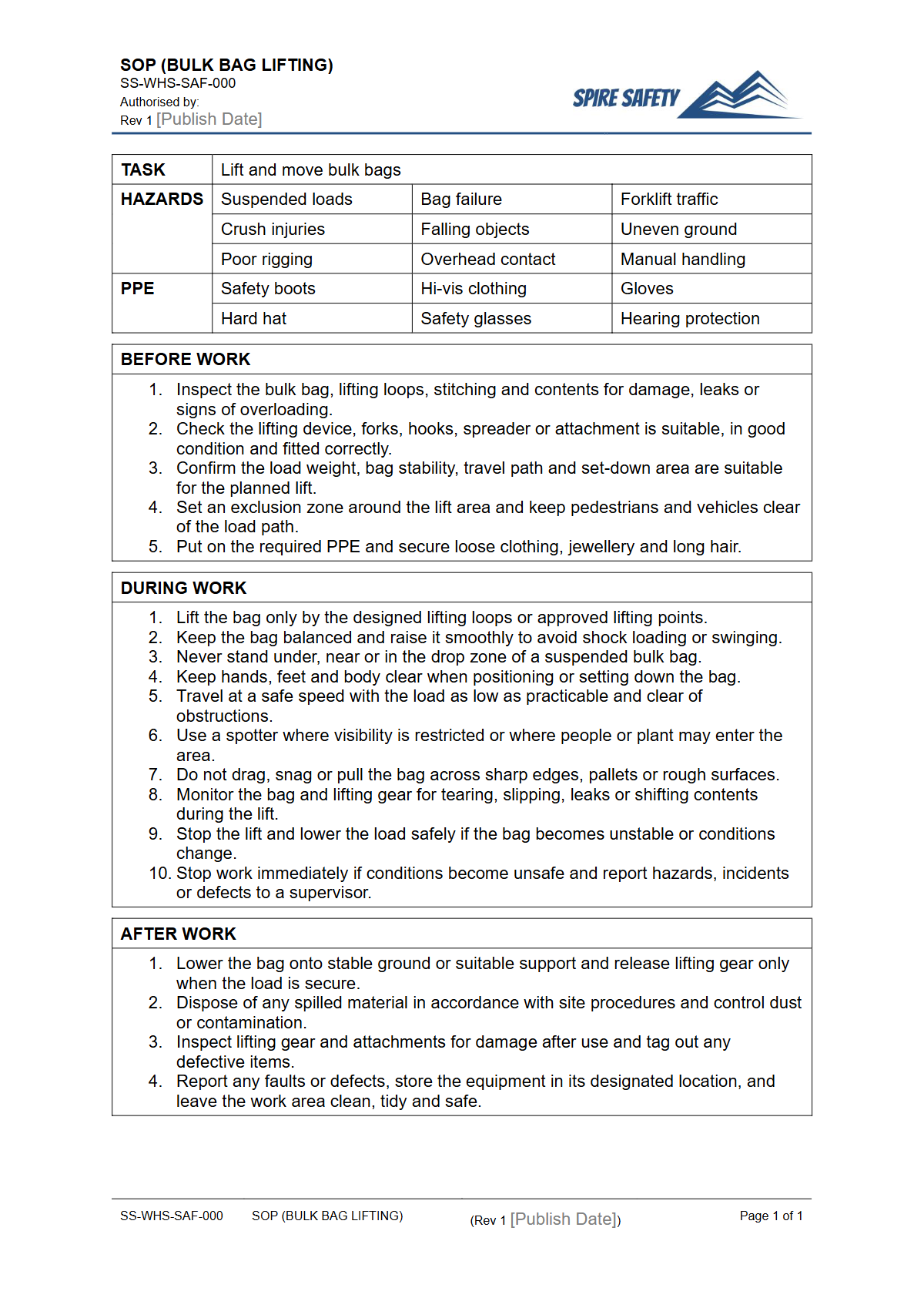
Lifting and moving bulk bags, also known as Flexible Intermediate Bulk Containers (FIBCs), presents significant workplace hazards, including crushing, entanglement, and musculoskeletal injuries. This Free Safe Operating Procedure (Bulk Bag Lifting) Template provides a structured starting point for documenting the risks and controls associated with this common task.
Using this template helps you formally outline step-by-step instructions, identify required Personal Protective Equipment (PPE), and specify emergency procedures, ensuring a clear and consistent process for all workers.
A documented SOP is a key component of a functional safety framework. It serves as evidence that you have a process for managing specific high-risk tasks, integrating seamlessly into your broader WHS management systems. This helps demonstrate your commitment to providing a safe system of work for your employees.
Video walkthrough
How to use the Free Safe Operating Procedure (Bulk Bag Lifting) Template
This template is provided in both DOCX and PDF formats for your convenience. To use it, simply download the file and open it in your preferred editor.
The document is structured with clear headings covering everything from hazard identification to the operational sequence.
This template provides a solid foundation based on Australian WHS principles, but it is not a complete, off-the-shelf solution. You must customise this Safe Operating Procedure to reflect the specific bulk bags, lifting equipment (e.g., crane, forklift, telehandler), tasks, and environment at your workplace.
We recommend consulting with your workers and other relevant stakeholders during this customisation process to ensure the procedure is practical and effective.
When to Use This Safe Operating Procedure
A Safe Operating Procedure for bulk bag lifting should be used in several key situations. It is essential for training and inducting new employees or workers who are new to the task, providing them with a clear, authoritative guide on how to perform the job safely.
It should also be readily available at the worksite as a reference for operators and supervisors before they begin the task.
Furthermore, the SOP is a critical document during incident investigations, helping to establish whether correct procedures were followed. Regularly reviewing and updating your SOPs is a vital part of continuous improvement.
A periodic review, conducted as part of a formal WHS compliance auditing program, ensures your procedures remain current with equipment, processes, and legislative changes.
Who Should Use This SOP
This Safe Operating Procedure is intended for use by multiple roles within an organisation. Persons Conducting a Business or Undertaking (PCBUs) and managers can use it to fulfil their duty of care.
Supervisors are responsible for ensuring workers follow the SOP and for providing the necessary training and resources. Workers who perform the lifting task are the primary users, relying on the SOP to guide their actions and reinforce safe work habits.
The procedure is particularly important for operators of plant used in the lifting process. For example, if a telehandler is used, workers should be familiar with both the bulk bag lifting SOP and the specific FREE Telehandler SOP (Safe Operating Procedure) Template. This ensures a comprehensive understanding of the risks associated with both the load and the machinery.
Similarly, if the task involves loading or unloading vehicles, procedures specific to that activity are required. You may find our FREE Body Truck SOP (Safe Operating Procedure) Template useful in these scenarios.
Documenting procedures for all related heavy machinery, like those covered in a FREE Dozer SOP (Safe Operating Procedure) Template, helps build a more robust safety system across your site.
This resource is one of many documents available to help you build out your safety systems. You can browse our complete free WHS resources library for more templates, checklists, and guides.
Common mistakes
Common mistakes to avoid
- Using bags with frayed loops, holes, or signs of UV degradation.
- Allowing personnel to stand or work under a suspended bulk bag.
- Attaching only one or two loops when four are provided, causing an unbalanced and unsafe load.
- Jerking the load during lifting or lowering, which can shock-load the bag and lifting equipment.
Legal references
Legal considerations
The following legal requirements may be relevant to this type of work.
- Work Health and Safety Act (Harmonised) — Provides the primary duties for protecting workers and other people from work health and safety risks.
- Work Health and Safety Regulations (Harmonised) — Sets out requirements supporting the management of workplace hazards and risks.
The following codes may be relevant to this type of work.
- Managing WHS Risks Code of Practice — Provides practical guidance on identifying hazards, assessing risks and applying effective controls.
- Work Health and Safety Consultation, Cooperation and Coordination Code of Practice — Provides practical guidance on consulting workers and coordinating with other duty holders.
- Managing the Work Environment and Facilities Code of Practice — Provides practical guidance on safe work environments, workplace facilities and related controls.
Did you know
SWL is Critical
A standard one cubic metre bulk bag filled with sand can weigh over 1.5 tonnes. Always verify the Safe Working Load (SWL) of the bag and the lifting equipment before starting.
UV Degradation
Bulk bags, also known as Flexible Intermediate Bulk Containers (FIBCs), can be weakened by prolonged exposure to sunlight. This UV degradation can significantly reduce a bag's structural integrity and lead to failure during a lift.
FAQ
Frequently asked questions
01What should be included in an SOP for bulk bag lifting?
02How often should a bulk bag lifting SOP be reviewed?
03Is a Safe Operating Procedure a legal requirement in Australia for lifting operations?
04Who is responsible for developing a bulk bag lifting SOP?
Share this resource
Free Safe Operating Procedure (Bulk Bag Lifting) Template
Browse Categories
How To Use It
- 1Download and open in Word or PDF.
- 2Replace the placeholders with your business details.
- 3Get it reviewed by a WHS specialist before rollout.
Need it customised?
Our WHS consultants can adapt this template to your site, run a gap analysis, or audit what you already have in place.
Book a Free Consultation WHS consulting servicesor call 1300 156 382
Related templates
- Free Safe Operating Procedure (Bulk Bag Unloading) Template
- Free Safe Operating Procedure (Bulk Food Handling) Template
- Free Safe Operating Procedure (Bulk Freight Staging) Template
- Free Safe Operating Procedure (Bulk Ingredient Storage) Template
- Free Safe Operating Procedure (Bulk Seed Handling) Template
- Free Safe Operating Procedure (Bulk Waste Transfer) Template