
Free Safe Operating Procedure (Buffing Machine) Template
Download our free Safe Operating Procedure (Buffing Machine) template.
Free Safe Operating Procedure (Buffing Machine) Template
DOCX • 126 KB + PDF
Updated Oct 2026
No signup required
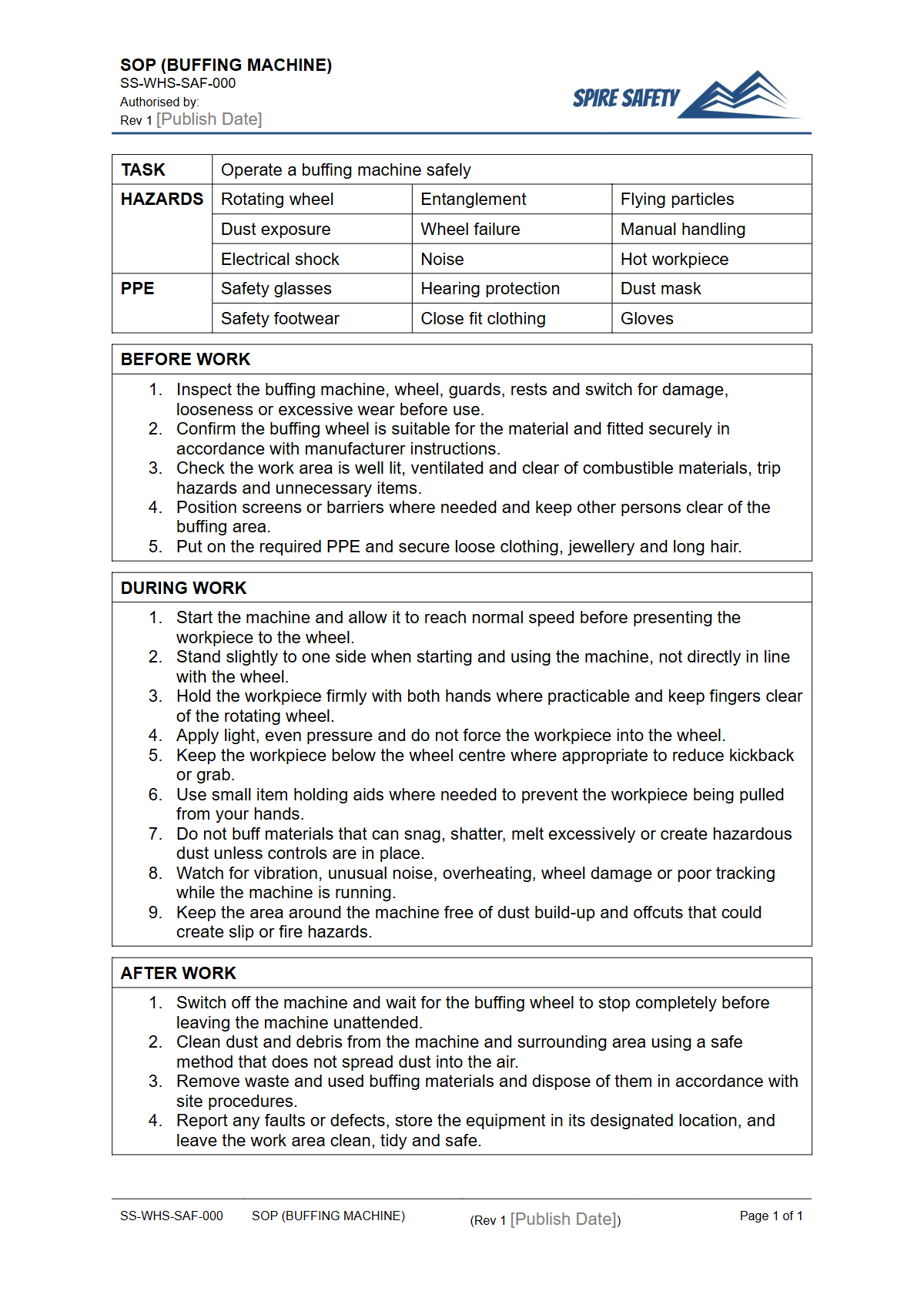
Purpose of the Free Safe Operating Procedure (Buffing Machine) Template
A buffing machine is an essential tool in many workshops for finishing and polishing surfaces, but it also presents significant hazards if not used correctly. This Free Safe Operating Procedure (Buffing Machine) Template provides a structured framework for documenting the steps required to operate this equipment safely.
Formalising your process helps control risks like entanglement, airborne dust, and contact with the rotating wheel. A well-drafted SOP is a critical administrative control that supports your primary duty of care under WHS legislation.
The primary purpose of this Free Safe Operating Procedure (Buffing Machine) Template is to help your organisation establish and communicate a safe system of work. It provides clear, step-by-step instructions for operators, minimises operational ambiguity, and serves as a key document for worker training, inductions, and competency assessments.
Using this template helps you systematically address hazards and implement control measures specific to your buffing operations, forming a crucial part of your overall safety management.
Video walkthrough
How to use the Free Safe Operating Procedure (Buffing Machine) Template
Download the template in your preferred format (DOCX for easy editing or PDF). It is crucial to understand that this document must be customised for your specific workplace to be effective.
This template provides a solid foundation, but you must consult with your workers and adapt the content to reflect the specific make and model of your buffing machine, the materials being processed, and the unique conditions of your site.
When customising the document, pay close attention to specifying pre-start checks, required Personal Protective Equipment (PPE), and emergency shutdown procedures. For complex operations or high-risk environments, engaging expert support through WHS consulting can ensure your final SOP is robust, practical, and fit for purpose.
Key Hazards of Buffing Machine Operation
Before authoring your SOP, you must understand the risks involved. A thorough risk assessment should identify hazards including, but not limited to:
- Entanglement: Loose clothing, long hair, gloves, or rags can be caught by the rotating wheel or spindle.
- Contact & Abrasion: Accidental contact with the moving buffing wheel can cause severe friction burns and abrasions.
- Projectiles: The workpiece may be forcefully thrown if not held correctly or if it snags on the wheel. Parts of a damaged wheel can also become projectiles.
- Airborne Contaminants: Buffing generates dust, fibres, and lint from the wheel and workpiece. Polishing compounds can release hazardous substances like silica.
- Noise: Buffing machines can generate high noise levels, potentially leading to hearing loss over time.
- Vibration: Prolonged use can expose operators to hand-arm vibration (HAV), which can cause musculoskeletal and neurological disorders.
When to use it
A buffing machine SOP should be a core part of your daily safety management. It must be used during the induction and training of new operators to ensure they understand the correct procedures from day one.
It also serves as a critical reference for experienced workers and as a foundational document for conducting refresher training. The SOP must be reviewed during workplace inspections and referenced during incident investigations or when planning any changes to the work process.
Just as a circular saw SOP is essential for woodworking tasks, this procedure is vital for all polishing and finishing work.
Who should use it
This procedure is designed for use by multiple roles within an organisation. Persons Conducting a Business or Undertaking (PCBUs) and managers can use it to help fulfil their duty to provide and maintain safe systems of work.
Supervisors rely on it to monitor work practices and instruct operators correctly. WHS advisors and safety officers use it as part of the broader risk management framework for the site.
Most importantly, operators of the buffing machine must use the finalised SOP as their primary guide for performing the task safely. Integrating such documents is a key part of building effective WHS management systems that protect workers and ensure operational consistency.
Establishing clear procedures for all plant and equipment is fundamental to workplace safety. While this document focuses on buffing machines, similar principles apply to other common workshop tools.
For instance, documenting the safe use of pressurised air systems is equally important, which is why we also provide a free air compressor SOP template. Explore our complete free WHS resources library to find more templates to support your safety management efforts.
Common mistakes
Common mistakes to avoid
- Using the wrong type or size of buffing wheel for the machine's specified RPM.
- Applying excessive pressure, which can cause the workpiece to be thrown or the motor to overheat.
- Failing to wear appropriate respiratory protection for the specific dust and fibres being generated.
- Neglecting to securely hold the workpiece, especially when presenting it to the lower quadrant of the wheel.
Legal references
Legal considerations
The following legal requirements may be relevant to this type of work.
- Work Health and Safety Act (Harmonised) — Provides the primary duties for protecting workers and other people from work health and safety risks.
- Work Health and Safety Regulations (Harmonised) — Sets out requirements supporting the management of workplace hazards and risks.
The following codes may be relevant to this type of work.
- Managing WHS Risks Code of Practice — Provides practical guidance on identifying hazards, assessing risks and applying effective controls.
- Work Health and Safety Consultation, Cooperation and Coordination Code of Practice — Provides practical guidance on consulting workers and coordinating with other duty holders.
- Managing the Work Environment and Facilities Code of Practice — Provides practical guidance on safe work environments, workplace facilities and related controls.
Did you know
Hidden Danger in Polishing
Some polishing and buffing compounds contain crystalline silica. When these compounds become airborne during use, they create a risk of silicosis, a serious and irreversible lung disease. Always check the Safety Data Sheet (SDS) for your compound.
FAQ
Frequently asked questions
01What are the main hazards of a buffing machine?
02Is a Safe Operating Procedure a legal requirement in Australia?
03How often should I review a buffing machine SOP?
04What PPE is needed for using a buffing machine?
Share this resource
Free Safe Operating Procedure (Buffing Machine) Template
Browse Categories
How To Use It
- 1Download and open in Word or PDF.
- 2Replace the placeholders with your business details.
- 3Get it reviewed by a WHS specialist before rollout.
Need it customised?
Our WHS consultants can adapt this template to your site, run a gap analysis, or audit what you already have in place.
Book a Free Consultation WHS consulting servicesor call 1300 156 382
Related templates
- Free Safe Operating Procedure (Building Access Control) Template
- Free Safe Operating Procedure (Building Entry Clean) Template
- Free Safe Operating Procedure (Building Washdown) Template
- Free Safe Operating Procedure (Bulb Planting) Template
- Free Safe Operating Procedure (Bulk Bag Lifting) Template
- Free Safe Operating Procedure (Bulk Bag Unloading) Template