
Free Safe Operating Procedure (Building Entry Clean) Template
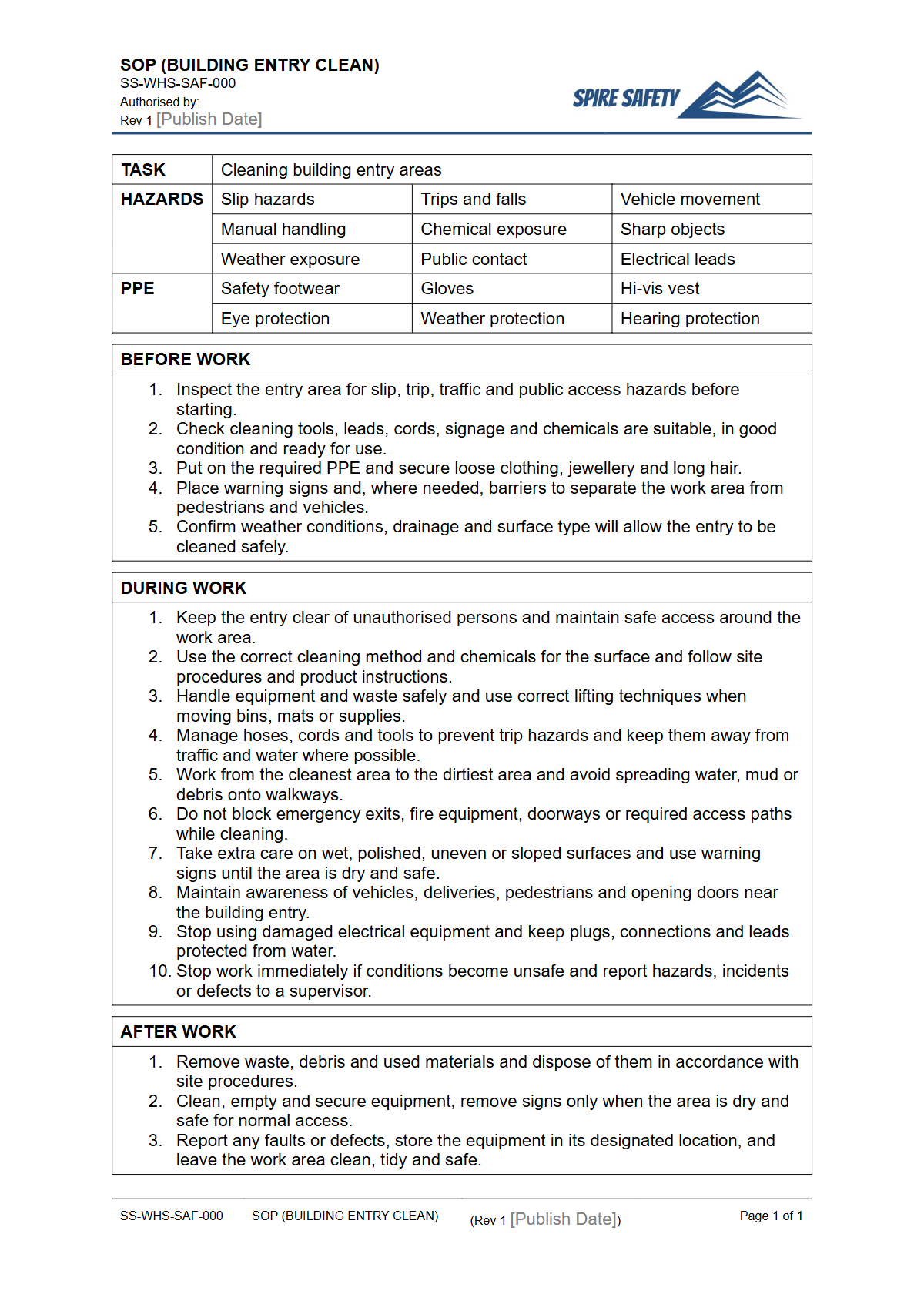
Download our free Safe Operating Procedure (Building Entry Clean) Template. This customisable DOCX and PDF helps formalise your cleaning processes.
Free Safe Operating Procedure (Building Entry Clean) Template
DOCX • 126 KB + PDF
Updated Oct 2026
No signup required
Purpose of the Free Safe Operating Procedure (Building Entry Clean) Template
This Free Safe Operating Procedure (Building Entry Clean) Template provides a structured starting point for documenting the steps required to safely clean and maintain building entry points. High-traffic areas like lobbies, foyers, and entrances present unique Work Health and Safety (WHS) risks, including slip and trip hazards from wet floors, ergonomic injuries from manual tasks, and exposure to hazardous chemicals.
A documented SOP helps standardise cleaning processes, ensuring every worker performs the task safely and consistently. It serves as a crucial training tool for new employees and a reference guide for experienced staff, forming a key part of your overall safety management system.
By clearly outlining potential hazards, required Personal Protective Equipment (PPE), and step-by-step instructions, this template helps your organisation meet its duty of care. Formalising this process demonstrates a commitment to proactively managing risks associated with property maintenance and cleaning operations.
Integrating this SOP into your broader operational framework is a fundamental step in building a robust WHS management system that protects workers and visitors alike.
Video walkthrough
How to use the Free Safe Operating Procedure (Building Entry Clean) Template
This document is a template and must be customised to reflect the specific environment, equipment, and chemicals used in your workplace. A generic procedure is not sufficient to ensure safety.
Download the DOCX file and adapt it to your unique operational context.
We recommend the following steps for customisation:
- Consult your team: Involve the cleaners and supervisors who perform the work. Their practical experience is invaluable for identifying real-world hazards and effective controls.
- Conduct a risk assessment: Analyse the specific building entry area. Identify hazards such as floor type (e.g., tile, carpet, matting), public traffic flow, lighting conditions, and specific cleaning challenges.
- Detail specific chemicals: Replace generic chemical placeholders with the exact names of the products you use. Include details from their Safety Data Sheets (SDS), such as handling precautions, first aid measures, and required PPE.
- Specify equipment: List the exact tools and equipment used, from mops and buckets to floor polishers or auto-scrubbers. Provide instructions for their safe use and pre-start checks.
- Define the area and frequency: Clearly state which entry points the SOP applies to and the required frequency of cleaning.
- Review and approve: Once customised, have the SOP formally reviewed and approved by a competent person, such as a manager or WHS representative.
If you require expert assistance in tailoring this document or developing more complex safety procedures, consider engaging professional WHS consulting services.
When to use it
A Safe Operating Procedure for building entry cleaning should be used as the primary reference document for all cleaning activities in these areas. It is not a document to be filed away and forgotten.
It should be actively used during worker induction and training, for regular refresher training, and as a guide for supervisors conducting safety observations. The SOP should also be reviewed immediately following any incident or near miss to identify any procedural gaps.
Just as a high-risk task requires a specific FREE Plasma Cutter SOP Template, even routine tasks like cleaning need their own documented procedures to manage unique hazards effectively.
Who should use it
This SOP is intended for any person involved in the cleaning and maintenance of building entrances. This includes:
- Commercial cleaners and cleaning contractors
- Facilities management personnel
- Property managers and body corporate managers
- Maintenance staff
- Supervisors and team leaders responsible for overseeing cleaning operations
Ultimately, the Person Conducting a Business or Undertaking (PCBU) is responsible for ensuring safe systems of work are in place, making this template a valuable tool for business owners and senior managers in demonstrating compliance. For tasks that involve working at heights, such as cleaning high glass near an entrance, a separate, specific procedure like our FREE Step Ladder SOP Template is essential. For other specialised tasks, you can find more templates in our free WHS resources library.
Common mistakes
Common mistakes to avoid
- Using the template without customising it for the specific workplace, chemicals, and equipment.
- Failing to adequately train workers on the final, approved SOP and confirm their understanding.
- Neglecting to review and update the SOP after an incident or when processes change.
- Storing cleaning chemicals improperly, such as in unlabelled containers or in areas accessible to the public.
Legal references
Legal considerations
The following legal requirements may be relevant to this type of work.
- Work Health and Safety Act (Harmonised) — Provides the primary duties for protecting workers and other people from work health and safety risks.
- Work Health and Safety Regulations (Harmonised) — Sets out requirements supporting the management of workplace hazards and risks.
The following codes may be relevant to this type of work.
- Managing WHS Risks Code of Practice — Provides practical guidance on identifying hazards, assessing risks and applying effective controls.
- Work Health and Safety Consultation, Cooperation and Coordination Code of Practice — Provides practical guidance on consulting workers and coordinating with other duty holders.
- Managing the Work Environment and Facilities Code of Practice — Provides practical guidance on safe work environments, workplace facilities and related controls.
Did you know
Slips, Trips, and Falls
According to Safe Work Australia, slips, trips, and falls are a leading cause of serious workplace injuries, with contaminated floors (including those wet from cleaning) being a major contributing factor.
Chemical Safety
Australia uses the Globally Harmonized System (GHS) for classifying and labelling chemicals. Understanding the pictograms and information on Safety Data Sheets (SDS) is critical for anyone handling cleaning products.
FAQ
Frequently asked questions
01What are the main hazards in building entry cleaning?
02How often should a Safe Operating Procedure for cleaning be reviewed?
03Is an SOP a legal requirement in Australia?
04What is the difference between an SOP and a Safe Work Method Statement (SWMS)?
Share this resource
Free Safe Operating Procedure (Building Entry Clean) Template
Browse Categories
How To Use It
- 1Download and open in Word or PDF.
- 2Replace the placeholders with your business details.
- 3Get it reviewed by a WHS specialist before rollout.
Need it customised?
Our WHS consultants can adapt this template to your site, run a gap analysis, or audit what you already have in place.
Book a Free Consultation WHS consulting servicesor call 1300 156 382
Related templates
- Free Safe Operating Procedure (Building Washdown) Template
- Free Safe Operating Procedure (Bulb Planting) Template
- Free Safe Operating Procedure (Bulk Bag Lifting) Template
- Free Safe Operating Procedure (Bulk Bag Unloading) Template
- Free Safe Operating Procedure (Bulk Food Handling) Template
- Free Safe Operating Procedure (Bulk Freight Staging) Template