
Free Safe Operating Procedure (Buffet Setup) Template
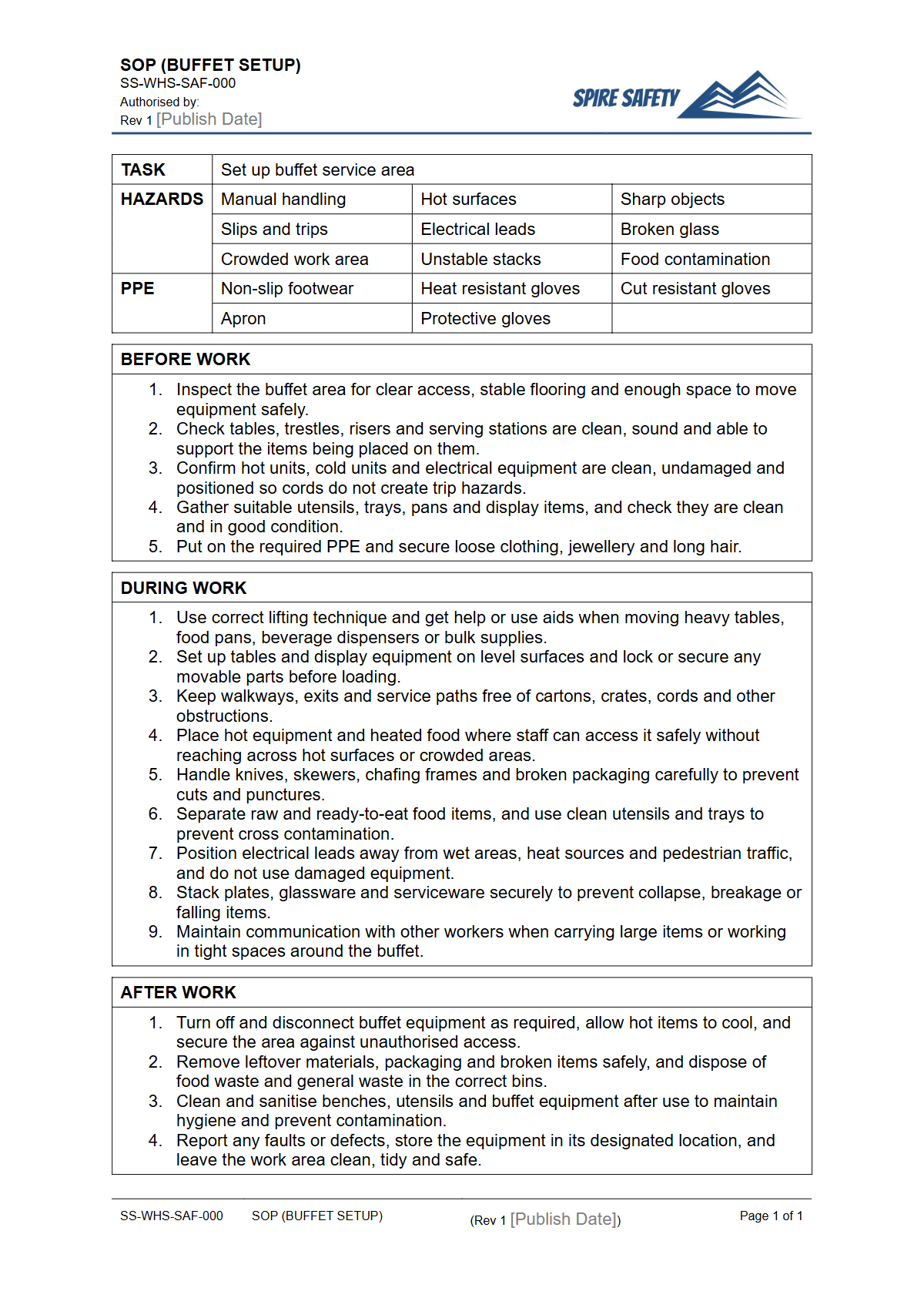
Download our free Safe Operating Procedure (Buffet Setup) Template to manage risks like food contamination, slips, and manual handling.
Free Safe Operating Procedure (Buffet Setup) Template
DOCX • 126 KB + PDF
Updated Oct 2026
No signup required
Purpose of the Free Safe Operating Procedure (Buffet Setup) Template
This Free Safe Operating Procedure (Buffet Setup) Template provides a structured framework for outlining the health and safety steps required for setting up and managing a buffet service. A buffet environment presents a unique combination of hazards, including food safety risks, ergonomic strains, and general workplace safety issues.
Using a standardised procedure helps control these risks, ensures consistency among staff, and demonstrates a commitment to workplace health and safety.
Key hazards addressed in a buffet setup SOP include:
- Food Safety: Controlling temperature to prevent bacterial growth (the 'danger zone'), avoiding cross-contamination between raw and cooked foods, and ensuring proper allergen management.
- Manual Handling: Lifting and carrying heavy trays of food, equipment like bain-maries, and stacks of plates, which can lead to musculoskeletal injuries.
- Slips, Trips, and Falls: Spilled food or liquids on the floor, and cables from electrical warmers creating trip hazards.
- Burns and Scalds: Handling hot food, operating chafing dishes with fuel burners, and using steam from bain-maries or heat lamps.
By documenting the safest way to perform these tasks, this SOP serves as a vital tool for worker training, operational consistency, and risk management in any hospitality setting.
Video walkthrough
How to use the Free Safe Operating Procedure (Buffet Setup) Template
This Safe Operating Procedure for Buffet Setup is provided as a fully editable DOCX file and a ready-to-print PDF. The DOCX version allows for complete customisation to suit your specific operational needs.
To use it effectively, you should identify the equipment used (e.g., specific models of food warmers, trolleys), the layout of your service area, the types of food served, and the specific control measures your business has implemented.
Important: This document is a template, not a finished safety solution. We have developed it as a starting point aligned with Australian WHS principles, but it must be adapted to your unique workplace.
You must conduct your own risk assessment and consult with your workers to ensure the final procedure is comprehensive and reflects the actual tasks and hazards on-site. Integrating this SOP into your broader WHS management systems ensures it works alongside your other policies and procedures for a holistic approach to safety.
When to use it
A formal SOP for buffet setup should be used consistently as part of your daily operations. Its primary applications include:
- Worker Training: As a core training document for new employees and a refresher for existing staff to ensure everyone follows the same safe process.
- Pre-Service Briefings: To review key safety checks and responsibilities before a function or service period begins.
- Incident Investigation: As a benchmark to determine if procedures were followed correctly in the event of a food safety issue, injury, or near miss.
- Operational Audits: During internal or external reviews to verify that documented safety processes are being implemented effectively. A thorough review can be part of a scheduled WHS compliance auditing program.
Who should use it
This template is designed for use by any person responsible for overseeing staff and safety in a food service environment. This includes:
- Function Managers and Supervisors
- Head Chefs and Sous Chefs
- Catering Managers
- Venue Owners
- WHS or OHS Managers and Representatives
Once customised and approved, the final Safe Operating Procedure is a tool for all food and beverage attendants, kitchen hands, and chefs involved in setting up, replenishing, and packing down the buffet. In a large venue, safety extends beyond the kitchen; for example, setting up decorations or signage may require working at height, necessitating a specific Step Ladder SOP to manage fall risks.
For catering companies that handle off-site events, logistics become a major part of the operation. The safe transport of food and equipment is critical and can be managed with dedicated procedures.
For instance, a formal Body Truck SOP can ensure that vehicles used for catering are loaded, driven, and unloaded safely, protecting both workers and the public.
Larger organisations like hotels and convention centres often have diverse operational needs beyond food service. An in-house maintenance or events team might be responsible for building custom displays or making repairs, requiring procedures like a Circular Saw SOP for their workshop.
This highlights how a comprehensive safety system is built from multiple, task-specific procedures. You can explore more templates in our free WHS resources library to cover the various activities at your workplace.
Common mistakes
Common mistakes to avoid
- Failing to regularly monitor and log food temperatures throughout the service period.
- Placing electrical cords for food warmers across walkways, creating a significant trip hazard.
- Overfilling bain-marie trays, which increases the risk of spills, burns, and manual handling injuries.
- Not having clear, immediate procedures for cleaning up spills, leading to an increased risk of slips and falls for both staff and guests.
Legal references
Legal considerations
The following legal requirements may be relevant to this type of work.
- Work Health and Safety Act (Harmonised) — Provides the primary duties for protecting workers and other people from work health and safety risks.
- Work Health and Safety Regulations (Harmonised) — Sets out requirements supporting the management of workplace hazards and risks.
The following codes may be relevant to this type of work.
- Managing WHS Risks Code of Practice — Provides practical guidance on identifying hazards, assessing risks and applying effective controls.
- Work Health and Safety Consultation, Cooperation and Coordination Code of Practice — Provides practical guidance on consulting workers and coordinating with other duty holders.
- Managing the Work Environment and Facilities Code of Practice — Provides practical guidance on safe work environments, workplace facilities and related controls.
Did you know
The Temperature Danger Zone
Australian food safety standards define the 'temperature danger zone' as being between 5°C and 60°C. In this range, harmful bacteria can grow to unsafe levels in as little as two hours, making temperature control one of the most critical aspects of buffet management.
Hospitality Hazards
The accommodation and food services industry has one of the higher rates of serious workers' compensation claims in Australia. Body stressing from manual handling and slips, trips, and falls are the two leading causes of injury.
FAQ
Frequently asked questions
01What key hazards should a Safe Operating Procedure for a buffet setup address?
02Is an SOP a legal requirement for buffet service in Australia?
03How often should we review our buffet setup SOP?
04Can this buffet setup template be used for both small cafes and large hotels?
Share this resource
Free Safe Operating Procedure (Buffet Setup) Template
Browse Categories
How To Use It
- 1Download and open in Word or PDF.
- 2Replace the placeholders with your business details.
- 3Get it reviewed by a WHS specialist before rollout.
Need it customised?
Our WHS consultants can adapt this template to your site, run a gap analysis, or audit what you already have in place.
Book a Free Consultation WHS consulting servicesor call 1300 156 382
Related templates
- Free Safe Operating Procedure (Buffing Machine) Template
- Free Safe Operating Procedure (Building Access Control) Template
- Free Safe Operating Procedure (Building Entry Clean) Template
- Free Safe Operating Procedure (Building Washdown) Template
- Free Safe Operating Procedure (Bulb Planting) Template
- Free Safe Operating Procedure (Bulk Bag Lifting) Template