
Free Safe Operating Procedure (Bucket Elevator) Template
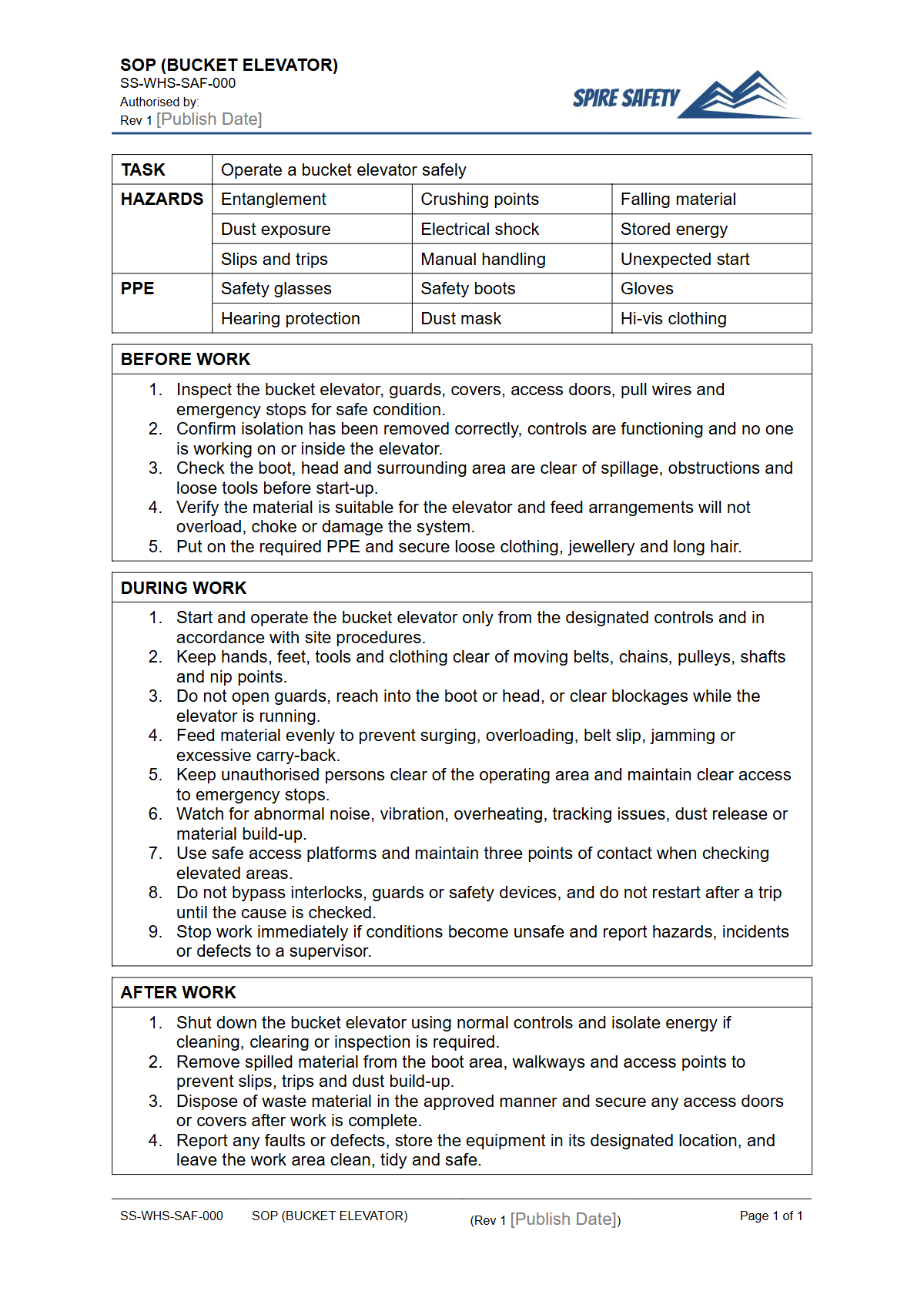
Download our free Safe Operating Procedure (Bucket Elevator) Template. This user-friendly DOCX and PDF document helps you outline safe work practices.
Free Safe Operating Procedure (Bucket Elevator) Template
DOCX • 126 KB + PDF
Updated Oct 2026
No signup required
Purpose of the Free Safe Operating Procedure (Bucket Elevator) Template
Operating heavy plant like a bucket elevator introduces significant workplace hazards. This Free Safe Operating Procedure (Bucket Elevator) Template provides a structured starting point for documenting the essential steps to perform tasks safely.
A well-drafted Safe Operating Procedure (SOP) is a key administrative control measure that helps your organisation manage risks associated with entanglement in moving parts, falls from height during maintenance, engulfment, and atmospheric hazards within confined spaces like pits and hoppers.
By clearly defining pre-operational checks, safe operational sequences, and shutdown procedures, this SOP helps standardise work methods and ensures all operators understand the expected safety standards. Integrating specific SOPs like this one is a fundamental part of developing robust and effective WHS management systems that protect workers and support your duty of care obligations.
Video walkthrough
How to use the Free Safe Operating Procedure (Bucket Elevator) Template
This document is provided as a downloadable DOCX file that you can easily edit and adapt. It is essential to methodically work through each section and populate it with information specific to your equipment, site, and materials being handled.
Generic procedures are insufficient; a risk assessment should inform the specific controls you document.
Important: This is a template only. We've provided a foundation aligned with Australian WHS principles, but you must customise it with your specific site details, machinery models, and operational procedures to ensure it is relevant and effective for your workplace.
Consultation with operators and maintenance personnel during this process is critical to ensure the procedure is practical and reflects how work is actually done.
Many workplaces use a range of specialised equipment, each requiring its own documented procedure. For example, in agricultural settings where bucket elevators are common, you may also need a specific Grain Drill SOP template to cover all high-risk tasks on site.
When to use a Safe Operating Procedure
A Safe Operating Procedure for a bucket elevator should be a living document, actively used in daily operations rather than just filed away. Its primary uses include:
- Worker Training: As a core training document for new operators and for refresher training for existing staff.
- Pre-Operational Checks: As a checklist for operators to follow before starting the equipment for each shift, ensuring safety-critical components are functional.
- Supervision: As a benchmark for supervisors to monitor performance and confirm that safe work practices are being followed consistently.
- Incident Investigation: To help determine if procedural deviations contributed to an incident or near-miss.
The effectiveness of your SOPs should also be reviewed periodically as part of your internal safety review process. This can be formalised through scheduled WHS compliance auditing to identify any gaps or opportunities for improvement.
Who should use it
Different personnel within an organisation will interact with this Safe Operating Procedure in various ways:
- PCBU / Management: The Person Conducting a Business or Undertaking uses the SOP as a tool to help meet their primary duty of care to provide and maintain a safe system of work.
- Supervisors: Use the SOP to train, instruct, and monitor operators, ensuring compliance with established safety protocols.
- Operators: Follow the step-by-step instructions for pre-start, operation, and shutdown to perform their work safely and efficiently.
- Maintenance Personnel: Refer to the isolation, lock-out/tag-out (LOTO), and servicing sections to ensure the equipment is de-energised and safe to work on.
In environments like mining or large-scale civil projects, operators often work with multiple types of machinery. Ensuring clear procedures are available for all equipment, such as a Dozer SOP template for earthmoving tasks, is crucial for maintaining a consistent safety culture.
You can browse our complete free WHS resources library for more templates to support your operations.
Common mistakes
Common mistakes to avoid
- Failing to implement and enforce lock-out/tag-out procedures during maintenance.
- Neglecting regular inspections of belts, buckets, and casings for wear and tear.
- Allowing untrained or unauthorised personnel to operate or access the equipment.
- Ignoring dust accumulation, which significantly increases the risk of fire and explosion.
Legal references
Legal considerations
The following legal requirements may be relevant to this type of work.
- Work Health and Safety Act (Harmonised) — Provides the primary duties for protecting workers and other people from work health and safety risks.
- Work Health and Safety Regulations (Harmonised) — Sets out requirements supporting the management of workplace hazards and risks.
The following codes may be relevant to this type of work.
- Managing WHS Risks Code of Practice — Provides practical guidance on identifying hazards, assessing risks and applying effective controls.
- Work Health and Safety Consultation, Cooperation and Coordination Code of Practice — Provides practical guidance on consulting workers and coordinating with other duty holders.
- Managing the Work Environment and Facilities Code of Practice — Provides practical guidance on safe work environments, workplace facilities and related controls.
Did you know
Dust Explosions
Fine dust from materials like grain, coal, or flour can become explosive when suspended in air, a major hazard associated with bucket elevators requiring strict dust control measures.
Ancient Origins
The concept of the bucket elevator dates back to ancient times, with early chain-and-bucket systems (Noria) used for irrigation and powered by animals or water wheels.
FAQ
Frequently asked questions
01What are the main hazards of operating a bucket elevator?
02How often should a Safe Operating Procedure for a bucket elevator be reviewed?
03Is specific training required to operate a bucket elevator?
04What personal protective equipment (PPE) is needed for bucket elevator operation?
Share this resource
Free Safe Operating Procedure (Bucket Elevator) Template
Browse Categories
How To Use It
- 1Download and open in Word or PDF.
- 2Replace the placeholders with your business details.
- 3Get it reviewed by a WHS specialist before rollout.
Need it customised?
Our WHS consultants can adapt this template to your site, run a gap analysis, or audit what you already have in place.
Book a Free Consultation WHS consulting servicesor call 1300 156 382
Related templates
- Free Safe Operating Procedure (Buffet Packdown) Template
- Free Safe Operating Procedure (Buffet Setup) Template
- Free Safe Operating Procedure (Buffing Machine) Template
- Free Safe Operating Procedure (Building Access Control) Template
- Free Safe Operating Procedure (Building Entry Clean) Template
- Free Safe Operating Procedure (Building Washdown) Template