
Free Safe Operating Procedure (Broaching Machine) Template
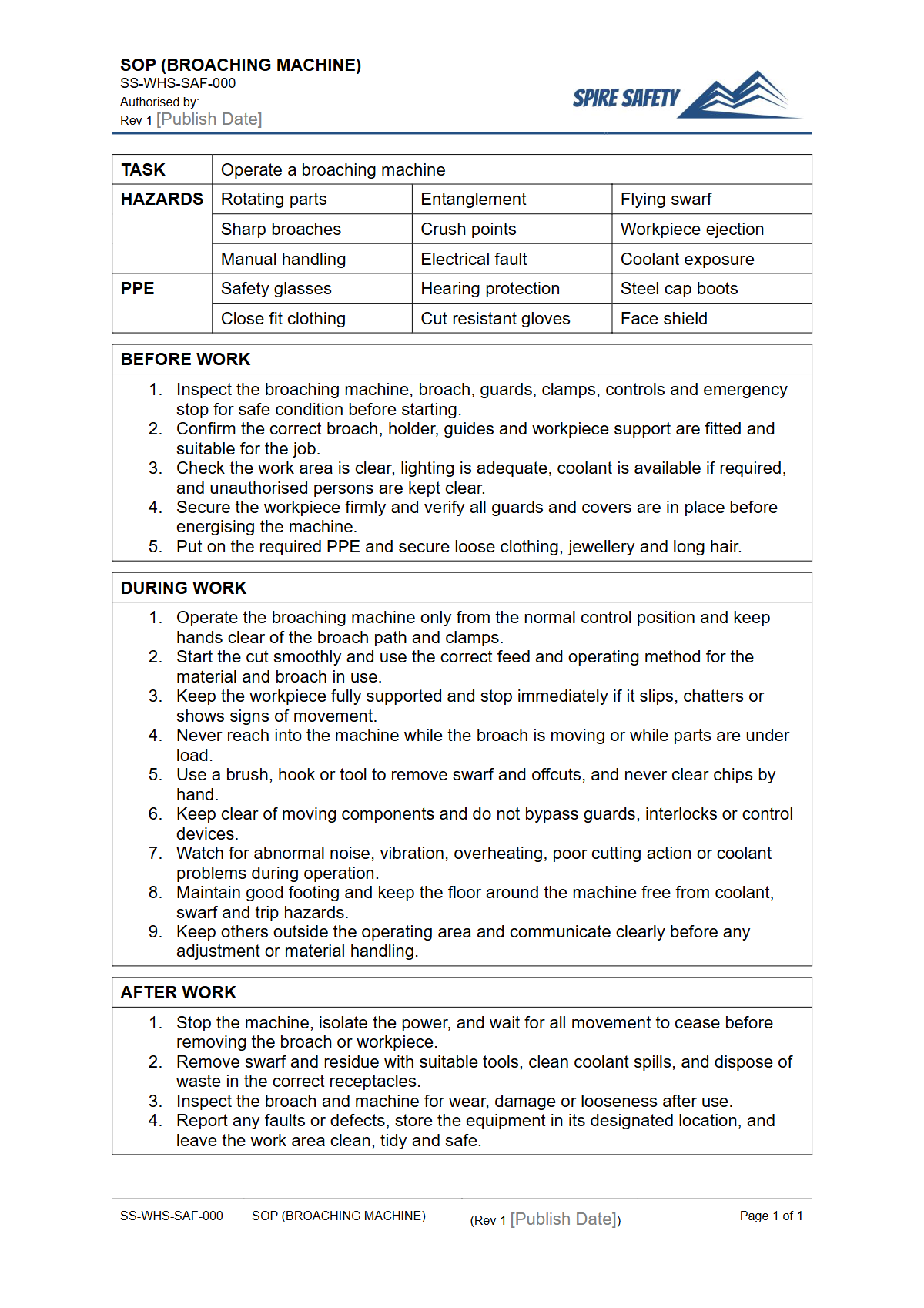
Download our free Safe Operating Procedure (Broaching Machine) template (DOCX & PDF).
Free Safe Operating Procedure (Broaching Machine) Template
DOCX • 126 KB + PDF
Updated Oct 2026
No signup required
Purpose of the Free Safe Operating Procedure (Broaching Machine) Template
Operating a broaching machine involves significant risks, including entanglement, severe cuts from the broach tool, and injuries from flying metal chips (swarf). This Free Safe Operating Procedure (Broaching Machine) Template provides a structured framework for documenting the essential steps to perform tasks safely.
A documented SOP is a cornerstone of a safe system of work, helping your organisation to standardise procedures, train workers effectively, and demonstrate due diligence in managing workplace hazards associated with industrial machinery.
By implementing a thorough SOP, you can minimise the risk of incidents, ensure operational consistency, and provide clear instructions for operators. This template is designed as a practical tool to help you meet your Work Health and Safety (WHS) obligations by formalising your risk management processes for this specific piece of plant.
It serves as an auditable record of the required safety measures for operating your broaching machine.
Video walkthrough
How to use the Free Safe Operating Procedure (Broaching Machine) Template
This template is provided in both DOCX and PDF formats for your convenience. We recommend downloading the DOCX version to edit and customise the document to suit your specific operational context.
A well-drafted SOP is not a generic document; it must reflect the reality of your workshop floor.
Important: This template is a comprehensive starting point, but it is not a finished document. We have drafted it to be broadly applicable, but you MUST customise it to reflect your specific broaching machine model (e.g., vertical, horizontal, continuous), the materials you process, your unique workplace environment, and any state or territory-specific regulations. You will need to consult with operators and supervisors to add site-specific details, including:
- The exact make and model of the broaching machine.
- Specific pre-start checks and lockout/tagout procedures.
- The types of Personal Protective Equipment (PPE) required (e.g., safety glasses, gloves, protective footwear).
- Step-by-step instructions for setting up, operating, and shutting down the machine.
- Procedures for clearing blockages and managing swarf.
- Emergency stop and first aid information.
Integrating this SOP into your broader WHS management systems ensures it is part of a holistic approach to safety, rather than a standalone document.
When to use a Broaching Machine SOP
A Safe Operating Procedure for a broaching machine should be a living document that is used consistently throughout the equipment's lifecycle. It is critical during the induction and training of new operators to ensure they learn the correct, safe method from day one.
It should also be used for regular refresher training for experienced personnel to prevent complacency and bad habits from developing.
The SOP should be readily available at or near the machine, serving as a quick-reference guide for operators before they begin a task. Furthermore, it is an essential document for review during incident investigations or after a near-miss, helping to identify whether the procedure was followed and if it needs revision.
This continual review process is vital for ongoing safety improvement and can be formalised through a periodic WHS compliance auditing schedule.
Who should use this SOP
This Safe Operating Procedure is intended for use by a range of personnel within an organisation. Machine operators are the primary users, as it guides their daily work practices and reinforces safety-critical behaviours.
Workshop supervisors and managers are responsible for ensuring the SOP is implemented, understood, and followed by their teams. They also play a key role in the review and customisation process.
WHS managers and safety officers will use this template to establish and maintain safety standards across the business. It forms a key part of the risk assessment and control documentation required by Australian WHS legislation.
The process of creating and reviewing SOPs for different equipment, including those covered by our free Plasma Cutter SOP template, helps embed a proactive safety culture throughout the organisation.
Key Elements of a Comprehensive Broaching Machine SOP
Your customised SOP should be clear, concise, and easy to follow. Key sections to develop include:
- Hazard Identification: List all potential hazards associated with the machine, such as cutting, crushing, entanglement, noise, and manual handling risks.
- Required PPE: Specify non-negotiable personal protective equipment.
- Pre-Operational Checks: Detail the daily checks required before the machine is energised, including verifying that guards are in place and emergency stops are functional. This is a common requirement across many machines, similar to procedures in our free Brake Press SOP.
- Operating Steps: A sequential list of actions for safely completing a broaching task, from securing the workpiece to initiating the cut and removing the finished part.
- Post-Operational Tasks: Instructions for powering down the machine, cleaning the work area, and performing any required end-of-shift maintenance.
- Emergency Procedures: Clear instructions on how to use the emergency stop, respond to a fire, or administer first aid in case of injury.
By customising this template with these specific details, you create a powerful tool for preventing harm in your workplace. For additional guidance on documenting procedures for various types of equipment, you can explore our free WHS resources library.
Common mistakes
Common mistakes to avoid
- Using a generic SOP without customising it for the specific machine, material, and task.
- Failing to adequately train operators on the SOP's contents and emergency procedures.
- Not enforcing the use of specified Personal Protective Equipment (PPE) during operation.
- Neglecting to include procedures for safe maintenance, cleaning, and swarf removal.
Legal references
Legal considerations
The following legal requirements may be relevant to this type of work.
- Work Health and Safety Act (Harmonised) — Provides the primary duties for protecting workers and other people from work health and safety risks.
- Work Health and Safety Regulations (Harmonised) — Sets out requirements supporting the management of workplace hazards and risks.
The following codes may be relevant to this type of work.
- Managing WHS Risks Code of Practice — Provides practical guidance on identifying hazards, assessing risks and applying effective controls.
- Work Health and Safety Consultation, Cooperation and Coordination Code of Practice — Provides practical guidance on consulting workers and coordinating with other duty holders.
- Managing the Work Environment and Facilities Code of Practice — Provides practical guidance on safe work environments, workplace facilities and related controls.
Did you know
Broaching's Precision
Broaching is a machining process so precise it is often used to create internal keyways, splines, and other complex geometric shapes that are difficult or impossible to produce with other methods.
Swarf Danger
The sharp metal chips (swarf) produced during broaching can be ejected at high speed and may be extremely hot. Effective guarding, proper swarf management systems, and appropriate PPE are essential to manage this risk.
FAQ
Frequently asked questions
01Is a Safe Operating Procedure a legal requirement for broaching machines in Australia?
02What are the most common hazards of a broaching machine?
03How often should our Broaching Machine SOP be reviewed?
04Can I use this one template for all types of broaching machines?
Share this resource
Free Safe Operating Procedure (Broaching Machine) Template
Browse Categories
How To Use It
- 1Download and open in Word or PDF.
- 2Replace the placeholders with your business details.
- 3Get it reviewed by a WHS specialist before rollout.
Need it customised?
Our WHS consultants can adapt this template to your site, run a gap analysis, or audit what you already have in place.
Book a Free Consultation WHS consulting servicesor call 1300 156 382
Related templates
- Free Safe Operating Procedure (Brush Cutter Whipper Snipper Operation) Template
- Free Safe Operating Procedure (Brush Painting) Template
- Free Safe Operating Procedure (Bucket Elevator) Template
- Free Safe Operating Procedure (Buffet Packdown) Template
- Free Safe Operating Procedure (Buffet Setup) Template
- Free Safe Operating Procedure (Buffing Machine) Template