
Free Safe Operating Procedure (Brush Cutter Whipper Snipper Operation) Template
Download our free Safe Operating Procedure (SOP) template for Brush Cutter & Whipper Snipper Operation. Customise for your workplace to manage risks.
Free Safe Operating Procedure (Brush Cutter Whipper Snipper Operation) Template
DOCX • 168 KB + PDF
Updated Oct 2026
No signup required
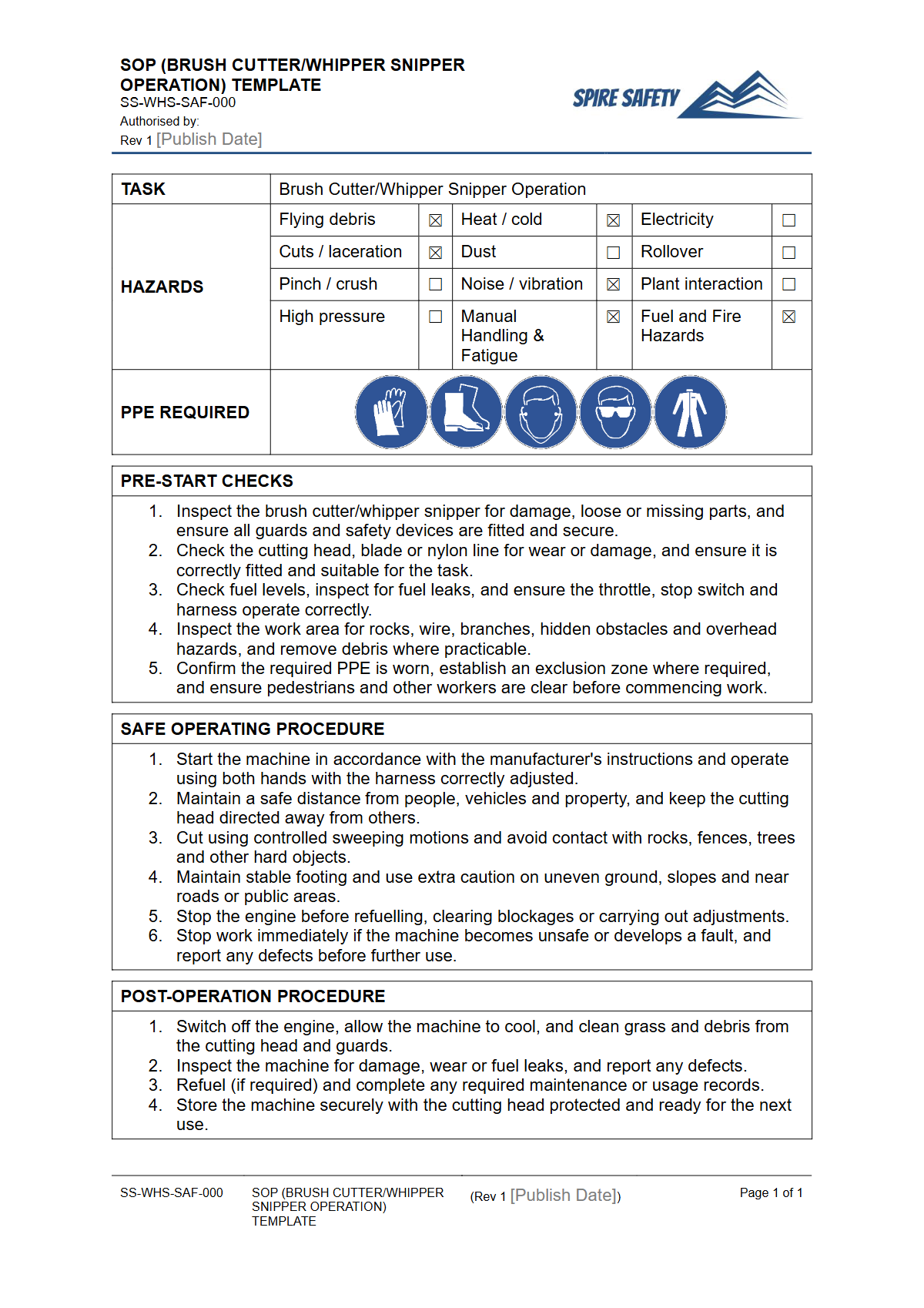
Purpose of the Free Safe Operating Procedure (Brush Cutter Whipper Snipper Operation) Template
Managing the risks associated with powerful landscaping equipment is a fundamental aspect of workplace safety. This free Safe Operating Procedure (Brush Cutter Whipper Snipper Operation) template provides a structured starting point for documenting the safe use of this common but hazardous tool.
Using a brush cutter or whipper snipper exposes operators to risks including flying debris, cuts and amputations, high noise levels, vibration, and ergonomic strain. A documented SOP is a critical administrative control to manage these hazards.
This template, available in both DOCX and PDF formats, helps your organisation formalise its processes and demonstrate a commitment to safety. It guides you in outlining pre-operational checks, step-by-step operating instructions, and post-operational procedures.
A well-developed SOP is an essential tool for worker training, competency assessments, and provides a clear standard for expected safe work behaviour. It forms a key part of your overall safety management system, helping you meet your duty of care under Australian WHS legislation.
Video walkthrough
How to use the Free Safe Operating Procedure (Brush Cutter Whipper Snipper Operation) Template
Using this template is straightforward. Simply download the editable DOCX file and adapt it to the specific context of your workplace.
While the document is designed to align with Australian WHS best practices, it is a template, not a finished document. It requires customisation to be effective and to properly manage the risks present in your specific environment.
Important: We have provided a comprehensive framework based on recognised safety principles. However, you must customise this template to reflect the specific equipment, environment, and procedures at your worksite.
This includes adding the make and model of your brush cutters, detailing hazards unique to your work areas (e.g., slopes, proximity to public, specific vegetation), and integrating your organisation's emergency response and first aid procedures. A generic procedure is not sufficient; it must be made site-specific to be a valid risk control measure.
When to use this Safe Operating Procedure
A Safe Operating Procedure for brush cutters and whipper snippers should be an active part of your safety management. It should be used before any worker is authorised to operate the equipment for the first time.
The SOP serves as a foundational document for hands-on training and competency verification, ensuring every operator understands the required safety controls and emergency actions.
It should also be revisited regularly for refresher training, especially for workers who use the equipment infrequently. Furthermore, the SOP must be reviewed and updated following any incident or near-miss, when new models of brush cutters are introduced, or when work conditions change significantly.
Similar to other powered landscaping tools, such as those covered in our free Edger SOP template, a formal procedure is vital for maintaining a safe system of work.
Who should use this Safe Operating Procedure
This SOP template is designed for anyone responsible for the safety of workers using brush cutters and whipper snippers. This includes Persons Conducting a Business or Undertaking (PCBUs), WHS Managers, Safety Officers, Team Leaders, and Supervisors across various industries such as landscaping, grounds maintenance, horticulture, agriculture, and local government.
It is a practical tool for those tasked with developing and implementing safety documentation.
Frontline supervisors will find it invaluable for conducting pre-start briefs and for reinforcing safe work standards on the job. Integrating this SOP into your broader safety framework is a key step.
A robust system ensures all procedures are managed, reviewed, and improved over time, which is a core component of our WHS management systems services.
For larger-scale grounds maintenance, your safety systems might also need to cover heavy machinery. Effective risk management involves documenting procedures for all high-risk plant, from handheld tools to larger equipment like that described in the Front End Loader SOP.
If you need assistance in tailoring this document or embedding it within your existing safety protocols, professional guidance can help ensure its effectiveness. Our team provides expert WHS consulting to help businesses of all sizes strengthen their safety practices.
Explore this and other resources in our free WHS resources library to build a safer workplace.
Common mistakes
Common mistakes to avoid
- Using the machine without the manufacturer-supplied guard in place.
- Failing to wear appropriate PPE, particularly AS/NZS-compliant eye protection and sturdy leg protection.
- Operating the tool too close to other people, vehicles, or brittle objects like windows.
- Using an incorrect cutting head (e.g., a metal blade on a machine designed only for nylon line) or a damaged head.
Legal references
Legal considerations
The following legal requirements may be relevant to this type of work.
- Work Health and Safety Act (Harmonised) — Provides the primary duties for protecting workers and other people from work health and safety risks.
- Work Health and Safety Regulations (Harmonised) — Sets out requirements supporting the management of workplace hazards and risks.
The following codes may be relevant to this type of work.
- Managing WHS Risks Code of Practice — Provides practical guidance on identifying hazards, assessing risks and applying effective controls.
- Work Health and Safety Consultation, Cooperation and Coordination Code of Practice — Provides practical guidance on consulting workers and coordinating with other duty holders.
- Managing the Work Environment and Facilities Code of Practice — Provides practical guidance on safe work environments, workplace facilities and related controls.
Did you know
Vibration Exposure
Prolonged use of high-vibration tools like brush cutters can lead to Hand-Arm Vibration Syndrome (HAVS), a permanent and debilitating condition. SOPs should include controls like work rotation and regular breaks.
Flying Object Speed
The tip of a whipper snipper line can travel at over 300 km/h. This immense speed is why robust guarding, correct PPE (especially eye protection), and strict exclusion zones are non-negotiable safety requirements.
FAQ
Frequently asked questions
01What should be included in a brush cutter SOP?
02Is a Safe Operating Procedure a legal requirement in Australia for using a whipper snipper?
03Who is responsible for developing a Safe Operating Procedure for a brush cutter?
04How often should a brush cutter SOP be reviewed?
Share this resource
Free Safe Operating Procedure (Brush Cutter Whipper Snipper Operation) Template
Browse Categories
How To Use It
- 1Download and open in Word or PDF.
- 2Replace the placeholders with your business details.
- 3Get it reviewed by a WHS specialist before rollout.
Need it customised?
Our WHS consultants can adapt this template to your site, run a gap analysis, or audit what you already have in place.
Book a Free Consultation WHS consulting servicesor call 1300 156 382
Related templates
- Free Safe Operating Procedure (Brush Painting) Template
- Free Safe Operating Procedure (Bucket Elevator) Template
- Free Safe Operating Procedure (Buffet Packdown) Template
- Free Safe Operating Procedure (Buffet Setup) Template
- Free Safe Operating Procedure (Buffing Machine) Template
- Free Safe Operating Procedure (Building Access Control) Template