
Free Safe Operating Procedure (Brazing Torch) Template
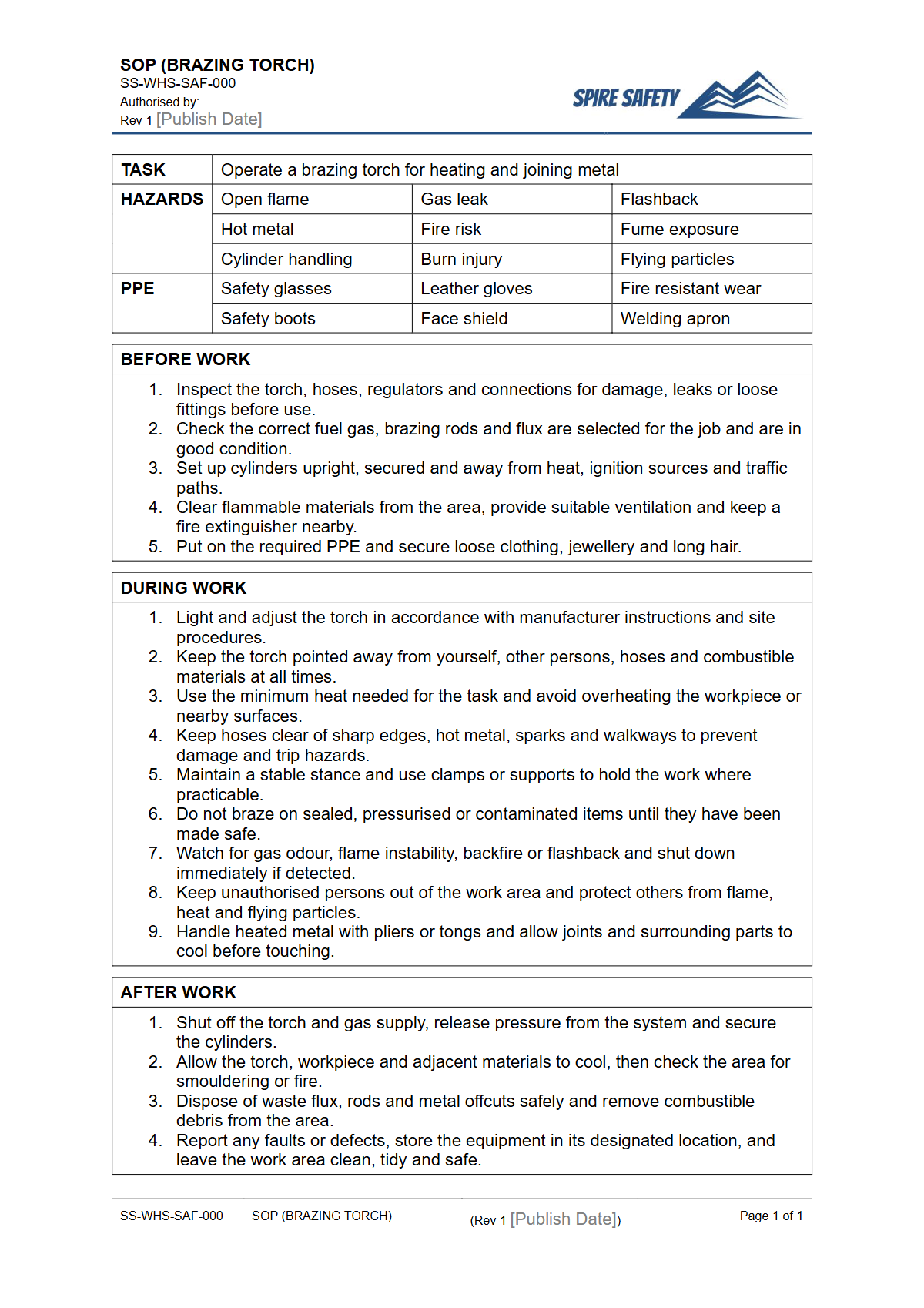
Download our Free Safe Operating Procedure (Brazing Torch) Template. This document provides a structured starting point for creating a task-specific SOP.
Free Safe Operating Procedure (Brazing Torch) Template
DOCX • 126 KB + PDF
Updated Oct 2026
No signup required
Purpose of the Free Safe Operating Procedure (Brazing Torch) Template
A Safe Operating Procedure (SOP) is a fundamental document for managing workplace health and safety. This Free Safe Operating Procedure (Brazing Torch) Template provides a structured framework to formalise the process of using brazing equipment safely.
Its primary purpose is to provide clear, step-by-step instructions that minimise the risk of injury or incident. By documenting the procedure, you create a consistent and repeatable standard for all workers to follow.
This helps control significant hazards associated with brazing, including intense heat, open flames, fire, exposure to fumes, and risks from compressed gas cylinders.
Using an SOP ensures that all personnel are aware of the required precautions, personal protective equipment (PPE), and emergency responses. It serves as a critical training tool and a reference point for competent operators, helping your organisation meet its duty of care under Australian WHS legislation.
Formalising your process moves beyond verbal instructions, creating a reliable system that supports a positive safety culture.
Video walkthrough
How to use the Free Safe Operating Procedure (Brazing Torch) Template
This resource is available for download in both DOCX and PDF formats. The DOCX file is fully editable, allowing for complete customisation to your specific operational needs.
To effectively use this template, you must adapt it to reflect the unique environment of your workplace. This involves a detailed review and inclusion of site-specific information.
Important: This is a template, not a finished document. To make it effective, we recommend you consult with the workers who will be performing the task. You must add details such as:
- Specific make and model of the brazing torch and gas cylinders used.
- The types of materials being worked on.
- Your worksite's specific PPE requirements (e.g., flame-retardant clothing, specific glove types, welding goggles with correct shade rating).
- Site-specific emergency procedures, including locations of fire extinguishers, emergency stops, and first aid stations.
- Names or roles of authorised and competent persons.
Integrating this SOP into your broader safety framework is crucial. A well-developed SOP is a key component of effective WHS management systems, demonstrating a systematic approach to risk control.
When to use it
A brazing torch SOP should be a living document used consistently throughout your operations. It is essential during the induction and training of new workers, providing the foundational knowledge needed to operate the equipment safely.
It should also be used for refresher training to ensure established procedures are maintained over time. Competent operators can use it as a quick reference to confirm steps, especially for non-routine tasks or after a period of absence.
The document is also a critical tool during safety inspections and reviews. When preparing for safety assessments or formal audits, the SOP serves as evidence of your risk management processes.
Regular reviews of the SOP are triggered by incidents, near misses, changes in equipment or process, or on a scheduled basis (e.g., annually) as part of a WHS compliance auditing program.
Who should use the Free Safe Operating Procedure (Brazing Torch) Template
This template is designed for use by anyone responsible for safety management in workplaces where brazing occurs. This includes WHS Managers, Safety Officers, Site Supervisors, and Team Leaders.
Business owners in sectors such as plumbing, HVAC installation and repair, metal fabrication, automotive workshops, and general manufacturing will find it an essential starting point for documenting their processes. It helps translate manufacturers' instructions and safety data sheets into practical, actionable steps for the workshop floor.
It is also a valuable resource for maintenance teams and trainers who need to deliver consistent and accurate safety information. By customising this document, you can create a procedure that is directly relevant to your specific hot work tasks, similar to how one might develop a free Plasma Cutter SOP template for other thermal cutting processes.
Key Information for Your Brazing SOP
Your customised SOP should clearly outline the entire workflow, broken down into logical phases. This ensures nothing is missed and all risks are considered.
- Pre-operational Checks: This section is critical for preventing equipment failure. It should mandate checks for damaged hoses, cracked fittings, and faulty regulators. Operators must verify gas cylinder pressures, ensure cylinders are secured upright, and confirm the work area is clear of flammable or combustible materials like oily rags, timber, and solvents. It is also the step where the presence and serviceability of an appropriate fire extinguisher (e.g., Dry Powder ABE) is confirmed. Similar to an Air Compressor SOP template, these checks focus on the integrity of pressurised systems.
- Operating Sequence: Detail the correct, safe sequence for starting up, using, and shutting down the equipment. This includes steps for opening cylinder valves slowly, leak-testing connections with soapy water, purging lines, and using a striker to ignite the torch. It should also specify techniques for applying heat and filler material safely, as well as maintaining a safe distance from the flame and hot workpiece.
- Post-operational Tasks: Define the procedure for making the area safe after the work is complete. This involves closing the cylinder valves first, then bleeding the gas from the hoses and torch before storing them correctly. A crucial step often overlooked is the requirement for a 'fire watch'—monitoring the work area for at least 30-60 minutes post-operation to ensure no smouldering embers develop into a fire. Proper storage, much like what's outlined in a step ladder SOP, prevents equipment from becoming a hazard when not in use.
By thoroughly documenting these stages, you create a comprehensive guide that supports worker safety from start to finish. For more templates and safety documents, browse our complete free WHS resources library.
Common mistakes
Common mistakes to avoid
- Failing to clear the immediate work area of all combustible and flammable materials.
- Not performing a leak test with soapy water on all connections after changing a gas cylinder.
- Using brazing equipment in a poorly ventilated space, leading to the inhalation of hazardous fumes.
- Leaving gas cylinders unsecured in an upright position or storing them improperly (e.g., lying down).
Legal references
Legal considerations
The following legal requirements may be relevant to this type of work.
- Work Health and Safety Act (Harmonised) — Provides the primary duties for protecting workers and other people from work health and safety risks.
- Work Health and Safety Regulations (Harmonised) — Sets out requirements supporting the management of workplace hazards and risks.
The following codes may be relevant to this type of work.
- Managing WHS Risks Code of Practice — Provides practical guidance on identifying hazards, assessing risks and applying effective controls.
- Work Health and Safety Consultation, Cooperation and Coordination Code of Practice — Provides practical guidance on consulting workers and coordinating with other duty holders.
- Managing the Work Environment and Facilities Code of Practice — Provides practical guidance on safe work environments, workplace facilities and related controls.
Did you know
Fire Watch Requirement
After hot work like brazing, Australian standards often recommend a 'fire watch' for 30 to 60 minutes. This involves monitoring the area to ensure smouldering embers or residual heat don't ignite a delayed fire.
Gas Cylinder Pressure
The gas in a brazing torch cylinder, such as propane or MAPP, is stored as a liquid under high pressure. If a cylinder is damaged or heated, it can rupture with explosive force, making proper handling and storage critical.
FAQ
Frequently asked questions
01What's the difference between a Safe Operating Procedure (SOP) and a Safe Work Method Statement (SWMS) for brazing?
02Is this brazing SOP template suitable for oxy-acetylene equipment?
03How often should a brazing torch SOP be reviewed?
04Who needs to be trained on the brazing SOP?
Share this resource
Free Safe Operating Procedure (Brazing Torch) Template
Browse Categories
How To Use It
- 1Download and open in Word or PDF.
- 2Replace the placeholders with your business details.
- 3Get it reviewed by a WHS specialist before rollout.
Need it customised?
Our WHS consultants can adapt this template to your site, run a gap analysis, or audit what you already have in place.
Book a Free Consultation WHS consulting servicesor call 1300 156 382
Related templates
- Free Safe Operating Procedure (Bread Slicer) Template
- Free Safe Operating Procedure (Brick Saw) Template
- Free Safe Operating Procedure (Brick Splitter) Template
- Free Safe Operating Procedure (Broaching Machine) Template
- Free Safe Operating Procedure (Brush Cutter Whipper Snipper Operation) Template
- Free Safe Operating Procedure (Brush Painting) Template