
Free Safe Operating Procedure (Bread Slicer) Template
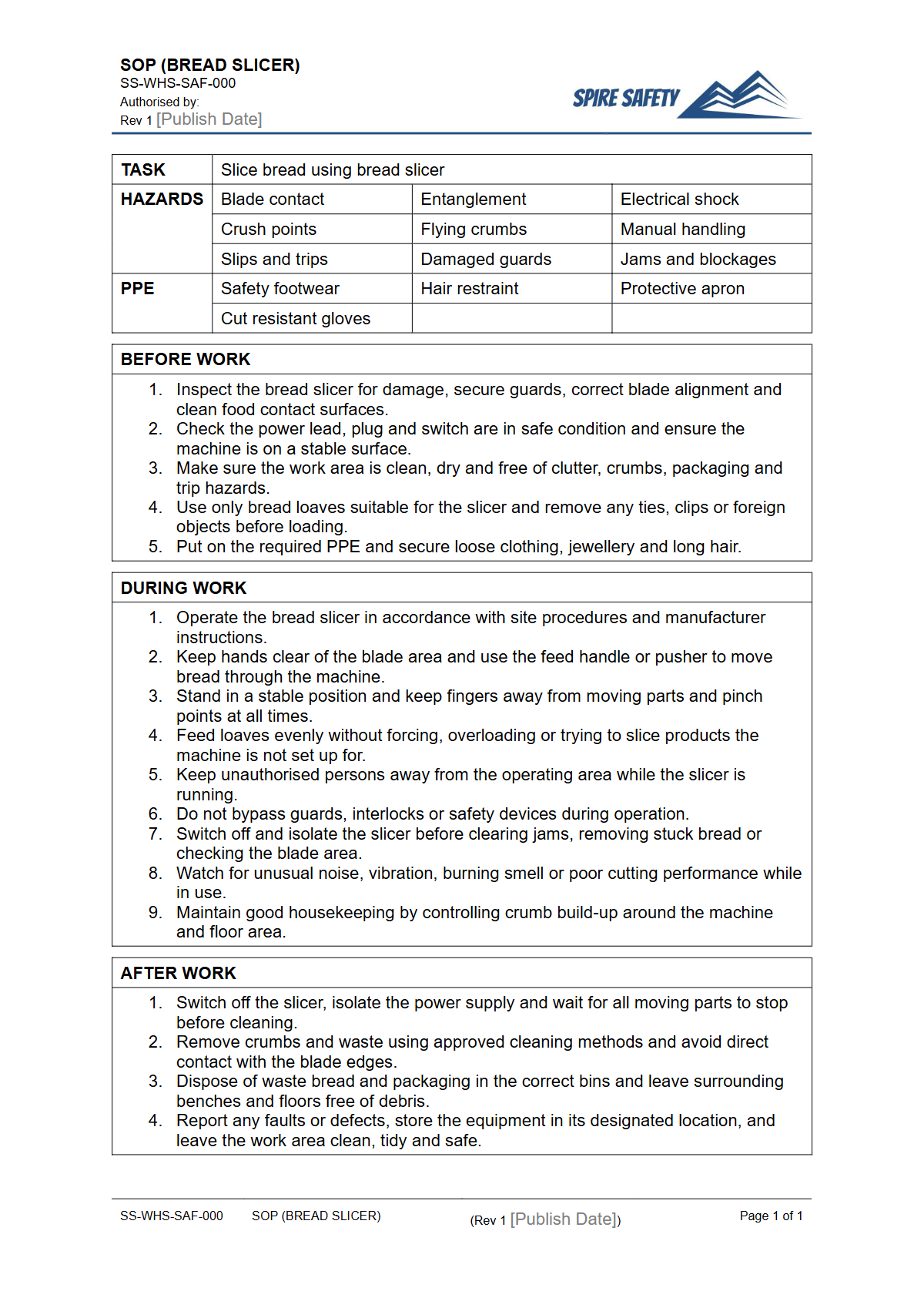
Download our free Safe Operating Procedure (Bread Slicer) template. This customisable DOCX & PDF resource helps outline safe work steps for bakery staff.
Free Safe Operating Procedure (Bread Slicer) Template
DOCX • 126 KB + PDF
Updated Oct 2026
No signup required
Purpose of the Free Safe Operating Procedure (Bread Slicer) Template
Operating a commercial bread slicer presents significant risks, including severe cuts, entanglement, and electrical hazards. This Free Safe Operating Procedure (Bread Slicer) Template provides a structured framework for documenting the step-by-step process required to use this equipment safely.
A Safe Operating Procedure (SOP), also known as a Safe Work Procedure (SWP), is a critical administrative control measure that helps your business meet its duty of care under Australian WHS legislation. It details the identified hazards and the control measures necessary to minimise the risk of injury to workers.
By implementing a clear, written procedure, you ensure that all operators receive consistent instructions on how to handle the machine, from pre-start checks to cleaning and shutdown. A well-developed SOP is a cornerstone of effective WHS management systems, demonstrating a commitment to proactive risk control rather than reactive incident management.
It forms an essential part of your training program and helps foster a positive safety culture within your organisation.
Video walkthrough
How to use the Free Safe Operating Procedure (Bread Slicer) Template
This template is designed for ease of use. Simply download the document in your preferred format (DOCX for easy editing or PDF) and fill in the sections.
It guides you through documenting required personal protective equipment (PPE), pre-operational safety checks, step-by-step operating instructions, and procedures for cleaning, maintenance, and emergencies. The structure is based on established Australian WHS practices and is intended to be a robust starting point.
Important: This is a template only. We cannot guarantee it will be suitable for your specific circumstances.
You must customise this Safe Operating Procedure to reflect the make and model of the bread slicer at your workplace, your site-specific risks, and your internal safety procedures. We strongly recommend that a competent person drafts, reviews, and approves the final document in consultation with the workers who operate the equipment.
While this template provides a solid foundation, similar principles apply when documenting procedures for other cutting equipment, as seen in our FREE Plasma Cutter SOP (Safe Operating Procedure) Template. Consulting the manufacturer’s operating manual is also a critical step in developing a comprehensive and effective SOP.
When to use a Safe Operating Procedure
A Safe Operating Procedure for a bread slicer should be used consistently in several key situations. It is a primary training document for new employees, apprentices, or any worker unfamiliar with the specific machine.
The SOP should be the basis for competency assessments before an operator is authorised to use the slicer unsupervised. It also serves as a valuable tool for conducting refresher training to prevent complacency and reinforce safe work habits.
The SOP should be readily accessible in the work area for quick reference. It is not a document to be filed away and forgotten.
Supervisors can use it to conduct informal observations and verify that correct procedures are being followed. Furthermore, it should be reviewed during incident investigations to determine if procedural gaps contributed to the event. It also serves as a critical piece of evidence during safety inspections or a WHS compliance audit.
Who should use it
This procedure is intended for anyone who interacts with the bread slicer. This includes, but is not limited to:
- Bakery and kitchen staff
- Apprentices and trainees
- Supervisors and team leaders responsible for overseeing operations
- Maintenance personnel performing servicing or repairs
- WHS managers and officers responsible for developing and implementing safety systems
Essentially, any person whose role requires them to operate, clean, maintain, or supervise the use of a bread slicer must be trained on and adhere to the site-specific SOP. Procedures for using other types of powered cutting tools will share some principles, such as pre-start checks, but will have unique hazards, as detailed in our FREE Circular Saw SOP (Safe Operating Procedure) Template.
Integrating the SOP into your workflow
To be effective, the SOP must be a living document that is embedded in your daily operations. Use it as a checklist for training and a guide for workplace inspections.
Regularly ask for feedback from operators on whether the procedure is practical and clear. For tasks that require accessing higher areas for maintenance, a separate procedure like our FREE Step Ladder SOP Template should be developed and referenced.
By integrating the SOP fully, you move beyond a simple compliance exercise and create a genuinely safer work environment. For more guidance, you can explore our entire free WHS resources library for more templates and guides.
Common mistakes
Common mistakes to avoid
- Failing to disconnect the power source and use a lockout/tagout procedure before cleaning or clearing a jam.
- Using a generic template without customising it for the specific machine, tasks, and hazards in the workplace.
- Not providing adequate hands-on training and competency assessment based on the finalised SOP.
- Neglecting to review and update the SOP after an incident, equipment change, or legislative update.
Legal references
Legal considerations
The following legal requirements may be relevant to this type of work.
- Work Health and Safety Act (Harmonised) — Provides the primary duties for protecting workers and other people from work health and safety risks.
- Work Health and Safety Regulations (Harmonised) — Sets out requirements supporting the management of workplace hazards and risks.
The following codes may be relevant to this type of work.
- Managing WHS Risks Code of Practice — Provides practical guidance on identifying hazards, assessing risks and applying effective controls.
- Work Health and Safety Consultation, Cooperation and Coordination Code of Practice — Provides practical guidance on consulting workers and coordinating with other duty holders.
- Managing the Work Environment and Facilities Code of Practice — Provides practical guidance on safe work environments, workplace facilities and related controls.
Did you know
Blade Guard Dangers
A significant number of bread slicer injuries occur during cleaning tasks or when safety guards have been deliberately bypassed or removed. Always ensure all guards are secured and functioning correctly before operation.
Lockout/Tagout is Non-Negotiable
Before any cleaning or maintenance, a formal Lockout/Tagout (LOTO) procedure is crucial. This ensures the slicer is de-energised and cannot be accidentally restarted, preventing catastrophic injuries.
FAQ
Frequently asked questions
01Is a Safe Operating Procedure a legal requirement for a bread slicer in Australia?
02What are the main hazards of a commercial bread slicer?
03How often should a bread slicer SOP be reviewed?
04Who can write a Safe Operating Procedure?
Share this resource
Free Safe Operating Procedure (Bread Slicer) Template
Browse Categories
How To Use It
- 1Download and open in Word or PDF.
- 2Replace the placeholders with your business details.
- 3Get it reviewed by a WHS specialist before rollout.
Need it customised?
Our WHS consultants can adapt this template to your site, run a gap analysis, or audit what you already have in place.
Book a Free Consultation WHS consulting servicesor call 1300 156 382
Related templates
- Free Safe Operating Procedure (Brick Saw) Template
- Free Safe Operating Procedure (Brick Splitter) Template
- Free Safe Operating Procedure (Broaching Machine) Template
- Free Safe Operating Procedure (Brush Cutter Whipper Snipper Operation) Template
- Free Safe Operating Procedure (Brush Painting) Template
- Free Safe Operating Procedure (Bucket Elevator) Template