
Free Safe Operating Procedure (Bowling Pin Handling) Template
Download our free Safe Operating Procedure (SOP) template for bowling pin handling. This customisable DOCX & PDF resource helps outline safe work methods.
Free Safe Operating Procedure (Bowling Pin Handling) Template
DOCX • 126 KB + PDF
Updated Oct 2026
No signup required
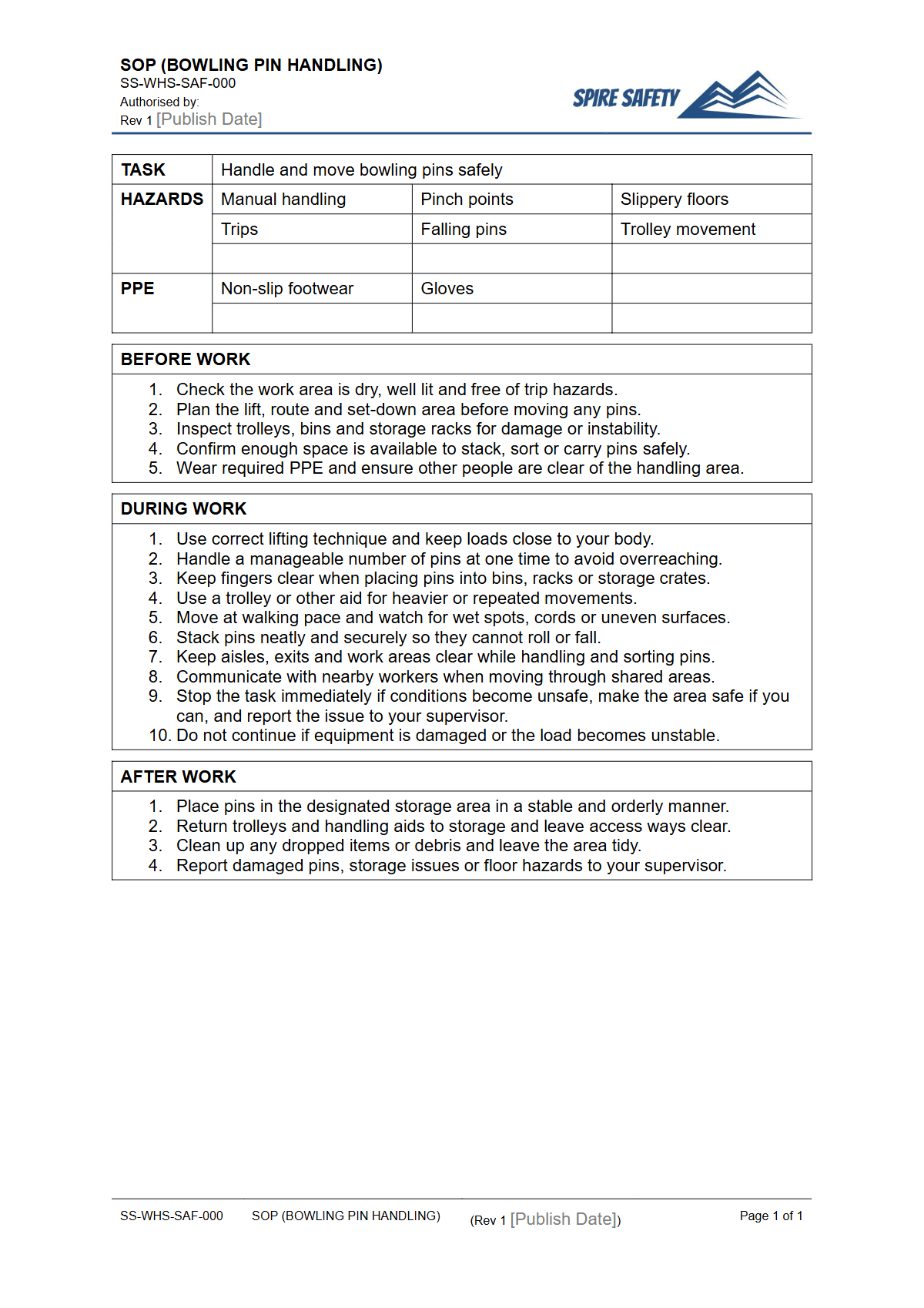
Purpose of the Free Safe Operating Procedure (Bowling Pin Handling) Template
This Free Safe Operating Procedure (Bowling Pin Handling) Template provides a structured framework for documenting the safe methods required to handle bowling pins manually. While seemingly a simple task, handling pins—whether clearing jams in a pinsetter, restocking, or moving them in bulk—involves recognised WHS hazards.
The primary risks include musculoskeletal injuries from repetitive lifting, awkward postures, bending, and reaching. This SOP template is designed to help you systematically identify these hazards and document the essential control measures to mitigate them.
A documented Safe Operating Procedure (SOP) is a fundamental tool for worker training, ensuring everyone performs the task consistently and safely. It serves as a practical expression of your commitment to a safe work environment and is a key document within effective WHS management systems. By clearly outlining the steps for pre-operational checks, safe operation, and post-task clean-up, this procedure helps reduce the likelihood of injury and supports compliance with Australian WHS regulations concerning hazardous manual tasks.
Video walkthrough
How to use the Free Safe Operating Procedure (Bowling Pin Handling) Template
To effectively implement this SOP, download the template in your preferred format (DOCX for easy editing or PDF). The next step is customisation, which is critical for the document's effectiveness.
You must adapt the content to your specific workplace, including the make and model of your pinsetters, the layout of the lanes and service areas, and any personal protective equipment (PPE) required.
Consultation is a mandatory part of this process. Involve your lane mechanics, technicians, and other workers who regularly handle pins.
Their direct experience is invaluable for identifying the real-world risks and practical control measures. Once customised and validated, the final SOP should be used as a primary tool for training new employees and conducting refresher courses for existing staff.
The finalised document should be signed off by a supervisor. Regular reviews are also crucial, which can be formalised through periodic WHS compliance auditing.
Important: This document is a template and must be customised to your specific workplace. We are not liable for any incidents that may occur from the use of this document.
It is the responsibility of the Person Conducting a Business or Undertaking (PCBU) to ensure it is tailored to the site-specific risks and control measures.
When to use this Safe Operating Procedure
A Safe Operating Procedure for bowling pin handling should be an integral part of your daily operations. It must be used to train any worker before they are assigned tasks involving the manual handling of pins.
This includes, but is not limited to, clearing common pin jams, performing routine cleaning of pinsetter machinery, or transporting boxes of new or used pins.
The SOP should also be referenced during refresher training sessions to reinforce safe work habits and ensure long-term adherence. Furthermore, it is a critical document to review and consult following any incident or near-miss related to pin handling.
This ensures that any new hazards or procedural gaps identified during an investigation are incorporated into the SOP to prevent recurrence. Many facilities find that tasks like cleaning also involve other equipment, so it's wise to have procedures for all tools, such as an SOP for air compressors if they are used for blowing out dust.
Who should use this Safe Operating Procedure
This SOP is intended for use by several groups within a bowling centre or related facility. Managers and supervisors are responsible for implementing the procedure, ensuring workers are trained in its contents, and monitoring compliance on the floor.
They use the SOP as a benchmark for safe performance and a tool for workplace inspections.
The primary users, however, are the workers themselves. Lane mechanics, pin chasers, and maintenance staff must understand and follow the steps outlined in the procedure every time they handle pins.
Following the SOP protects their own health and safety and that of their colleagues. For any task involving working at height, even on a small platform, a safe procedure for step ladder use is equally important.
Finally, WHS representatives and committee members will use this document to verify that adequate risk controls are in place for manual tasks.
This template is one of many documents available to help you build a safer workplace. You can browse our complete free WHS resources library for more templates, checklists, and guides.
Common mistakes
Common mistakes to avoid
- Using a generic template without customising it for the specific workplace layout and pinsetter model.
- Failing to consult with mechanics and lane staff who actually perform the task when drafting the procedure.
- Not providing practical training on the SOP, assuming that just reading the document is enough.
- Forgetting to review and update the SOP after a pinsetter is upgraded or the work process changes.
Legal references
Legal considerations
The following legal requirements may be relevant to this type of work.
- Work Health and Safety Act (Harmonised) — Provides the primary duties for protecting workers and other people from work health and safety risks.
- Work Health and Safety Regulations (Harmonised) — Sets out requirements supporting the management of workplace hazards and risks.
The following codes may be relevant to this type of work.
- Managing WHS Risks Code of Practice — Provides practical guidance on identifying hazards, assessing risks and applying effective controls.
- Work Health and Safety Consultation, Cooperation and Coordination Code of Practice — Provides practical guidance on consulting workers and coordinating with other duty holders.
- Managing the Work Environment and Facilities Code of Practice — Provides practical guidance on safe work environments, workplace facilities and related controls.
Did you know
Pin Weight
A standard ten-pin bowling pin weighs between 1.53 kg and 1.64 kg. While this seems light, handling them in bulk or in awkward postures is a recognised ergonomic hazard.
Ergonomic Risk
Musculoskeletal disorders from hazardous manual tasks are the most common type of workplace injury in Australia, highlighting the importance of procedures for even seemingly simple tasks.
FAQ
Frequently asked questions
01What is a Safe Operating Procedure (SOP) for bowling pin handling?
02Are bowling pins a manual handling risk?
03Who is responsible for creating a Bowling Pin Handling SOP?
04How often should I review my SOPs?
Share this resource
Free Safe Operating Procedure (Bowling Pin Handling) Template
Browse Categories
How To Use It
- 1Download and open in Word or PDF.
- 2Replace the placeholders with your business details.
- 3Get it reviewed by a WHS specialist before rollout.
Need it customised?
Our WHS consultants can adapt this template to your site, run a gap analysis, or audit what you already have in place.
Book a Free Consultation WHS consulting servicesor call 1300 156 382
Related templates
- Free Safe Operating Procedure (Brake Bleeder) Template
- Free Safe Operating Procedure (Brake Disc Replacement) Template
- Free Safe Operating Procedure (Brake Drum Removal) Template
- Free Safe Operating Procedure (Brake Fluid Change) Template
- Free Safe Operating Procedure (Brake Lathe) Template
- Free Safe Operating Procedure (Brake Pad Replacement) Template