
Free Safe Operating Procedure (Bottle Bin Handling) Template
Download our free Safe Operating Procedure (Bottle Bin Handling) template.
Free Safe Operating Procedure (Bottle Bin Handling) Template
DOCX • 126 KB + PDF
Updated Oct 2026
No signup required
Purpose of the Free Safe Operating Procedure (Bottle Bin Handling) Template
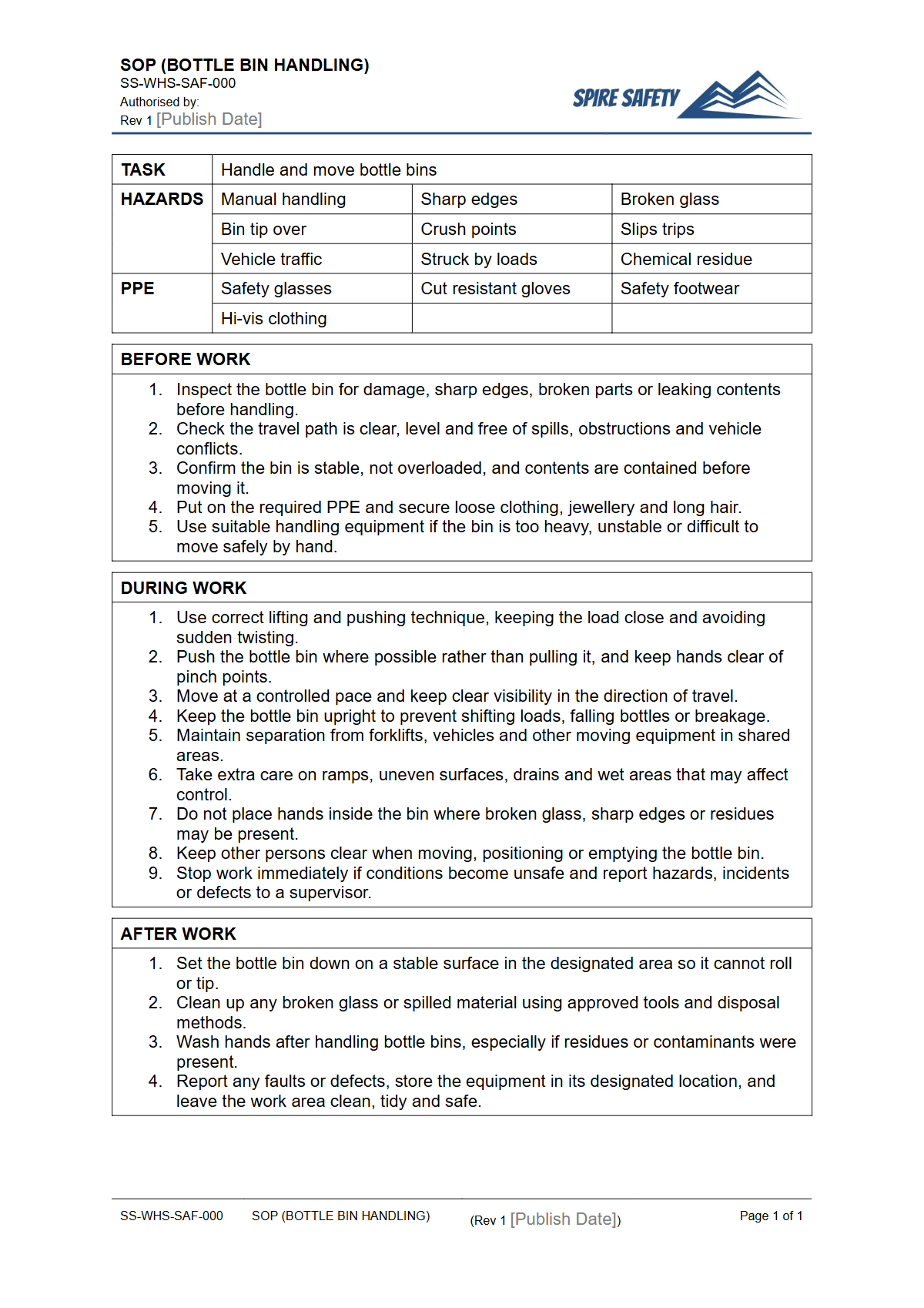
Effectively managing the risks associated with moving and emptying glass waste is crucial in hospitality and waste management. This Free Safe Operating Procedure (Bottle Bin Handling) Template provides a structured framework to help your organisation document the step-by-step process for handling bottle bins safely.
It's designed as a starting point, aligned with Australian WHS principles, to help you control hazards like manual handling, cuts, and noise.
The primary purpose of a Safe Operating Procedure (SOP) for bottle bin handling is to establish a clear, documented, and repeatable method for performing the task safely. It formalises the safest way to move, empty, and clean bottle bins, minimising the risk of injury to workers.
Key hazards addressed include musculoskeletal disorders (MSDs) from pushing, pulling, and lifting; lacerations from broken glass; hearing damage from excessive noise; and slips, trips, and falls from spills or poorly maintained equipment. By documenting these controls, you create a vital tool for worker training and supervision.
This document forms a critical component of wider comprehensive WHS management systems, demonstrating a commitment to proactive risk management.
Video walkthrough
How to use the Free Safe Operating Procedure (Bottle Bin Handling) Template
This template is provided in both DOCX and PDF formats for your convenience. To use it effectively, download the DOCX file and adapt it to the specific circumstances of your workplace.
This involves consulting with your workers and supervisors to detail the exact type of bins used, the travel paths, emptying procedures, and required Personal Protective Equipment (PPE).
Important: This is a template, not a finished document.
You must customise this Safe Operating Procedure to reflect the unique equipment, environment, and risks in your workplace. We are not liable for any incidents that may occur from the use of this template.
A generic procedure is not sufficient for compliance; it must be made site-specific. This may include adding details on using equipment to assist with the task, such as the controls outlined in our FREE Step Ladder SOP Template if workers need to access larger receptacles.
When to use this Safe Operating Procedure
An SOP for bottle bin handling should be used as a primary reference document for several key activities. It is essential during the induction and training of new employees who will be required to handle bottle bins.
It should also be used for refresher training for existing staff to reinforce safe work habits. The SOP serves as a benchmark for supervisors conducting routine observations or performance reviews related to the task.
Furthermore, it should be reviewed and referenced after any incident or near-miss involving bottle bins to identify any gaps in the procedure. For tasks involving vehicles, such as collecting bins from multiple sites, it should be integrated with other procedures, like those found in our FREE Body Truck SOP Template.
Who should use it
This template is designed for use by Persons Conducting a Business or Undertaking (PCBUs), WHS managers, supervisors, and team leaders. These individuals are responsible for developing, implementing, and reviewing workplace safety procedures.
They should lead the customisation process in consultation with the workers who actually perform the task. Workers should then use the finalised, site-specific SOP as their guide for correct procedure and as a tool for raising safety concerns.
For complex operational environments, engaging with specialist WHS consulting services can help ensure your procedures are robust and effectively integrated. In large-scale facilities where heavy machinery is used to move industrial-sized containers, you may also need to develop procedures for that equipment, such as our FREE Telehandler SOP Template.
Developing clear and specific SOPs is a fundamental part of managing workplace health and safety. This template provides a solid foundation for one specific task.
For more tools to support your safety systems, explore our complete free WHS resources library for a wide range of checklists, policies, and procedures.
Common mistakes
Common mistakes to avoid
- Overfilling bins, significantly increasing the force required to move them.
- Using poor manual handling techniques, such as twisting the back while pushing or pulling.
- Failing to wear appropriate PPE, especially puncture-resistant gloves and safety glasses.
- Neglecting to inspect bin wheels for damage or debris, leading to sudden stops and strains.
Legal references
Legal considerations
The following legal requirements may be relevant to this type of work.
- Work Health and Safety Act (Harmonised) — Provides the primary duties for protecting workers and other people from work health and safety risks.
- Work Health and Safety Regulations (Harmonised) — Sets out requirements supporting the management of workplace hazards and risks.
The following codes may be relevant to this type of work.
- Managing WHS Risks Code of Practice — Provides practical guidance on identifying hazards, assessing risks and applying effective controls.
- Work Health and Safety Consultation, Cooperation and Coordination Code of Practice — Provides practical guidance on consulting workers and coordinating with other duty holders.
- Managing the Work Environment and Facilities Code of Practice — Provides practical guidance on safe work environments, workplace facilities and related controls.
Did you know
Push vs. Pull
Pushing a heavy bin is generally safer for your back than pulling it. Pushing allows you to use your body weight and larger leg muscles, reducing the strain on your spine.
Glass Smash
The sound of a full bottle bin being emptied can exceed 100 decibels, similar to a chainsaw. Without proper hearing protection, repeated exposure can lead to permanent hearing damage.
FAQ
Frequently asked questions
01What are the main hazards of handling bottle bins?
02Who is responsible for creating a Safe Operating Procedure for bottle bins?
03How often should a Safe Operating Procedure for bottle bin handling be reviewed?
04Is a Safe Operating Procedure enough to manage bottle bin risks?
Share this resource
Free Safe Operating Procedure (Bottle Bin Handling) Template
Browse Categories
How To Use It
- 1Download and open in Word or PDF.
- 2Replace the placeholders with your business details.
- 3Get it reviewed by a WHS specialist before rollout.
Need it customised?
Our WHS consultants can adapt this template to your site, run a gap analysis, or audit what you already have in place.
Book a Free Consultation WHS consulting servicesor call 1300 156 382
Related templates
- Free Safe Operating Procedure (Bottle Crusher) Template
- Free Safe Operating Procedure (Bottle Jack) Template
- Free Safe Operating Procedure (Bottling Line) Template
- Free Safe Operating Procedure (Boundary Fence Check) Template
- Free Safe Operating Procedure (Bowling Green Care) Template
- Free Safe Operating Procedure (Bowling Lane Cleaning) Template