
Free Safe Operating Procedure (Bottle Crusher) Template
Download our free Safe Operating Procedure (Bottle Crusher) template. This customisable DOCX and PDF resource helps you outline safe work practices.
Free Safe Operating Procedure (Bottle Crusher) Template
DOCX • 126 KB + PDF
Updated Oct 2026
No signup required
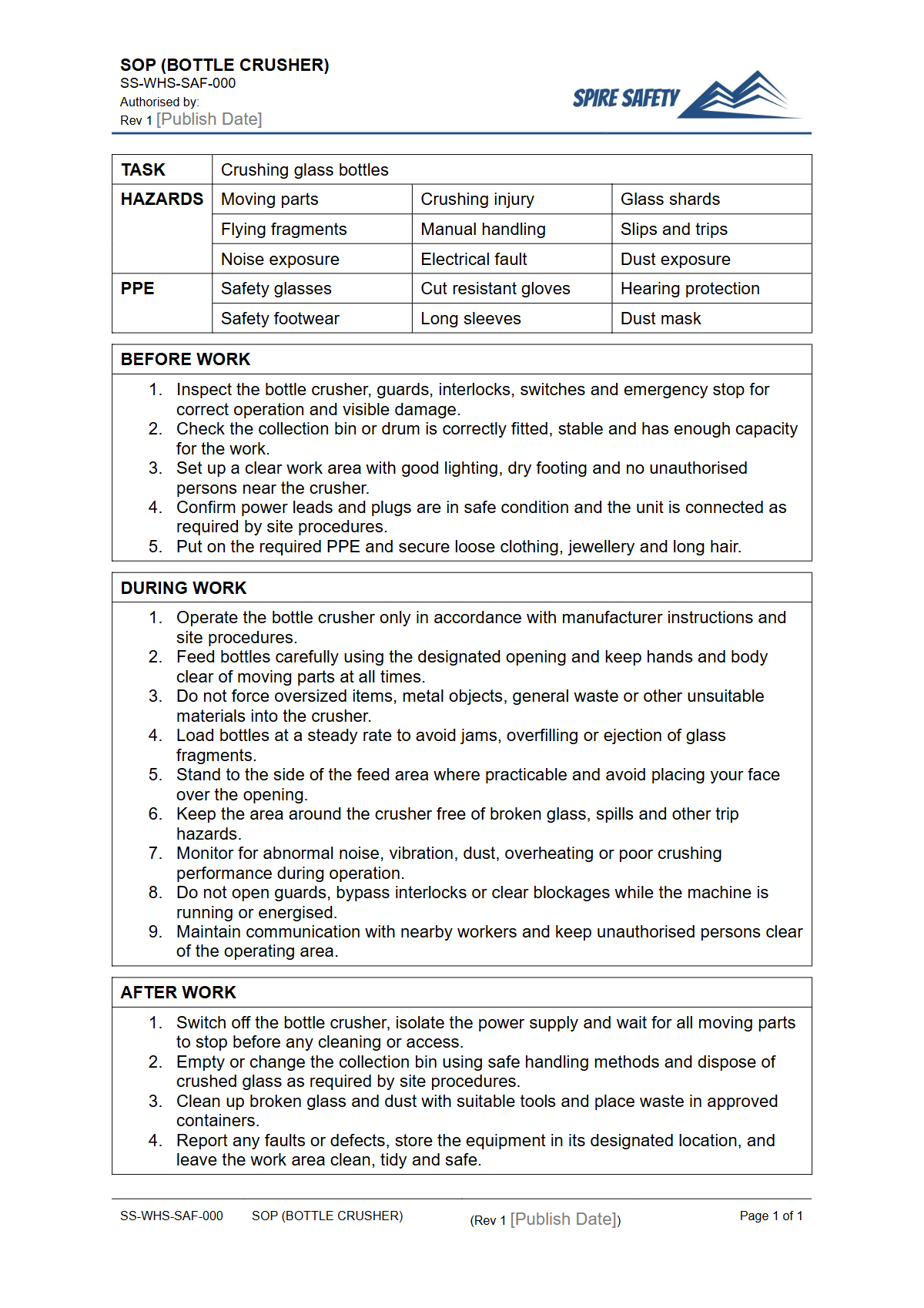
Purpose of the Free Safe Operating Procedure (Bottle Crusher) Template
This Free Safe Operating Procedure (Bottle Crusher) Template provides a structured framework for documenting the safe use of bottle crushing equipment in your workplace. A well-drafted SOP is a critical administrative control that formalises a safe system of work, helping to prevent injuries related to cuts, entanglement, hazardous manual tasks, and noise exposure.
It outlines the step-by-step process for pre-operational checks, operation, and shutdown, ensuring consistency and clarity for all operators. Implementing robust SOPs is a fundamental part of developing effective WHS management systems, as they provide clear instructions that support training, risk assessments, and incident investigations.
Video walkthrough
How to use the Free Safe Operating Procedure (Bottle Crusher) Template
Using this template is straightforward. First, download the file in your preferred format (DOCX for easy editing or PDF).
The next step is to conduct a thorough risk assessment of the specific bottle crusher and its environment at your site. You must then adapt the document to reflect your unique operational context, including the specific make and model of the equipment, workplace layout, required personal protective equipment (PPE), and emergency procedures.
Consultation is key; involve the workers who operate the machinery to ensure the procedure is practical and reflects how the work is actually done. Once finalised and approved, the SOP should be used as a primary training document for all new and existing operators.
Please note: This document is a template and a starting point. We have provided a structured guide, but you must customise it to reflect the specific equipment, processes, and risks present in your workplace.
It is not a complete solution and does not supports your compliance efforts on its own. If you require more tailored documentation, you can browse our complete free WHS resources library for other useful templates.
When to use a Bottle Crusher SOP
A Safe Operating Procedure for a bottle crusher should be in place before the equipment is first used. It serves as an essential tool in several situations.
It is the foundation for initial training when onboarding new employees or when an existing worker is assigned to operate the machine for the first time. It should also be used for regular refresher training to reinforce safe behaviours and correct any procedural drift.
Following an incident or a near-miss involving the bottle crusher, the SOP should be reviewed and updated to incorporate learnings and prevent recurrence. Finally, the procedure should be revisited and amended whenever there is a change in the equipment, the process, or the work environment.
Regular reviews are also a key activity during WHS compliance auditing to verify that documented procedures remain current and effective.
Who should use it
This Safe Operating Procedure is intended for use by multiple groups within an organisation. Persons Conducting a Business or Undertaking (PCBUs) and management are responsible for ensuring such procedures are developed, implemented, and maintained as part of their duty of care.
Supervisors and team leaders use the SOP to train, monitor, and guide workers, ensuring tasks are performed safely and consistently. Most importantly, operators of the bottle crusher must use the SOP as their primary guide for safe operation.
They should be thoroughly familiar with its contents and encouraged to provide feedback for continuous improvement. This collaborative approach ensures the SOP is a living document that genuinely contributes to a safer workplace, similar to how procedures for other common equipment like an Air Compressor SOP are used.
Key Hazards and Controls
Operating a bottle crusher introduces several significant hazards that must be managed with specific control measures. These should be detailed within your customised SOP.
Common Hazards
- Cuts and Lacerations: From handling bottles and contact with broken glass during loading, operation, or clearing blockages.
- Entanglement and Crushing: Contact with moving parts inside the machine, such as the crushing mechanism or conveyor belts.
- Hazardous Manual Tasks: Lifting heavy bags or bins of bottles, leading to musculoskeletal injuries.
- Noise: The crushing process can generate high noise levels, potentially causing hearing damage over time.
- Airborne Contaminants: Fine glass dust (crystalline silica) can be generated, posing a respiratory hazard if inhaled.
- Electrical Hazards: From faulty wiring or improper isolation during maintenance.
Essential Control Measures
- Guarding and Interlocks: Ensure all guards are in place and that safety interlocks (which stop the machine if a guard is opened) are functional.
- Personal Protective Equipment (PPE): Mandate the use of appropriate PPE, including cut-resistant gloves, safety glasses or a face shield, hearing protection, and respiratory protection if dust is a risk.
- Lockout-Tagout (LOTO): Implement and train workers on LOTO procedures for cleaning, maintenance, and clearing jams to ensure the machine is de-energised.
- Safe Loading Practices: Provide guidance on correct manual handling techniques. If workers must use platforms or ladders to load the machine, ensure they are trained on safe use, referencing documents like our free Step Ladder SOP Template.
- Waste Management: Establish clear procedures for handling and transporting the crushed glass (cullet), which may involve coordinating with waste collection services that use specific vehicles, a process which can also be managed with tools like a FREE Body Truck SOP Template.
Common mistakes
Common mistakes to avoid
- Using the generic template without customising it for the specific machine model and workplace.
- Failing to consult with equipment operators during the drafting and review process.
- Not providing practical training to workers on the contents of the finalised SOP.
- Neglecting to specify the correct type of PPE, particularly the standard for cut-resistant gloves and eye protection.
Legal references
Legal considerations
The following legal requirements may be relevant to this type of work.
- Work Health and Safety Act (Harmonised) — Provides the primary duties for protecting workers and other people from work health and safety risks.
- Work Health and Safety Regulations (Harmonised) — Sets out requirements supporting the management of workplace hazards and risks.
The following codes may be relevant to this type of work.
- Managing WHS Risks Code of Practice — Provides practical guidance on identifying hazards, assessing risks and applying effective controls.
- Work Health and Safety Consultation, Cooperation and Coordination Code of Practice — Provides practical guidance on consulting workers and coordinating with other duty holders.
- Managing the Work Environment and Facilities Code of Practice — Provides practical guidance on safe work environments, workplace facilities and related controls.
Did you know
Waste Reduction
Using a bottle crusher can reduce glass waste volume by as much as 80-90%. This drastically cuts down on waste storage space and the frequency and cost of disposal.
Noise Levels
Commercial bottle crushers can operate at noise levels exceeding 85 decibels (dBA), the exposure standard for noise in Australian workplaces. This makes correctly fitted hearing protection a critical piece of PPE for operators.
FAQ
Frequently asked questions
01What should be included in a bottle crusher SOP?
02Who is responsible for writing a Safe Operating Procedure?
03How often should an SOP be reviewed?
04Is an SOP the same as a Safe Work Method Statement (SWMS)?
Share this resource
Free Safe Operating Procedure (Bottle Crusher) Template
Browse Categories
How To Use It
- 1Download and open in Word or PDF.
- 2Replace the placeholders with your business details.
- 3Get it reviewed by a WHS specialist before rollout.
Need it customised?
Our WHS consultants can adapt this template to your site, run a gap analysis, or audit what you already have in place.
Book a Free Consultation WHS consulting servicesor call 1300 156 382
Related templates
- Free Safe Operating Procedure (Bottle Jack) Template
- Free Safe Operating Procedure (Bottling Line) Template
- Free Safe Operating Procedure (Boundary Fence Check) Template
- Free Safe Operating Procedure (Bowling Green Care) Template
- Free Safe Operating Procedure (Bowling Lane Cleaning) Template
- Free Safe Operating Procedure (Bowling Pin Handling) Template