
Free Safe Operating Procedure (Bottling Line) Template
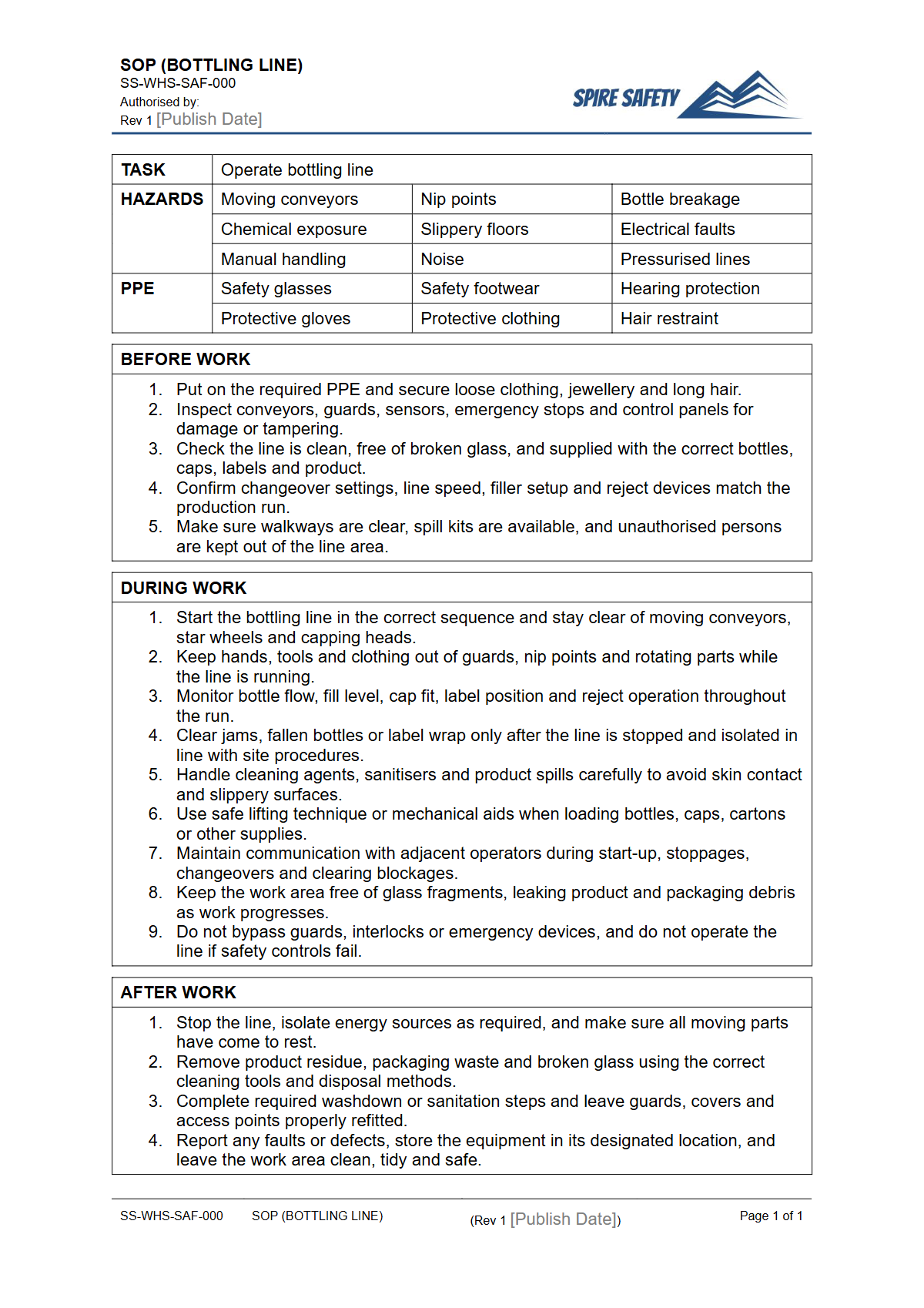
Download our free Safe Operating Procedure (Bottling Line) template. This customisable DOCX and PDF resource helps you outline safe work systems for your team.
Free Safe Operating Procedure (Bottling Line) Template
DOCX • 126 KB + PDF
Updated Oct 2026
No signup required
Purpose of the Free Safe Operating Procedure (Bottling Line) Template
Operating a bottling line involves multiple stages of automation and manual interaction, each with its own set of risks. This free Safe Operating Procedure (Bottling Line) Template provides a structured framework to help you document the safest way to perform tasks associated with your bottling line.
A well-developed SOP is a critical tool for managing hazards such as mechanical entanglement, noise exposure, chemical spills, and ergonomic strains. It serves as a clear, step-by-step guide for workers, ensuring that safety controls are consistently understood and applied.
Using a documented procedure helps your organisation meet its primary duty of care under Australian WHS laws by providing clear instruction and training. This template is designed as a comprehensive starting point, aligned with the model WHS framework.
Integrating such procedures is a fundamental part of developing effective WHS management systems that protect workers and improve operational efficiency. It formalises the expected safety behaviour for every person operating or working near the bottling line.
Video walkthrough
How to use the Free Safe Operating Procedure (Bottling Line) Template
This document is a template and must be customised to suit the specific requirements of your workplace. Download the DOCX file and adapt it to reflect your machinery, chemicals, environment, and established control measures.
The effectiveness of this Safe Operating Procedure for a bottling line depends entirely on its relevance to your unique operational context.
Important: It is crucial to understand that this is a generic template. We have developed it as a starting point, and you must customise it to reflect the specific machinery, substances, processes, and control measures used in your workplace.
Consult directly with the operators, maintenance staff, and supervisors who use the equipment daily. Their input is invaluable for creating a practical and effective document.
Once finalised, the SOP should be used as a primary training tool for all relevant personnel.
Once customised, the procedure should be formally reviewed and approved by a competent person. Its effectiveness can be verified through practical observation and regular safety checks.
Consider engaging external experts for WHS compliance auditing to ensure your documented procedures align with both legal requirements and industry best practice.
When to use it
A Safe Operating Procedure for a bottling line should be used as a core part of your daily safety management. It is essential during the induction and training of new employees or when existing workers are assigned to new tasks on the line.
It should also be readily available at the worksite for quick reference. The SOP is a critical reference document when conducting job safety analyses (JSAs) or risk assessments, particularly when introducing new equipment or modifying a process.
It also forms the basis for refresher training and is a key document to review following any incident or near-miss.
Many bottling facilities rely on an adjacent warehouse or logistics area for managing raw materials and finished goods. If your team uses specific vehicles for this, you may need additional procedures, such as our FREE Body Truck SOP Template, to manage those related risks.
Who should use it
This SOP is intended for a range of personnel within an organisation. WHS Managers and Safety Officers will use it to standardise procedures and ensure a baseline for safety compliance.
Supervisors and Team Leaders are responsible for implementing the SOP, training their teams, and ensuring adherence on the floor. Most importantly, the equipment operators themselves are the primary end-users.
The document must be written in clear, simple language that is easily understood by the people performing the work. Maintenance personnel should also be familiar with the SOP, especially regarding isolation, lockout-tagout, and safe start-up procedures.
If tasks involve working at height, such as for maintenance or clearing blockages, ensure specific procedures are in place for that work. Our FREE Step Ladder SOP Template can help document the safe use of common access equipment.
For a broader selection of templates, you can browse our complete free WHS resources library for more helpful documents.
Common mistakes
Common mistakes to avoid
- Using a generic SOP from the internet without customising it for your specific plant and processes.
- Failing to consult with the workers who actually operate the bottling line during the drafting process.
- Writing the procedure in complex language that is difficult for operators to understand and follow.
- Treating the SOP as a 'set and forget' document instead of reviewing and updating it regularly.
Legal references
Legal considerations
The following legal requirements may be relevant to this type of work.
- Work Health and Safety Act (Harmonised) — Provides the primary duties for protecting workers and other people from work health and safety risks.
- Work Health and Safety Regulations (Harmonised) — Sets out requirements supporting the management of workplace hazards and risks.
The following codes may be relevant to this type of work.
- Managing WHS Risks Code of Practice — Provides practical guidance on identifying hazards, assessing risks and applying effective controls.
- Work Health and Safety Consultation, Cooperation and Coordination Code of Practice — Provides practical guidance on consulting workers and coordinating with other duty holders.
- Managing the Work Environment and Facilities Code of Practice — Provides practical guidance on safe work environments, workplace facilities and related controls.
Did you know
Noise-Induced Hearing Loss
Manufacturing, including bottling operations, is one of the highest-risk industries for noise-induced hearing loss. An increase of just 3 decibels (dB) represents a doubling of sound energy and can halve the recommended safe exposure time.
Mechanical Hazards
According to Safe Work Australia, injuries involving being trapped by moving machinery are among the most severe, often resulting in serious or fatal outcomes. Guarding and isolation procedures are critical controls.
FAQ
Frequently asked questions
01What are the common hazards on a bottling line?
02Is a Safe Operating Procedure a legal requirement in Australia?
03How often should a bottling line SOP be reviewed?
04Who should be involved in writing an SOP for a bottling line?
Share this resource
Free Safe Operating Procedure (Bottling Line) Template
Browse Categories
How To Use It
- 1Download and open in Word or PDF.
- 2Replace the placeholders with your business details.
- 3Get it reviewed by a WHS specialist before rollout.
Need it customised?
Our WHS consultants can adapt this template to your site, run a gap analysis, or audit what you already have in place.
Book a Free Consultation WHS consulting servicesor call 1300 156 382
Related templates
- Free Safe Operating Procedure (Boundary Fence Check) Template
- Free Safe Operating Procedure (Bowling Green Care) Template
- Free Safe Operating Procedure (Bowling Lane Cleaning) Template
- Free Safe Operating Procedure (Bowling Pin Handling) Template
- Free Safe Operating Procedure (Brake Bleeder) Template
- Free Safe Operating Procedure (Brake Disc Replacement) Template