
Free Safe Operating Procedure (Boundary Fence Check) Template
Download our Free Safe Operating Procedure (Boundary Fence Check) Template to formalise your site's fence inspection process.
Free Safe Operating Procedure (Boundary Fence Check) Template
DOCX • 126 KB + PDF
Updated Oct 2026
No signup required
Purpose of the Free Safe Operating Procedure (Boundary Fence Check) Template
A well-maintained boundary fence is a critical first line of defence for site security, public safety, and managing on-site hazards. This Free Safe Operating Procedure (Boundary Fence Check) Template provides a structured framework for conducting and documenting regular inspections of your perimeter fencing.
Its primary purpose is to establish a consistent, step-by-step process that enables workers to systematically identify signs of damage, degradation, security breaches, or other potential risks. Formalising this process helps in managing liabilities, preventing unauthorised access, and ensuring the fence continues to perform its intended function effectively.
By implementing this SOP, your organisation can demonstrate proactive risk management and integrate a key physical asset into its broader safety framework. A documented procedure ensures that inspections are thorough and repeatable, forming an essential part of your overall WHS management systems and preventative maintenance program.
Video walkthrough
How to use the Free Safe Operating Procedure (Boundary Fence Check) Template
This Safe Operating Procedure is provided as a fully editable DOCX file and a ready-to-use PDF. To get the most value from this resource, it must be adapted to the specific context of your workplace.
Download the template and carefully review each section, adding or removing steps to reflect your site's unique layout, fence types, environmental conditions, and operational risks. For instance, a construction site's procedure may need to account for potential damage from heavy machinery, which would be covered in a specific document like our FREE Dozer SOP Template.
Important: This is a template document that you must customise to suit your specific workplace, equipment, and environment. We have provided a structured starting point, but you are responsible for ensuring the final Safe Operating Procedure is comprehensive and accurately reflects the risks and control measures relevant to your operations.
Consult with workers and other stakeholders during this process.
What is included in the template?
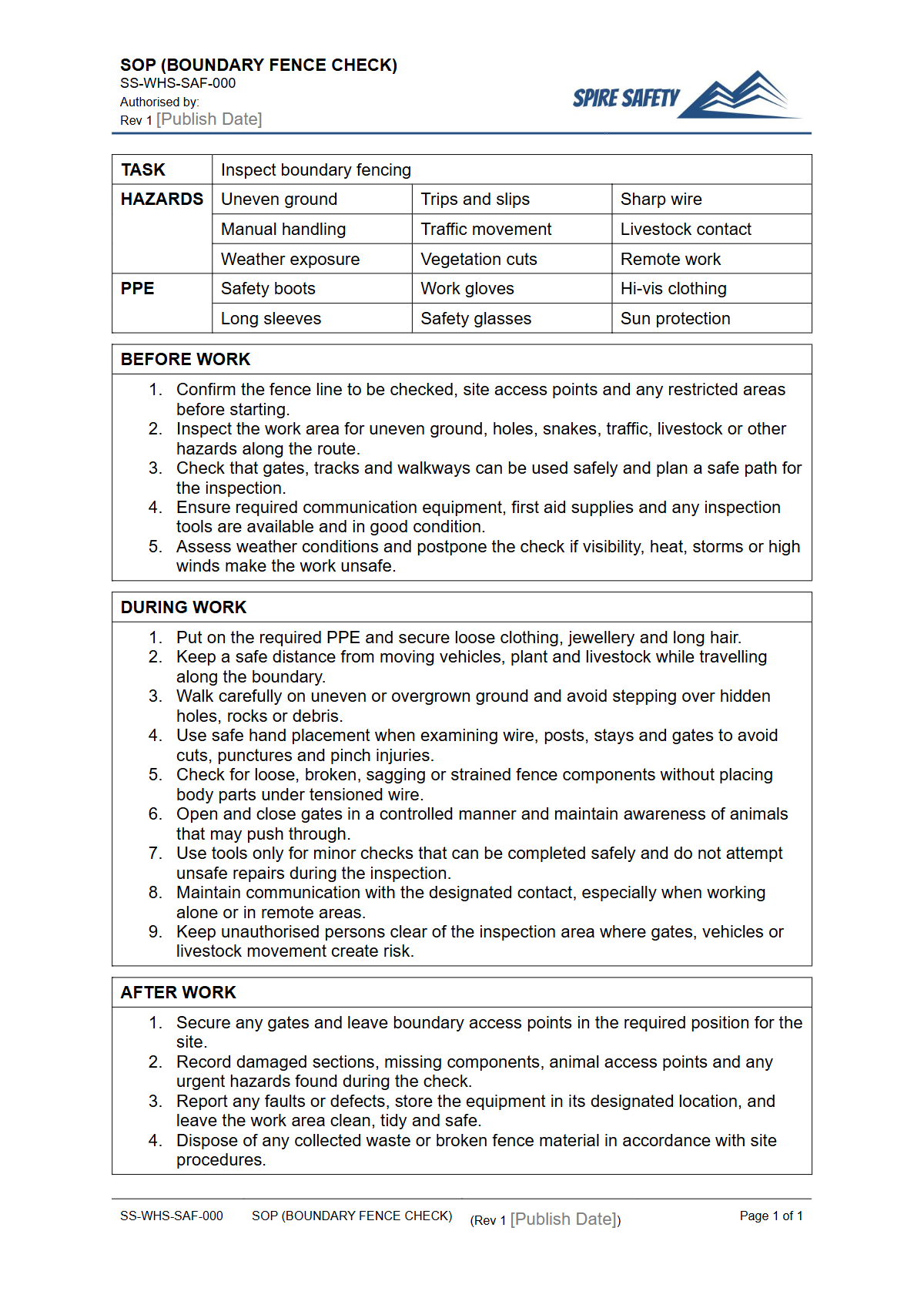
The SOP template is organised into logical sections to guide the user through the entire task safely. It includes fields for:
- Defining the scope and application of the procedure.
- Listing required Personal Protective Equipment (PPE).
- Outlining potential hazards and associated risks (e.g., sharp edges, unstable posts, wildlife).
- A step-by-step guide for pre-inspection, operational, and post-inspection tasks.
- A section for recording inspection findings, required actions, and sign-off.
When to use this Safe Operating Procedure
This SOP should be used whenever a formal inspection of a boundary fence is conducted. The frequency of these checks will depend on several factors, including the level of risk, site activity, and environmental conditions. It is typically used for:
- Routine scheduled inspections: Performing checks on a weekly, monthly, or quarterly basis as determined by your risk assessment.
- Post-incident checks: Inspecting the fence after a security breach, vehicle impact, or attempted unauthorised entry.
- Post-weather event checks: Assessing the fence for damage after severe storms, high winds, or flooding.
- Ad-hoc inspections: Conducting a check in response to a specific concern raised by staff or members of the public.
Documented checks using this SOP create a valuable historical record, which can be a key piece of evidence during a formal WHS compliance auditing process, demonstrating due diligence in maintaining a safe and secure site.
Who should use this Safe Operating Procedure
This procedure is designed for any person tasked with inspecting, maintaining, or managing workplace property and facilities. This may include:
- Facilities Managers
- Maintenance Personnel
- Security Guards or Teams
- Farm Managers or Rural Workers
- Site Supervisors or Forepersons
Users must be deemed competent to perform the task. This includes being able to identify common fence defects, understand the potential hazards involved in the inspection itself (e.g., manual handling, uneven ground), and know the correct reporting procedure for any faults discovered.
For example, if inspecting a tall security fence requires working at a minor height, workers must be trained in the correct use of equipment as detailed in resources like a FREE Step Ladder SOP Template. This ensures the inspection itself is carried out safely. If you require assistance tailoring this document or developing your WHS processes, our WHS consulting team can provide expert guidance.
Explore our complete free WHS resources library for more templates, checklists, and guides to support your safety management system.
Common mistakes
Common mistakes to avoid
- Using the template without customising it for site-specific fence types and risks.
- Failing to document inspection findings, leaving no record of due diligence or required repairs.
- Only inspecting the fence after a major failure or security incident, rather than performing regular preventative checks.
- Not training personnel on what to look for, leading to inconsistent or superficial inspections.
Legal references
Legal considerations
The following legal requirements may be relevant to this type of work.
- Work Health and Safety Act (Harmonised) — Provides the primary duties for protecting workers and other people from work health and safety risks.
- Work Health and Safety Regulations (Harmonised) — Sets out requirements supporting the management of workplace hazards and risks.
The following codes may be relevant to this type of work.
- Managing WHS Risks Code of Practice — Provides practical guidance on identifying hazards, assessing risks and applying effective controls.
- Work Health and Safety Consultation, Cooperation and Coordination Code of Practice — Provides practical guidance on consulting workers and coordinating with other duty holders.
- Managing the Work Environment and Facilities Code of Practice — Provides practical guidance on safe work environments, workplace facilities and related controls.
Did you know
A Legal Structure
Under Australian WHS law, a fence is considered a 'structure'. A Person Conducting a Business or Undertaking (PCBU) has a primary duty of care to ensure all structures at a workplace are maintained so they do not pose a risk to health and safety.
The Cost of Neglect
Failing to maintain a boundary fence can not only lead to security breaches but may also impact insurance claims and contribute to findings of negligence in the event of an incident, potentially leading to significant financial and legal consequences.
FAQ
Frequently asked questions
01What is the difference between an SOP and a Safe Work Method Statement (SWMS)?
02How often should I inspect my site's boundary fence?
03What are common hazards associated with damaged boundary fences?
04Can I use this template for any type of fence?
Share this resource
Free Safe Operating Procedure (Boundary Fence Check) Template
Browse Categories
How To Use It
- 1Download and open in Word or PDF.
- 2Replace the placeholders with your business details.
- 3Get it reviewed by a WHS specialist before rollout.
Need it customised?
Our WHS consultants can adapt this template to your site, run a gap analysis, or audit what you already have in place.
Book a Free Consultation WHS consulting servicesor call 1300 156 382
Related templates
- Free Safe Operating Procedure (Bowling Green Care) Template
- Free Safe Operating Procedure (Bowling Lane Cleaning) Template
- Free Safe Operating Procedure (Bowling Pin Handling) Template
- Free Safe Operating Procedure (Brake Bleeder) Template
- Free Safe Operating Procedure (Brake Disc Replacement) Template
- Free Safe Operating Procedure (Brake Drum Removal) Template