
Free Safe Operating Procedure (Bottle Jack) Template
Download our free Safe Operating Procedure (Bottle Jack) template.
Free Safe Operating Procedure (Bottle Jack) Template
DOCX • 126 KB + PDF
Updated Oct 2026
No signup required
Purpose of the Free Safe Operating Procedure (Bottle Jack) Template
A bottle jack is a powerful tool common in workshops, garages, and on-site maintenance tasks. However, its use presents significant risks, including equipment failure, vehicle collapse, and crushing injuries.
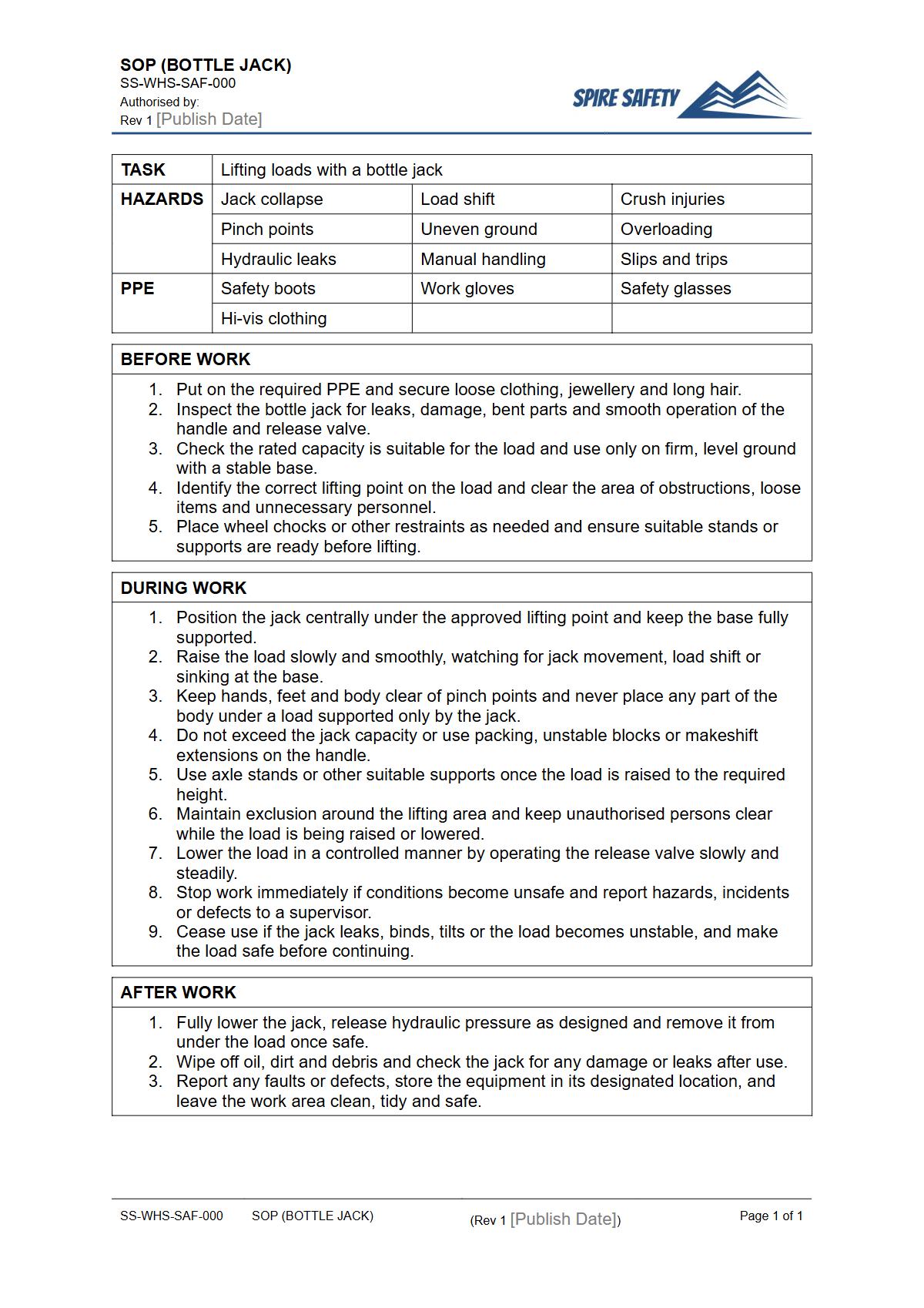
This Free Safe Operating Procedure (Bottle Jack) Template provides a structured framework for documenting the safest way to perform tasks using this equipment. Implementing a clear Safe Operating Procedure (SOP) is a fundamental step in managing these risks, ensuring workers are trained in a consistent, safe method, and demonstrating compliance with Australian WHS duties.
This template guides you in outlining the necessary pre-start checks, operational steps, personal protective equipment (PPE) requirements, and shutdown procedures. Using a standardised SOP helps minimise the chance of operator error and equipment misuse, which are leading causes of incidents.
It serves as a critical training document for new workers and a refresher for experienced operators. Integrating this SOP into a broader WHS management system ensures it is part of a holistic approach to workplace safety, rather than a standalone document.
Video walkthrough
How to use the Free Safe Operating Procedure (Bottle Jack) Template
This document is a template, not a finished procedure. To be effective, it must be adapted to your specific workplace.
Upon downloading the DOCX or PDF file, you will need to review and customise each section to reflect the models of bottle jacks you use, the specific tasks they are used for, and the unique environmental conditions of your worksite. This level of procedural detail is common for all workshop equipment, from lifting devices to tools like those covered in our FREE Plasma Cutter SOP Template.
Customisation is Essential
Every workplace is different. The loads being lifted, the surfaces worked on, and the workers involved will vary.
We strongly recommend customising this template in consultation with the people who actually use the equipment. Their direct experience is invaluable for creating a practical and effective procedure. Your customisation should include:
- Specific make and model of the bottle jack(s).
- The rated capacity or Safe Working Load (SWL).
- Site-specific hazards (e.g., sloped surfaces, soft ground).
- The exact type and model of jack stands to be used.
- Your organisation's specific emergency contacts and procedures.
When to use a Safe Operating Procedure for a Bottle Jack
An SOP for a bottle jack should be developed, implemented, and readily available before any work involving the equipment begins. It is an administrative control that forms part of a safe system of work.
It is particularly crucial for routine maintenance tasks in automotive workshops, field service repairs, and construction site activities where heavy components need to be lifted for access or replacement. While lifting the vehicle or machinery is one part, workers might then need to access other areas, highlighting the need for procedures like those found in our FREE Step Ladder SOP Template.
The SOP should be used as the primary reference document for training new operators and verifying their competence. It also serves as a benchmark during workplace inspections and safety observations.
Regular reviews of SOPs form a key part of any WHS compliance auditing program, ensuring that documented procedures remain current and effective. Having a robust procedure is just as important for a simple bottle jack as it is for complex machinery covered by our FREE Body Truck SOP Template.
Who should use this Safe Operating Procedure
This SOP is intended for several groups within an organisation. The primary users are the operators—the mechanics, technicians, and tradespeople who physically use the bottle jack.
They must be trained on the procedure and follow its steps every time they use the equipment. Supervisors and managers are also key users; they are responsible for ensuring operators are trained, that the SOP is being followed correctly, and for conducting periodic reviews and updates.
Safety officers and WHS representatives will use the SOP as a tool for risk assessments, incident investigations, and safety audits. By formalising the procedure, it creates a clear standard against which behaviour and practice can be measured.
You can find this and many other helpful documents in our free WHS resources library to support your entire team.
Common mistakes
Common mistakes to avoid
- Using the jack on soft, uneven, or unlevel ground, leading to instability.
- Exceeding the jack's specified Safe Working Load (SWL).
- Failing to use vehicle jack stands to support the load after lifting.
- Placing a part of your body under a load supported only by the jack.
Legal references
Legal considerations
The following legal requirements may be relevant to this type of work.
- Work Health and Safety Act (Harmonised) — Provides the primary duties for protecting workers and other people from work health and safety risks.
- Work Health and Safety Regulations (Harmonised) — Sets out requirements supporting the management of workplace hazards and risks.
The following codes may be relevant to this type of work.
- Managing WHS Risks Code of Practice — Provides practical guidance on identifying hazards, assessing risks and applying effective controls.
- Work Health and Safety Consultation, Cooperation and Coordination Code of Practice — Provides practical guidance on consulting workers and coordinating with other duty holders.
- Managing the Work Environment and Facilities Code of Practice — Provides practical guidance on safe work environments, workplace facilities and related controls.
Did you know
Hydraulic Power
Bottle jacks utilise Pascal's principle, where a small force applied to a small piston generates a much larger lifting force on a larger piston, allowing them to lift several tonnes with minimal human effort.
Creep and Fail
Hydraulic jacks can slowly 'creep' or lose pressure over time. They are designed for lifting, not for holding a load for extended periods. Always use correctly rated jack stands for support once the load is lifted.
FAQ
Frequently asked questions
01What should be included in a bottle jack safe operating procedure?
02Is a Safe Operating Procedure a legal requirement for a bottle jack in Australia?
03How often should a bottle jack SOP be reviewed?
04Can I use this template for other types of jacks, like trolley jacks?
Share this resource
Free Safe Operating Procedure (Bottle Jack) Template
Browse Categories
How To Use It
- 1Download and open in Word or PDF.
- 2Replace the placeholders with your business details.
- 3Get it reviewed by a WHS specialist before rollout.
Need it customised?
Our WHS consultants can adapt this template to your site, run a gap analysis, or audit what you already have in place.
Book a Free Consultation WHS consulting servicesor call 1300 156 382
Related templates
- Free Safe Operating Procedure (Bottling Line) Template
- Free Safe Operating Procedure (Boundary Fence Check) Template
- Free Safe Operating Procedure (Bowling Green Care) Template
- Free Safe Operating Procedure (Bowling Lane Cleaning) Template
- Free Safe Operating Procedure (Bowling Pin Handling) Template
- Free Safe Operating Procedure (Brake Bleeder) Template