
Free Safe Operating Procedure (Bore Pump) Template
Streamline your safety processes with our free Safe Operating Procedure (Bore Pump) template. Aligned with Australian WHS standards.
Free Safe Operating Procedure (Bore Pump) Template
DOCX • 126 KB + PDF
Updated Oct 2026
No signup required
Purpose of the Free Safe Operating Procedure (Bore Pump) Template
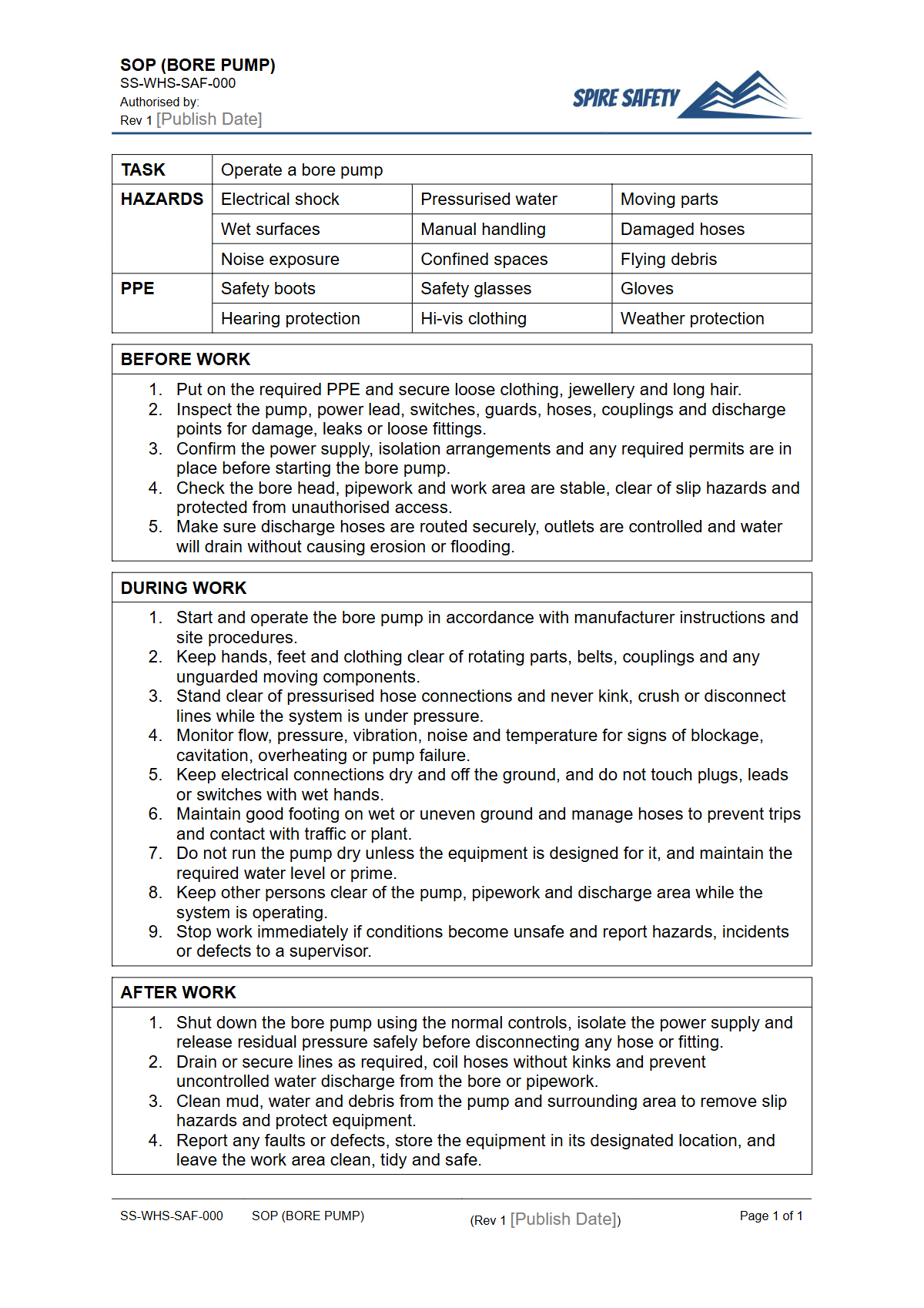
Operating a bore pump, while a common task in agriculture, construction, and mining, involves specific risks that must be managed. This Free Safe Operating Procedure (Bore Pump) Template provides a structured framework for documenting the safest way to perform this task.
It helps your organisation identify hazards, implement control measures, and provide clear instructions to workers, forming a crucial part of your overall safety management system. Using a standardised SOP ensures that all operators follow a consistent, pre-approved process designed to minimise risks such as electrical shock, entanglement, and drowning.
An SOP is a fundamental document within a comprehensive safety framework. It formalises the steps required to complete a job safely, acting as both a training tool for new workers and a refresher for experienced staff.
Integrating this procedure into your broader WHS management systems demonstrates a commitment to proactive risk management and helps you meet your duty of care obligations under Australian WHS legislation.
Video walkthrough
How to use the Free Safe Operating Procedure (Bore Pump) Template
This document is a template, not a finished product. To make it effective, you must customise it to reflect the specific bore pumps, equipment, and environmental conditions at your worksite.
Download the DOCX file and adapt it by adding site-specific details, machine model numbers, and emergency contact information.
Crucially, you must consult with your workers—the people who actually operate the bore pumps—during the customisation process. Their hands-on experience is invaluable for identifying practical risks and effective controls that may not be obvious from a purely theoretical perspective.
Once finalised, the SOP should be used as part of your induction and ongoing training programs. While this document is specific to bore pumps, the principles can be adapted for similar equipment, such as when you're developing an air compressor SOP.
When to use a Bore Pump Safe Operating Procedure
A Safe Operating Procedure for a bore pump should be a readily accessible document used in several key situations. It should be consulted by any worker before they operate the equipment for the first time or after a long absence.
It is an essential training document for new employees, apprentices, and trainees to ensure they understand the approved work method from the outset. The SOP should also be a central document for regular safety reviews, toolbox talks, and refresher training sessions.
If an incident or near-miss involving a bore pump occurs, the SOP must be reviewed and updated to incorporate any lessons learned and prevent a recurrence.
Who should use this Safe Operating Procedure
This SOP is intended for a range of personnel within your organisation. The primary users are the operators themselves, who must follow the documented steps to ensure their own safety and the safety of others.
Supervisors and managers are responsible for ensuring that operators are trained on the SOP and that its procedures are being followed correctly on-site. This verification is a key component of effective supervision.
WHS managers and safety officers will use the SOP as part of their risk management documentation, training programs, and safety audits. Regular verification that SOPs are current and correctly implemented is a standard part of any robust WHS compliance auditing program.
Lastly, maintenance personnel should be familiar with the SOP, particularly the sections on isolation, de-energisation, and pre-start checks.
While bore pumps and waterjet cutters operate on different principles, they both involve managing risks associated with pressurised systems. For another example of a procedure controlling hazardous equipment, you can review our FREE Waterjet Cutter SOP Template. This can provide useful context for how different machinery-specific risks are documented.
Similarly, if your work involves other types of pumps, you may find our FREE Boom Pump SOP (Safe Operating Procedure) Template a helpful reference for comparison.
This template is just one of many professionally developed documents available to help you build a safer workplace. You can explore our complete free WHS resources library for more templates, checklists, and guides to support your safety management efforts.
Common mistakes
Common mistakes to avoid
- Failing to electrically isolate and de-energise the pump before any inspection or maintenance.
- Neglecting to test the atmosphere in a well or pit before entry.
- Using incorrect or unsafe manual handling techniques when lifting or moving heavy pump components.
- Assuming the procedure for one pump model applies to all others without review and customisation.
Legal references
Legal considerations
The following legal requirements may be relevant to this type of work.
- Work Health and Safety Act (Harmonised) — Provides the primary duties for protecting workers and other people from work health and safety risks.
- Work Health and Safety Regulations (Harmonised) — Sets out requirements supporting the management of workplace hazards and risks.
The following codes may be relevant to this type of work.
- Managing WHS Risks Code of Practice — Provides practical guidance on identifying hazards, assessing risks and applying effective controls.
- Work Health and Safety Consultation, Cooperation and Coordination Code of Practice — Provides practical guidance on consulting workers and coordinating with other duty holders.
- Managing the Work Environment and Facilities Code of Practice — Provides practical guidance on safe work environments, workplace facilities and related controls.
Did you know
The Electrical Hazard
Submersible bore pumps combine high-voltage electricity and water, making them a significant electrical hazard if not correctly installed, earthed, and isolated before any maintenance work.
Confined Space Risk
Bore pits and wells are often classified as confined spaces. They can contain hazardous atmospheres (like methane or carbon monoxide) or have low oxygen levels, requiring specific entry permits and procedures.
FAQ
Frequently asked questions
01What are the main hazards when operating a bore pump?
02How often should a bore pump SOP be reviewed?
03Is a Safe Work Method Statement (SWMS) the same as an SOP for a bore pump?
04Does this bore pump SOP template cover maintenance tasks?
Share this resource
Free Safe Operating Procedure (Bore Pump) Template
Browse Categories
How To Use It
- 1Download and open in Word or PDF.
- 2Replace the placeholders with your business details.
- 3Get it reviewed by a WHS specialist before rollout.
Need it customised?
Our WHS consultants can adapt this template to your site, run a gap analysis, or audit what you already have in place.
Book a Free Consultation WHS consulting servicesor call 1300 156 382
Related templates
- Free Safe Operating Procedure (Bored Piling Rig) Template
- Free Safe Operating Procedure (Borescope) Template
- Free Safe Operating Procedure (Bosun Chair) Template
- Free Safe Operating Procedure (Bottle Bin Handling) Template
- Free Safe Operating Procedure (Bottle Crusher) Template
- Free Safe Operating Procedure (Bottle Jack) Template