
Free Safe Operating Procedure (Borescope) Template
Download our free Safe Operating Procedure (Borescope) template.
Free Safe Operating Procedure (Borescope) Template
DOCX • 126 KB + PDF
Updated Oct 2026
No signup required
Purpose of the Free Safe Operating Procedure (Borescope) Template
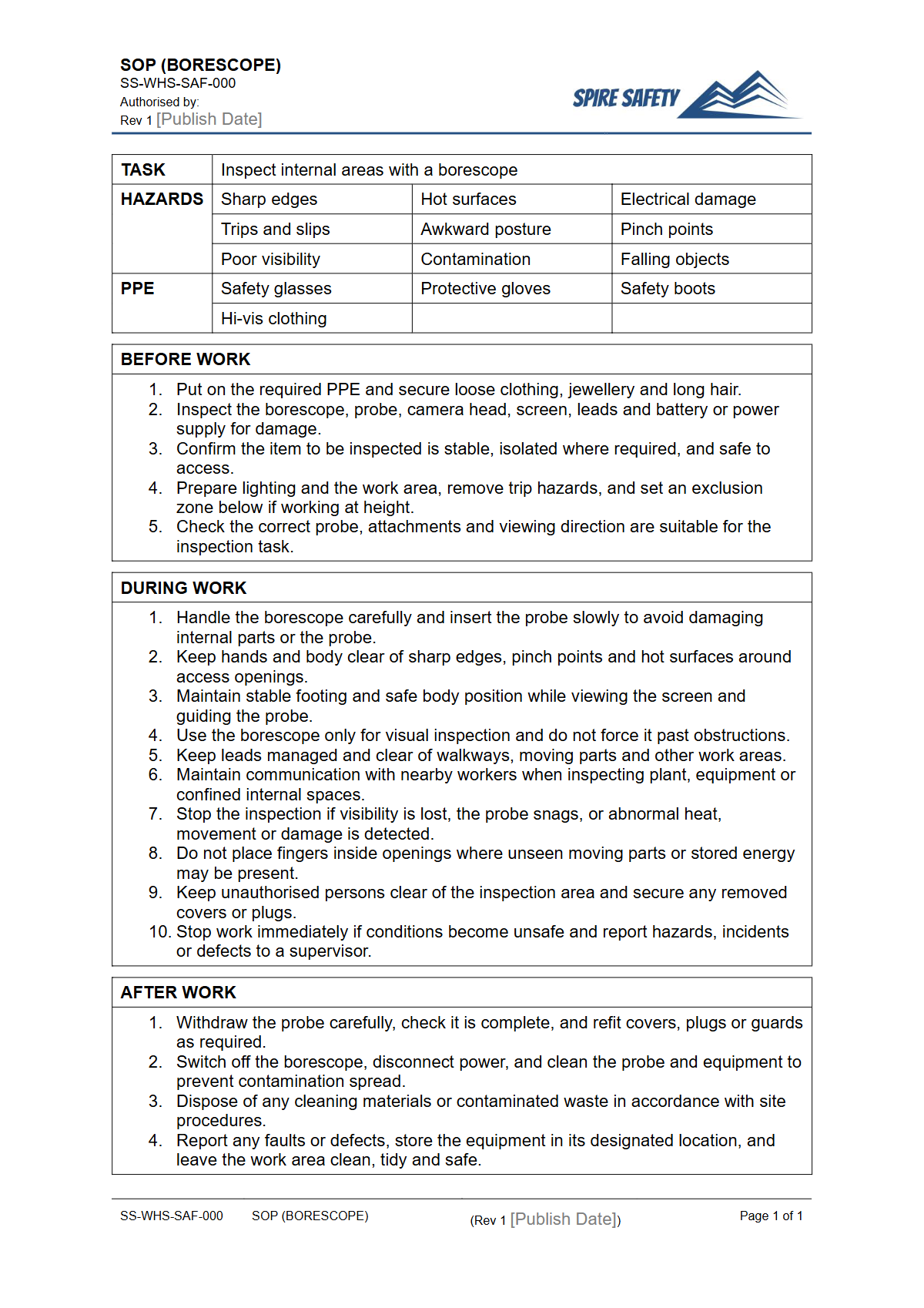
A Safe Operating Procedure (SOP) is a fundamental tool for ensuring tasks are performed safely and consistently. Our Free Safe Operating Procedure (Borescope) Template provides a comprehensive framework for documenting the safe use of borescopes, videoscopes, and other remote visual inspection tools.
Using this equipment often involves interacting with complex machinery or accessing potentially hazardous, confined spaces. A formalised procedure is essential for managing these risks effectively.
The primary purpose of this SOP is to provide a clear, step-by-step guide that helps prevent injuries to personnel and avoids damage to the borescope or the asset being inspected. It outlines critical pre-operational checks, safe handling techniques, and post-inspection requirements.
Integrating documented procedures like this one is a key component of building robust WHS management systems that demonstrate a commitment to proactive risk management.
Video walkthrough
How to use the Free Safe Operating Procedure (Borescope) Template
This downloadable Word document is a structured starting point, not a finished, universally applicable procedure. To be effective, it must be adapted to the specific context of your workplace.
You should consult with the workers who will be using the borescope to ensure the procedure reflects the practical realities of the task.
Important: This is a template that you must customise. We have included comments and placeholders to guide you, but the ultimate responsibility for creating a safe and effective procedure rests with the Person Conducting a Business or Undertaking (PCBU) at your workplace. This involves:
- Conducting a specific risk assessment for borescope use in your environment.
- Identifying the make, model, and specific characteristics of your equipment.
- Detailing the Personal Protective Equipment (PPE) required.
- Listing the step-by-step process, from isolating the machine to be inspected, through to performing the inspection and completing the task.
- Defining clear reporting and documentation requirements for inspection findings.
By customising this SOP, you create a valuable training and operational tool. For example, when inspecting pressurised equipment, your SOP can reference specific isolation and depressurisation steps also found in your free Air Compressor SOP.
When to use a Borescope SOP
A Borescope SOP should be used as a primary reference document in several key situations. It serves as a vital control measure that should be readily accessible to anyone involved in the task.
It is not a document to be filed away and forgotten; it is an active tool for ensuring safety.
Key instances for its use include:
- Before every use: Operators should review the SOP as part of their pre-task planning, especially if the task is non-routine.
- Training and competency: It is an essential document for inducting and training new operators on the correct and safe method of using the equipment.
- Toolbox talks: The SOP can be used as a basis for short safety meetings to refresh workers' knowledge of the risks and controls.
- Incident investigations: If an incident or near-miss occurs, the SOP will be reviewed to determine if it was followed and if it needs improvement.
- Audits: The document provides evidence of a formalised safe system of work during internal or external safety audits. Having clear, task-specific procedures in place is a critical part of any WHS compliance auditing process.
Furthermore, the SOP should be referenced when planning complex inspections. For instance, if accessing an inspection port requires working from a height, procedures from a step ladder SOP must also be consulted and followed concurrently.
Who should use this Safe Operating Procedure
This Safe Operating Procedure is intended for a range of personnel within an organisation, each with different responsibilities related to the task.
- Operators and Technicians: The primary users, who follow the procedure step-by-step to perform their work safely and effectively. They are responsible for understanding and adhering to every step.
- Supervisors and Team Leaders: Responsible for ensuring their team members are trained, competent, and following the SOP. They use it to monitor work, provide guidance, and conduct competency assessments.
- WHS Managers and Advisors: Use the SOP as a tool for risk management, ensuring that controls identified in risk assessments are implemented at the operational level. They also manage the review and update cycle for the document.
- PCBUs and Senior Management: While they may not use it directly, the existence and proper implementation of SOPs help them fulfil their primary duty of care under Australian WHS law to provide and maintain safe systems of work.
A well-written SOP ensures consistency across shifts and teams, making it an indispensable document in workshops that also utilise other specialised equipment governed by procedures like a plasma cutter SOP. You can find many other templates in our free WHS resources library to build out your safety documentation.
Common mistakes
Common mistakes to avoid
- Failing to de-energise and isolate the machinery or system being inspected, creating a risk of unexpected movement or energy release.
- Not performing pre-use inspections on the borescope, leading to equipment damage or poor image quality.
- Using a generic SOP that hasn't been customised with site-specific hazards and controls.
- Inadequate documentation of inspection findings, reducing the value of the inspection and potentially missing critical faults.
Legal references
Legal considerations
The following legal requirements may be relevant to this type of work.
- Work Health and Safety Act (Harmonised) — Provides the primary duties for protecting workers and other people from work health and safety risks.
- Work Health and Safety Regulations (Harmonised) — Sets out requirements supporting the management of workplace hazards and risks.
The following codes may be relevant to this type of work.
- Managing WHS Risks Code of Practice — Provides practical guidance on identifying hazards, assessing risks and applying effective controls.
- Work Health and Safety Consultation, Cooperation and Coordination Code of Practice — Provides practical guidance on consulting workers and coordinating with other duty holders.
- Managing the Work Environment and Facilities Code of Practice — Provides practical guidance on safe work environments, workplace facilities and related controls.
Did you know
Medical Origins
The technology behind modern industrial borescopes was originally developed for medical endoscopes, designed for minimally invasive internal examination of the human body.
FAQ
Frequently asked questions
01What should be included in a Borescope SOP?
02Is a Safe Operating Procedure a legal requirement in Australia?
03How often should a Borescope SOP be reviewed?
04Can this template be used for any type of borescope?
Share this resource
Free Safe Operating Procedure (Borescope) Template
Browse Categories
How To Use It
- 1Download and open in Word or PDF.
- 2Replace the placeholders with your business details.
- 3Get it reviewed by a WHS specialist before rollout.
Need it customised?
Our WHS consultants can adapt this template to your site, run a gap analysis, or audit what you already have in place.
Book a Free Consultation WHS consulting servicesor call 1300 156 382
Related templates
- Free Safe Operating Procedure (Bosun Chair) Template
- Free Safe Operating Procedure (Bottle Bin Handling) Template
- Free Safe Operating Procedure (Bottle Crusher) Template
- Free Safe Operating Procedure (Bottle Jack) Template
- Free Safe Operating Procedure (Bottling Line) Template
- Free Safe Operating Procedure (Boundary Fence Check) Template