
Free Safe Operating Procedure (Border Edging) Template
Download our free Safe Operating Procedure (SOP) for border edging. This template helps outline risks and controls for landscaping and construction tasks.
Free Safe Operating Procedure (Border Edging) Template
DOCX • 126 KB + PDF
Updated Oct 2026
No signup required
Purpose of the Free Safe Operating Procedure (Border Edging) Template
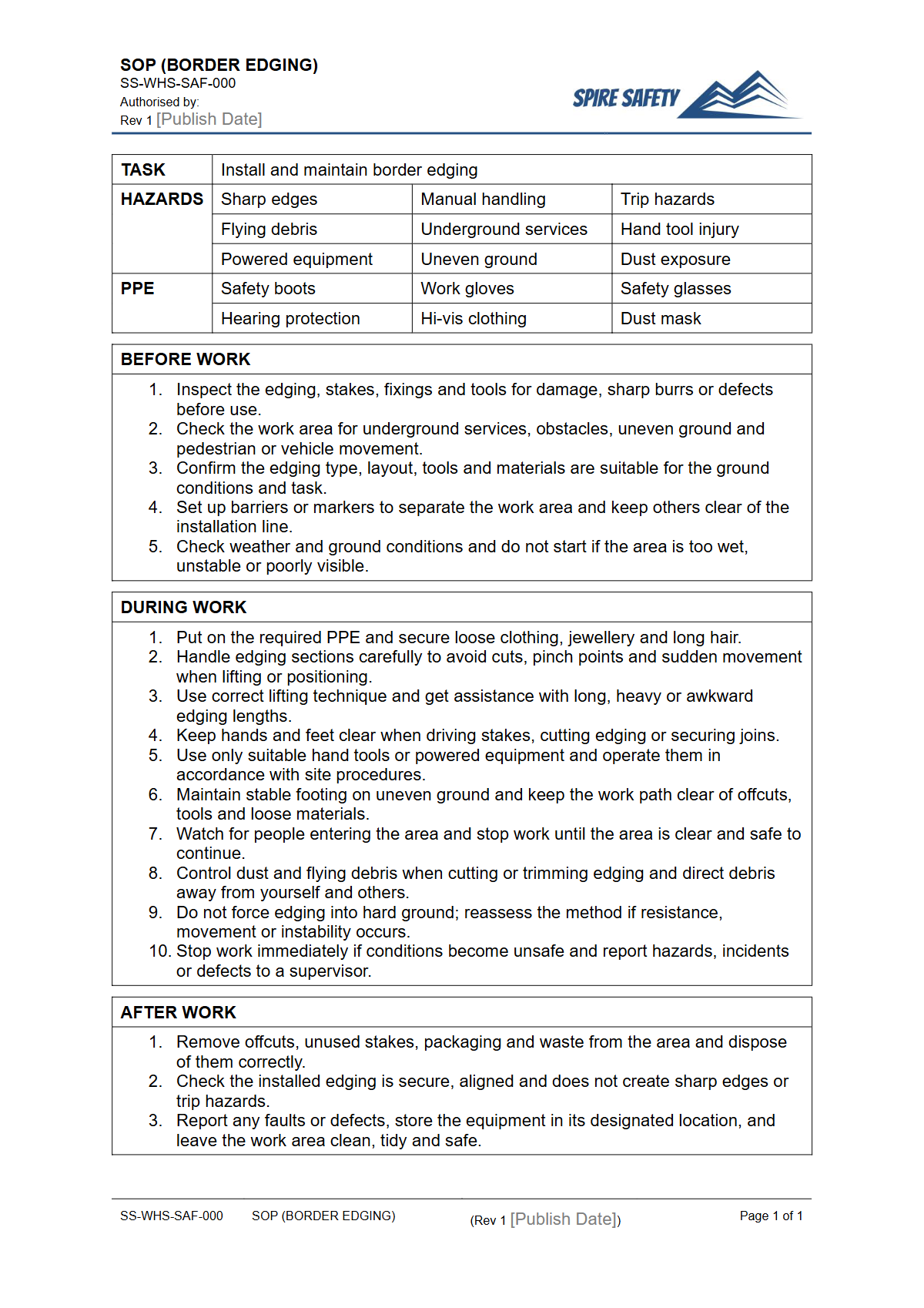
This Free Safe Operating Procedure (Border Edging) Template provides a structured framework for outlining the health and safety requirements for installing garden, pavement, or landscape edging. A Safe Operating Procedure (SOP) is a critical administrative control that documents a step-by-step process for performing a task safely.
It helps workers understand the potential hazards and the control measures required to minimise the risk of injury.
Key risks associated with border edging include hazardous manual tasks (lifting heavy materials like concrete or steel), slips, trips, and falls from uneven ground or discarded materials, and injuries from hand or power tools used for cutting and shaping. This template is designed as a starting point, aligned with Australian WHS best practices, to help your organisation formalise its safety processes.
A documented SOP is a fundamental component of effective WHS management systems, demonstrating a commitment to providing a safe work environment.
Hazards and Risks Addressed
This SOP template prompts you to consider and control risks such as:
- Manual Handling: Strains and sprains from lifting, carrying, and positioning heavy edging sections.
- Tool Use: Cuts or abrasions from saws, grinders, or hammers.
- Ground Conditions: Instability, trenches, and trip hazards.
- Underground Services: Risk of striking electrical cables, water pipes, or gas lines.
- Environmental Factors: Sun exposure, heat stress, and dust inhalation.
Video walkthrough
How to use the Free Safe Operating Procedure (Border Edging) Template
Using this template effectively involves more than just filling in the blanks. After downloading the DOCX or PDF file, you must adapt it to your specific operational context.
For example, the procedure for installing lightweight plastic edging will differ significantly from that for heavy precast concrete kerbing. When materials need to be cut to size on-site, a specific procedure for that tool, such as our free Circular Saw SOP, should be referenced or integrated.
IMPORTANT: This document is a template and must be customised to your workplace. We provide it as a starting point.
To ensure it is suitable, you must consult with your workers and other stakeholders to identify all site-specific hazards, equipment (e.g., specific brands or models of tools), and environmental conditions. Your final SOP should reflect the unique reality of your operations.
When to use it
A Safe Operating Procedure for border edging should be an active document used throughout the work lifecycle. It is not a 'set and forget' piece of paper.
Use it before work commences as a planning tool to ensure all safety measures, such as required PPE and tool inspections, are in place. It serves as an essential training resource for new workers or those unfamiliar with the task, providing clear, sequential instructions.
The SOP should also be referenced during toolbox talks to refresh safety awareness and discuss any recent incidents or near misses. For supervisors, it acts as a checklist for observing work practices and confirming that procedures are being followed correctly.
Regular reviews of SOPs are a key activity checked during a WHS compliance auditing process, ensuring your safety documentation remains current and effective.
Who should use it
This Safe Operating Procedure is intended for a range of personnel within any organisation involved in landscaping, construction, civil works, or grounds maintenance. Primarily, it is for the workers who directly perform the border edging tasks.
They must understand and follow the procedure to protect themselves and their colleagues from harm. For tasks involving heavy materials that require mechanical lifting aids, a corresponding SOP like the Telehandler SOP Template should also be made available to operators.
Supervisors and team leaders must use the SOP to induct, train, and monitor their teams. WHS Managers and Safety Advisors will use this template as a foundation for developing comprehensive safety documentation that aligns with the organisation's overall risk management framework.
For large-scale projects involving site preparation, an additional procedure like a Dozer SOP may be necessary for the earthworks phase before edging is installed.
Ultimately, the Person Conducting a Business or Undertaking (PCBU) is responsible for ensuring safe systems of work are in place, making this document a tool for fulfilling that primary duty of care. You can find more helpful documents when you browse our full library of free WHS resources.
Common mistakes
Common mistakes to avoid
- Failing to conduct a 'Dial Before You Dig' search for underground services.
- Using incorrect manual handling techniques when lifting heavy concrete or stone edging.
- Not wearing appropriate PPE, especially safety glasses when cutting materials and gloves when handling them.
- Creating trip hazards by leaving tools or offcuts in walkways.
Legal references
Legal considerations
The following legal requirements may be relevant to this type of work.
- Work Health and Safety Act (Harmonised) — Provides the primary duties for protecting workers and other people from work health and safety risks.
- Work Health and Safety Regulations (Harmonised) — Sets out requirements supporting the management of workplace hazards and risks.
The following codes may be relevant to this type of work.
- Managing WHS Risks Code of Practice — Provides practical guidance on identifying hazards, assessing risks and applying effective controls.
- Work Health and Safety Consultation, Cooperation and Coordination Code of Practice — Provides practical guidance on consulting workers and coordinating with other duty holders.
- Managing the Work Environment and Facilities Code of Practice — Provides practical guidance on safe work environments, workplace facilities and related controls.
Did you know
Manual Task Injuries
According to Safe Work Australia, injuries resulting from hazardous manual tasks are the most common type of workplace injury, making SOPs that address lifting and carrying crucial for prevention.
FAQ
Frequently asked questions
01What hazards are commonly associated with border edging work?
02Is a Safe Operating Procedure legally required for border edging in Australia?
03What should be included in training for border edging tasks?
04How often should an SOP for border edging be reviewed?
Share this resource
Free Safe Operating Procedure (Border Edging) Template
Browse Categories
How To Use It
- 1Download and open in Word or PDF.
- 2Replace the placeholders with your business details.
- 3Get it reviewed by a WHS specialist before rollout.
Need it customised?
Our WHS consultants can adapt this template to your site, run a gap analysis, or audit what you already have in place.
Book a Free Consultation WHS consulting servicesor call 1300 156 382
Related templates
- Free Safe Operating Procedure (Bore Pump) Template
- Free Safe Operating Procedure (Bored Piling Rig) Template
- Free Safe Operating Procedure (Borescope) Template
- Free Safe Operating Procedure (Bosun Chair) Template
- Free Safe Operating Procedure (Bottle Bin Handling) Template
- Free Safe Operating Procedure (Bottle Crusher) Template