
Free Safe Operating Procedure (Bolt Tensioner) Template
Download our free Safe Operating Procedure (Bolt Tensioner) Template. This DOCX & PDF resource helps document safe work practices for hydraulic bolt tensioning.
Free Safe Operating Procedure (Bolt Tensioner) Template
DOCX • 126 KB + PDF
Updated Oct 2026
No signup required
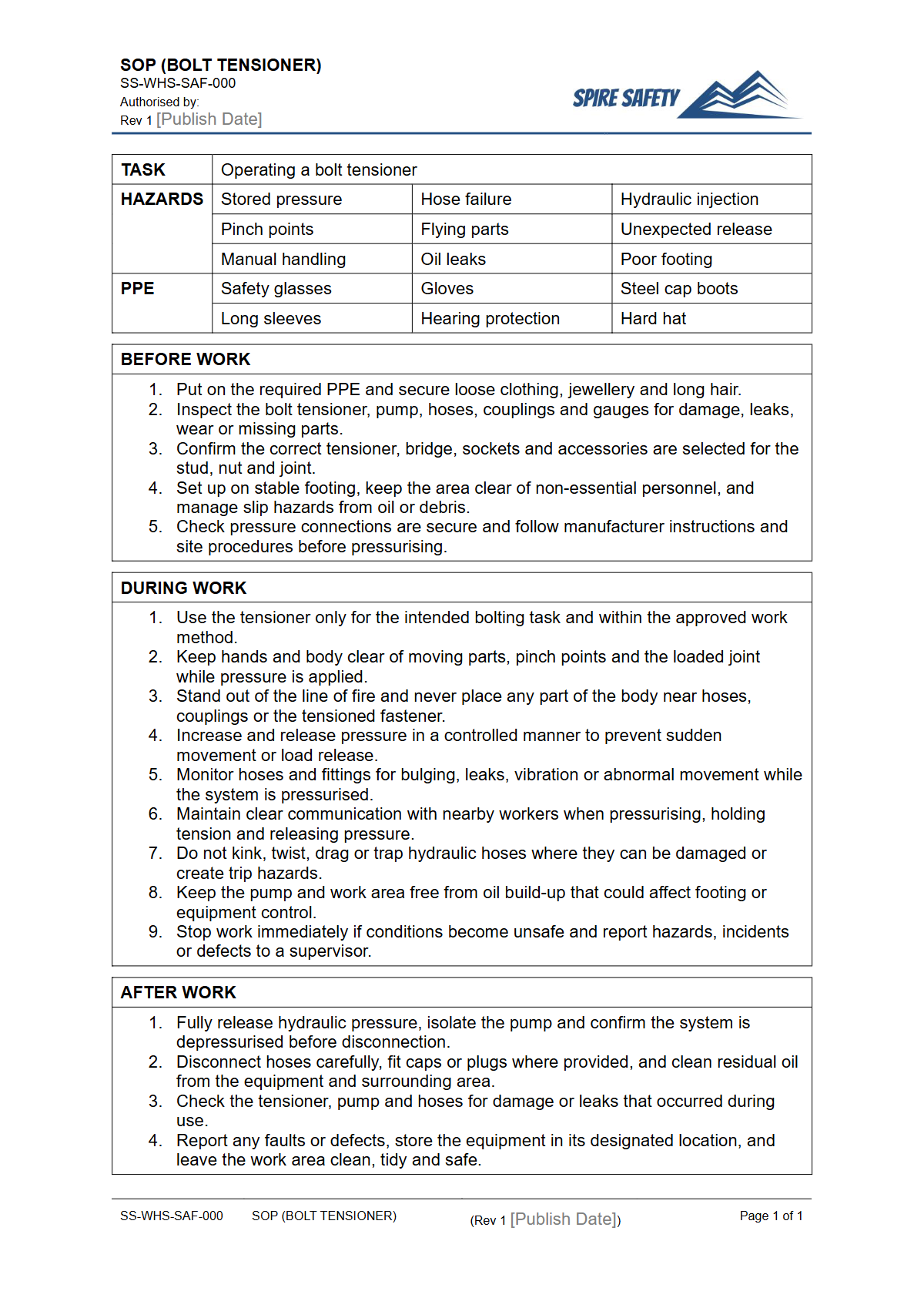
Purpose of the Free Safe Operating Procedure (Bolt Tensioner) Template
Operating a hydraulic bolt tensioner involves high-pressure equipment and significant stored energy, presenting serious risks if not managed correctly. This Free Safe Operating Procedure (Bolt Tensioner) Template provides a structured starting point for documenting the required safety controls and work steps for your organisation.
Using a clear SOP helps ensure that all workers follow a consistent, safe method every time they perform the task, minimising the risk of incidents such as hydraulic fluid injection, equipment failure, or incorrect bolt loading. It is a critical component of your broader WHS management systems, formalising your commitment to a safe workplace.
Video walkthrough
How to use the Free Safe Operating Procedure (Bolt Tensioner) Template
This Safe Operating Procedure for a bolt tensioner is provided in an editable DOCX format, allowing you to tailor it to your specific operational needs. To use the template effectively, you should review and modify each section to reflect the make and model of your equipment, the specific tasks performed, and the unique environmental conditions of your workplace.
Key areas for customisation include listing required Personal Protective Equipment (PPE), detailing pre-operational checks for your specific tensioner and pump, and outlining the step-by-step process your workers must follow. The document should be developed in consultation with the workers who will be using it.
Please note: This document is a template and must be customised to suit the specific equipment, environment, and tasks at your workplace. We are not responsible for the outcomes of any documentation you produce. If you require assistance, consider our WHS consulting services.
Key elements to include
A comprehensive bolt tensioner SOP should cover several critical stages of the task to be effective:
- Preparation and Pre-Operational Checks: This section details the visual inspection of all components, including the hydraulic pump, hoses, couplings, and the tensioner head itself. It should prompt the operator to check for leaks, frays, cracks, or other signs of wear and to verify the pressure gauge is calibrated. For workshops with various equipment, having clear procedures is essential, similar to the requirements outlined in our Free Air Compressor SOP (Safe Operating Procedure) Template.
- Step-by-Step Operating Procedure: This is the core of the SOP, guiding the user through setting up the equipment, fitting the tensioner over the stud, applying hydraulic pressure correctly, securing the nut, and safely releasing the pressure. It must include specific pressure values and sequences as specified by the manufacturer or engineering requirements.
- Post-Operation Checks and Shutdown: This outlines the process for cleaning, inspecting, and storing the equipment correctly. Proper storage prevents damage and ensures the tool is ready and safe for its next use.
- Emergency Procedures: Crucially, the SOP must detail actions to take in an emergency, such as a hydraulic hose burst, fluid injection injury, or equipment malfunction. Immediate first aid for hydraulic injection is critical and must be clearly understood by all users.
When to use a Safe Operating Procedure
An SOP for bolt tensioning should be used as a primary reference document in several scenarios. It is essential for inducting and training new operators, providing a clear, step-by-step guide to the task.
It should also be used for pre-start meetings or toolbox talks before any tensioning work begins, serving as a refresher on the key risks and controls. Furthermore, it acts as a baseline standard against which workplace practices can be measured during safety observations or formal WHS compliance auditing.
Who should use this template
This template is designed for use by any person conducting a business or undertaking (PCBU) where hydraulic bolt tensioning is performed. It should be implemented by WHS managers, supervisors, and maintenance managers responsible for workshop safety.
The final document is intended for the direct use of trained and competent operators, including mechanical fitters, maintenance technicians, and specialist contractors. Ensuring personnel are competent is vital, whether they are using a tensioner or require access via equipment detailed in a FREE Step Ladder SOP (Safe Operating Procedure) Template. You can find more templates for common workplace plant and equipment in our free WHS resources library.
Common mistakes
Common mistakes to avoid
- Using incorrect pressure calculations, leading to under- or over-tightened bolts.
- Failing to thoroughly inspect hydraulic hoses and couplings for wear, abrasion, or damage before use.
- Not ensuring the tensioner puller bar and bridge are seated squarely on the flange and nut.
- Placing hands or other body parts near pressurised components during operation.
Legal references
Legal considerations
The following legal requirements may be relevant to this type of work.
- Work Health and Safety Act (Harmonised) — Provides the primary duties for protecting workers and other people from work health and safety risks.
- Work Health and Safety Regulations (Harmonised) — Sets out requirements supporting the management of workplace hazards and risks.
The following codes may be relevant to this type of work.
- Managing WHS Risks Code of Practice — Provides practical guidance on identifying hazards, assessing risks and applying effective controls.
- Work Health and Safety Consultation, Cooperation and Coordination Code of Practice — Provides practical guidance on consulting workers and coordinating with other duty holders.
- Managing the Work Environment and Facilities Code of Practice — Provides practical guidance on safe work environments, workplace facilities and related controls.
Did you know
Tension vs. Torque
Bolt tensioning directly stretches the bolt axially like a spring, which provides a more accurate and even clamping force than torquing, as it eliminates variables like friction.
Extreme Pressure
Hydraulic bolt tensioners can operate at extreme pressures, often exceeding 21,750 PSI (1500 bar). A pinhole leak at this pressure can inject hydraulic fluid through skin and deep into tissue, causing severe and permanently disabling injuries.
FAQ
Frequently asked questions
01What should be included in a bolt tensioner SOP?
02Is a Safe Work Method Statement (SWMS) required for bolt tensioning?
03How often should bolt tensioner operators be trained?
04Can this bolt tensioner SOP template be used for a hydraulic torque wrench?
Share this resource
Free Safe Operating Procedure (Bolt Tensioner) Template
Browse Categories
How To Use It
- 1Download and open in Word or PDF.
- 2Replace the placeholders with your business details.
- 3Get it reviewed by a WHS specialist before rollout.
Need it customised?
Our WHS consultants can adapt this template to your site, run a gap analysis, or audit what you already have in place.
Book a Free Consultation WHS consulting servicesor call 1300 156 382
Related templates
- Free Safe Operating Procedure (Boom Deployment) Template
- Free Safe Operating Procedure (Boom Gate Operation) Template
- Free Safe Operating Procedure (Boom Spray Operation) Template
- Free Safe Operating Procedure (Booster Pump Check) Template
- Free Safe Operating Procedure (Border Edging) Template
- Free Safe Operating Procedure (Bore Pump) Template