
Free Safe Operating Procedure (Boom Gate Operation) Template
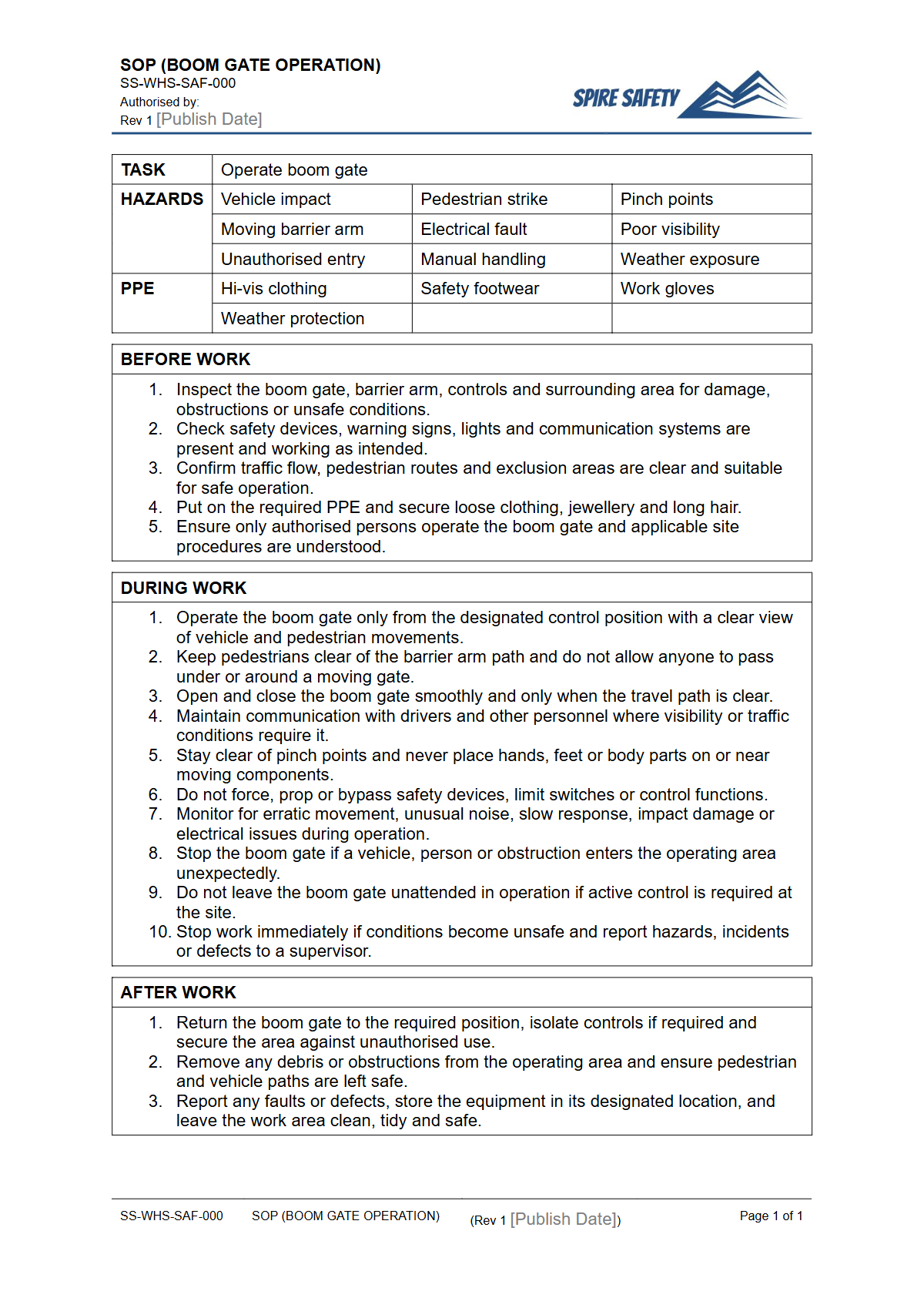
Download our free Safe Operating Procedure (Boom Gate Operation) template. This DOCX/PDF resource helps outline key risks and safety controls.
Free Safe Operating Procedure (Boom Gate Operation) Template
DOCX • 126 KB + PDF
Updated Oct 2026
No signup required
Purpose of the Free Safe Operating Procedure (Boom Gate Operation) Template
Managing vehicle and pedestrian traffic at entry and exit points is critical for workplace safety. Our Free Safe Operating Procedure (Boom Gate Operation) Template provides a structured framework for documenting the required steps to operate boom gates safely.
This template, available in both DOCX and PDF formats, helps you outline hazards, control measures, and emergency procedures specific to your site. It is an essential component of a robust WHS management system.
A Safe Operating Procedure (SOP) is a formal document that details the step-by-step process for performing a task safely. This template is designed to help you create a site-specific guide for your workers.
Its primary purpose is to minimise the risk of incidents, such as collisions with vehicles or pedestrians, equipment malfunction, or unauthorised access. By clearly defining the operational sequence, pre-start checks, potential hazards, and required personal protective equipment (PPE), the SOP serves as a vital training tool and a reference for competent operators.
It promotes consistent, safe work practices across all shifts and personnel, forming a key part of your overall risk management strategy. Implementing clear procedures is as important for fixed plant like boom gates as it is for machinery like a conveyor belt operation.
Video walkthrough
How to use the Free Safe Operating Procedure (Boom Gate Operation) Template
This Free Safe Operating Procedure (Boom Gate Operation) Template provides a comprehensive starting point, but it is not a complete, off-the-shelf solution. To be effective, you must adapt it to the specific equipment, environment, and procedural needs of your workplace.
Follow these steps:
- Download the template in your preferred format (DOCX for easy editing or PDF).
- Engage with workers and supervisors who operate the boom gates to gather practical insights.
- Conduct a thorough risk assessment for the specific location and type of boom gate used at your site.
- Fill in the details: company name, site location, specific model of the boom gate, and review dates.
- Customise the procedural steps, PPE requirements, and emergency responses to match your site's reality. Remove any steps that are not relevant.
- Have the final SOP reviewed and approved by a competent person before implementation.
If you need assistance with risk assessments or tailoring safety documents, our WHS consulting services can provide expert guidance.
Important: Customisation is Required
This document is a template only. We have provided it as a starting point, but you must review, edit, and customise it to reflect the specific hazards, risks, and control measures relevant to your workplace.
Compliance with WHS legislation depends on the final, implemented document and the associated safety practices at your site.
When to use it
An SOP for boom gate operation should be used as a central reference document in several key situations:
- Worker Training and Induction: For training new employees or contractors on the correct and safe method of operating the boom gate.
- Refresher Training: As a basis for periodic refresher training to ensure standards are maintained.
- Pre-operational Checks: As a guide for operators conducting daily or weekly checks to ensure the equipment is safe to use.
- Incident Investigation: To review whether established procedures were followed in the event of an accident or near-miss.
- Audits and Reviews: During internal or external safety reviews, such as a formal WHS compliance auditing process, to verify that documented procedures are in place and effective.
Who should use it
This SOP is intended for several key roles within an organisation:
- Boom Gate Operators: The primary users who must understand and follow the procedure for every operation.
- Supervisors and Managers: Responsible for ensuring operators are trained and competent, and that the SOP is being correctly implemented and enforced.
- WHS/HSE Personnel: For developing, reviewing, and updating safety documentation as part of the broader safety management system.
- Maintenance Staff: To understand the safe isolation and shutdown procedures before performing maintenance or repairs.
Just as with other site equipment, like what's covered in our SOP for Ride-On Mower Operation, clarity on roles and responsibilities is crucial for safe operation. This clarity is essential for all types of site machinery, from access systems to heavy equipment detailed in a Screening Plant Operation SOP.
You can find this template and many others in our comprehensive free WHS resources library to help build out your safety documentation.
Common mistakes
Common mistakes to avoid
- Failing to train relief staff or contractors on the specific boom gate procedures.
- Neglecting regular maintenance and inspection of safety sensors and mechanical parts.
- Not clearly defining exclusion zones for pedestrians around the gate's swing area.
- Using a generic SOP without customising it for the site's unique traffic flow and equipment model.
Legal references
Legal considerations
The following legal requirements may be relevant to this type of work.
- Work Health and Safety Act (Harmonised) — Provides the primary duties for protecting workers and other people from work health and safety risks.
- Work Health and Safety Regulations (Harmonised) — Sets out requirements supporting the management of workplace hazards and risks.
The following codes may be relevant to this type of work.
- Managing WHS Risks Code of Practice — Provides practical guidance on identifying hazards, assessing risks and applying effective controls.
- Work Health and Safety Consultation, Cooperation and Coordination Code of Practice — Provides practical guidance on consulting workers and coordinating with other duty holders.
- Managing the Work Environment and Facilities Code of Practice — Provides practical guidance on safe work environments, workplace facilities and related controls.
Did you know
Safety Sensor Technology
Modern boom gates often use induction loops buried in the road and photoelectric beams as safety mechanisms. These sensors detect the presence of a vehicle, preventing the gate from closing on it prematurely.
Beyond Vehicles
Boom gates are a primary form of vehicle access control, but their failure can pose significant risks to pedestrians and cyclists. A thorough risk assessment must consider all traffic types, not just cars and trucks.
FAQ
Frequently asked questions
01Is a Safe Operating Procedure for a boom gate a legal requirement in Australia?
02How often should a boom gate SOP be reviewed?
03What should be included in pre-start checks for a boom gate?
04Can this template be used for all types of boom gates?
Share this resource
Free Safe Operating Procedure (Boom Gate Operation) Template
Browse Categories
How To Use It
- 1Download and open in Word or PDF.
- 2Replace the placeholders with your business details.
- 3Get it reviewed by a WHS specialist before rollout.
Need it customised?
Our WHS consultants can adapt this template to your site, run a gap analysis, or audit what you already have in place.
Book a Free Consultation WHS consulting servicesor call 1300 156 382
Related templates
- Free Safe Operating Procedure (Boom Spray Operation) Template
- Free Safe Operating Procedure (Booster Pump Check) Template
- Free Safe Operating Procedure (Border Edging) Template
- Free Safe Operating Procedure (Bore Pump) Template
- Free Safe Operating Procedure (Bored Piling Rig) Template
- Free Safe Operating Procedure (Borescope) Template