
Free Safe Operating Procedure (Boom Spray Operation) Template
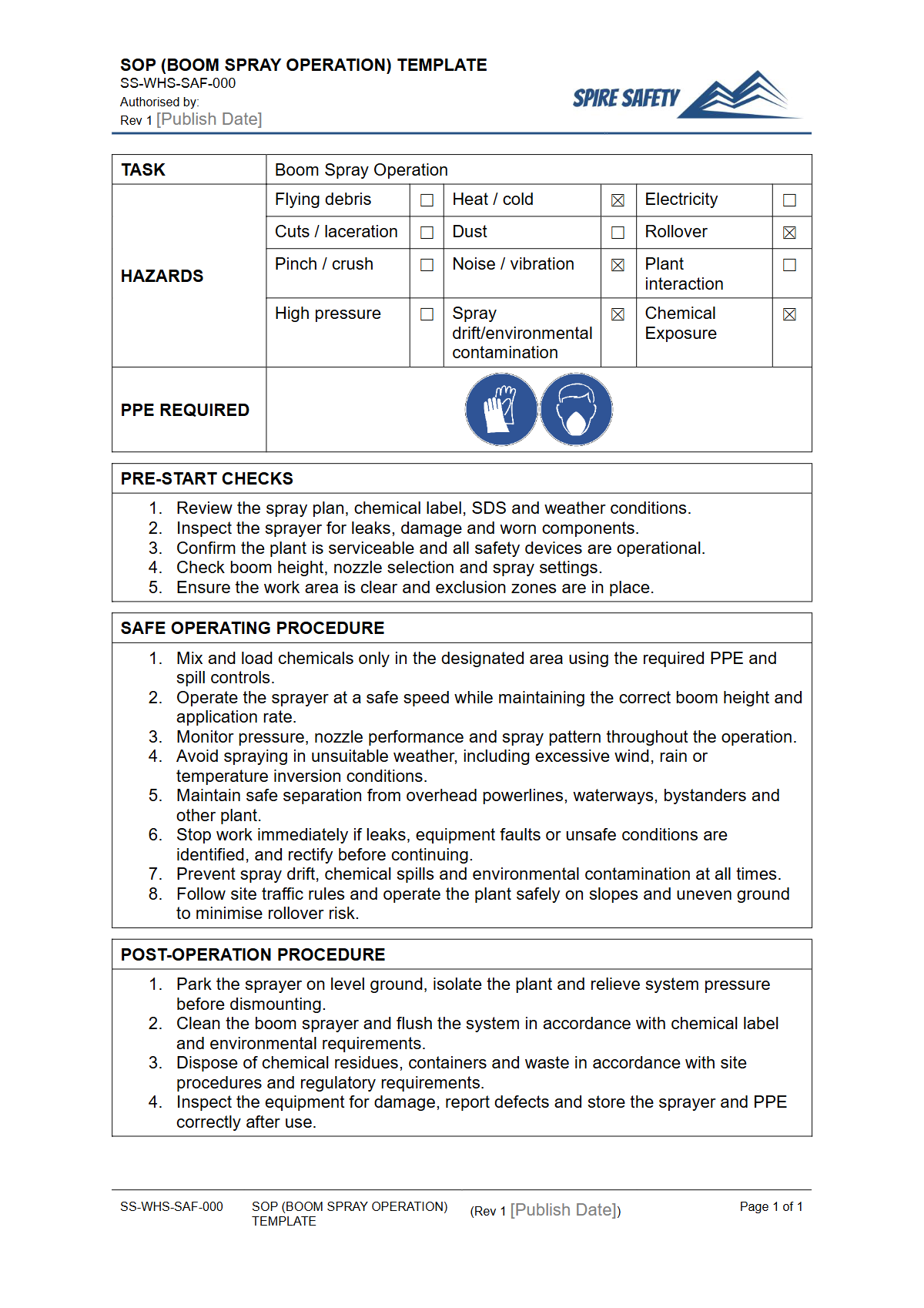
Download our free Safe Operating Procedure (SOP) for Boom Spray Operation. This DOCX and PDF template helps you document safety steps and manage risks.
Free Safe Operating Procedure (Boom Spray Operation) Template
DOCX • 151 KB + PDF
Updated Oct 2026
No signup required
Purpose of the Free Safe Operating Procedure (Boom Spray Operation) Template
Operating a boom spray involves significant risks, including chemical exposure, equipment rollover, and mechanical hazards. This Free Safe Operating Procedure (Boom Spray Operation) Template provides a structured framework for documenting the required steps to operate this equipment safely.
It is designed to help your organisation standardise practices, train operators effectively, and demonstrate a commitment to risk management. Properly developed and implemented SOPs are a fundamental component of effective WHS management systems, ensuring that all workers follow a consistent, safe method for high-risk tasks.
This template guides you through detailing pre-operational checks, safe spraying techniques, shutdown procedures, and emergency responses. By formalising these processes, you reduce the likelihood of incidents and create a safer working environment for everyone involved in agricultural or groundskeeping operations.
It serves as an essential tool for supervisors to enforce safety standards and for workers to reference correct procedures.
Video walkthrough
How to use the Free Safe Operating Procedure (Boom Spray Operation) Template
This template is available for download in both DOCX and PDF formats. The DOCX version is fully editable, allowing you to tailor the content directly to your specific machinery, chemicals, and site conditions.
Start by reviewing each section and replacing the placeholder text with information relevant to your workplace. This includes specifying the exact make and model of the boom sprayer, the types of chemicals used, required Personal Protective Equipment (PPE), and site-specific hazards like terrain, overhead powerlines, or public access areas.
It is crucial to note that this document is a template, not a finished procedure. We have not been to your workplace, assessed your specific equipment, or reviewed your chemicals and processes.
You must conduct your own risk assessment and adapt this document to reflect the unique hazards and control measures relevant to your operations. For related machinery, you might also find our free Tractor SOP Template useful, as these are often used in tandem.
When to use a Safe Operating Procedure
A Safe Operating Procedure for boom spray operation should be developed and implemented before any worker is permitted to use the equipment. It forms a core part of the training and induction process for new operators and serves as a valuable resource for refresher training for experienced staff.
The SOP should be readily accessible in the work area, either in the vehicle cabin or at a central location, for quick reference.
It should also be reviewed whenever there is a change in equipment, chemicals, or work processes, or after an incident or near miss occurs. Regular reviews, typically annually, ensure the procedure remains current and effective.
Furthermore, during a WHS compliance auditing process, documented and implemented SOPs are key evidence of a systematic approach to managing workplace risks.
Who should use it
This template is designed for use by Persons Conducting a Business or Undertaking (PCBUs), farm managers, WHS advisors, and supervisors in industries such as agriculture, horticulture, viticulture, and local government parks and gardens. It is a management tool used to establish and communicate safe work standards.
While managers and supervisors are responsible for developing, authorising, and implementing the SOP, the end-users are the operators themselves. The procedure should be written in clear, simple language that is easy for workers to understand and follow.
Consulting with experienced operators during the drafting process is essential to ensure the SOP is practical, accurate, and reflects the realities of the task. Similar documentation is critical for other heavy equipment, as outlined in our free Front End Loader SOP.
A well-drafted SOP not only protects workers but also helps the business meet its duties under WHS legislation. For more resources to support your safety framework, you can browse our complete free WHS resources library.
Common mistakes
Common mistakes to avoid
- Failing to check weather forecasts, particularly wind speed and direction, leading to spray drift.
- Using incorrect or poorly maintained Personal Protective Equipment (PPE) for the specific chemical being applied.
- Neglecting pre-start checks, such as inspecting hoses for leaks or checking nozzle condition.
- Operating the equipment at an unsafe speed for the terrain, increasing the risk of rollover.
Legal references
Legal considerations
The following legal requirements may be relevant to this type of work.
- Work Health and Safety Act (Harmonised) — Provides the primary duties for protecting workers and other people from work health and safety risks.
- Work Health and Safety Regulations (Harmonised) — Sets out requirements supporting the management of workplace hazards and risks.
The following codes may be relevant to this type of work.
- Managing WHS Risks Code of Practice — Provides practical guidance on identifying hazards, assessing risks and applying effective controls.
- Work Health and Safety Consultation, Cooperation and Coordination Code of Practice — Provides practical guidance on consulting workers and coordinating with other duty holders.
- Managing the Work Environment and Facilities Code of Practice — Provides practical guidance on safe work environments, workplace facilities and related controls.
Did you know
Chemical Drift
Spray drift can carry pesticides hundreds of metres from the target site, depending on droplet size, wind speed, and boom height. This is a leading cause of off-target environmental damage and neighbourhood disputes in agricultural areas.
Tractor Rollovers
Tractor rollovers are the single most common cause of fatalities on Australian farms. Using a boom spray can alter the tractor's centre of gravity, increasing this risk, especially on sloped or uneven ground.
FAQ
Frequently asked questions
01What is a Safe Operating Procedure for a boom spray?
02Who is responsible for creating a boom spray SOP?
03What key hazards should be included in a boom spray SOP?
04How often should a boom spray SOP be reviewed?
Share this resource
Free Safe Operating Procedure (Boom Spray Operation) Template
Browse Categories
How To Use It
- 1Download and open in Word or PDF.
- 2Replace the placeholders with your business details.
- 3Get it reviewed by a WHS specialist before rollout.
Need it customised?
Our WHS consultants can adapt this template to your site, run a gap analysis, or audit what you already have in place.
Book a Free Consultation WHS consulting servicesor call 1300 156 382
Related templates
- Free Safe Operating Procedure (Booster Pump Check) Template
- Free Safe Operating Procedure (Border Edging) Template
- Free Safe Operating Procedure (Bore Pump) Template
- Free Safe Operating Procedure (Bored Piling Rig) Template
- Free Safe Operating Procedure (Borescope) Template
- Free Safe Operating Procedure (Bosun Chair) Template