
Free Safe Operating Procedure (Boom Deployment) Template
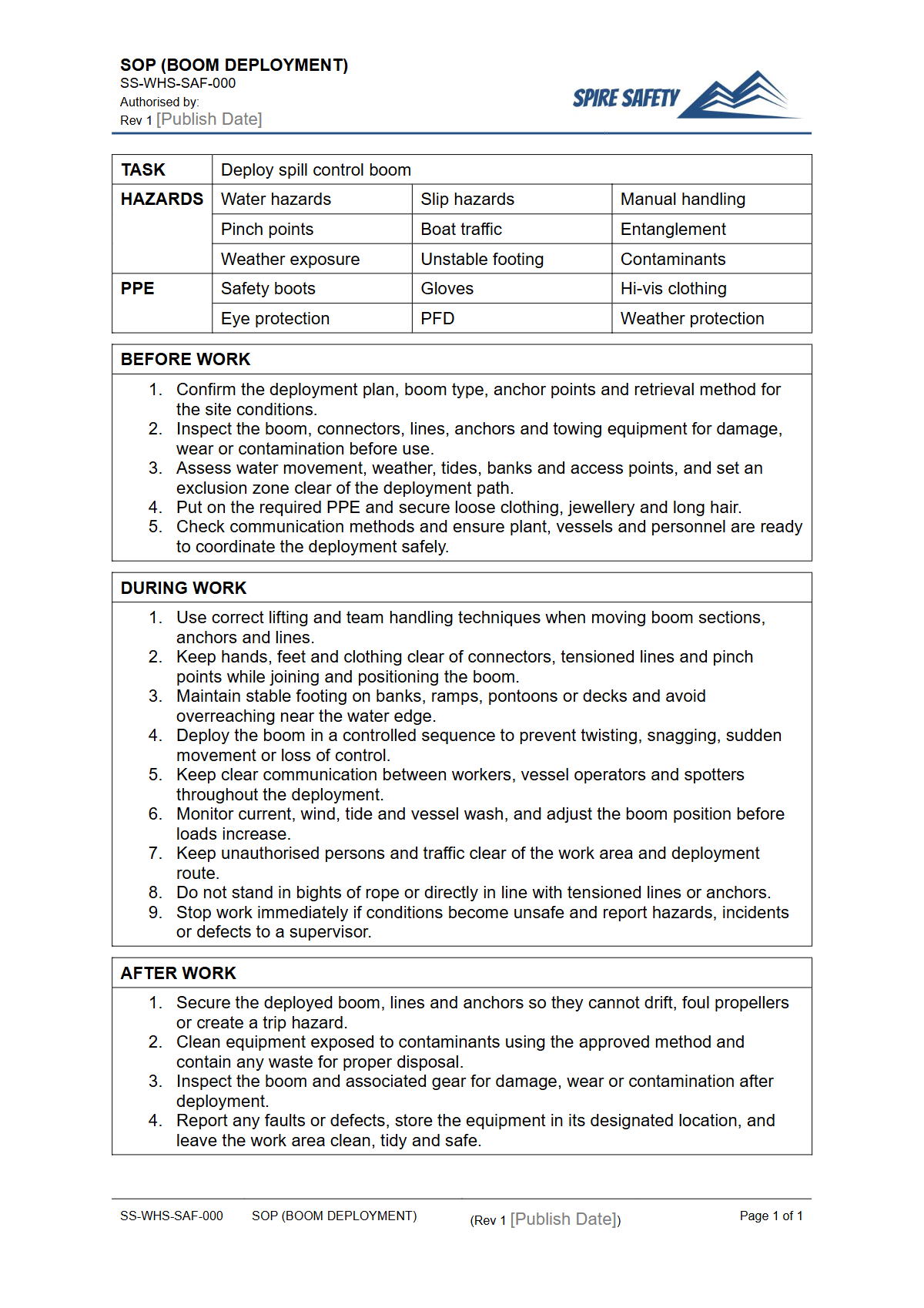
Download our free Safe Operating Procedure (Boom Deployment) template.
Free Safe Operating Procedure (Boom Deployment) Template
DOCX • 126 KB + PDF
Updated Oct 2026
No signup required
Purpose of the Free Safe Operating Procedure (Boom Deployment) Template
Operating machinery with deployable booms, such as mobile cranes, concrete pumps, or elevated work platforms (EWPs), presents significant safety risks if not managed correctly. This Free Safe Operating Procedure (Boom Deployment) Template provides a structured framework for documenting the required steps to perform this task safely.
It serves as a critical tool for any person conducting a business or undertaking (PCBU) to meet their primary duty of care under Australian WHS legislation.
A well-developed SOP formalises your risk management process, detailing pre-operational checks, hazard identification, control measures, and step-by-step instructions. Using this template helps ensure that all operators follow a consistent, safe method for boom deployment, minimising the risk of incidents related to equipment instability, structural failure, or contact with overhead powerlines.
It is a foundational document within broader comprehensive WHS management systems, demonstrating a proactive approach to workplace safety.
Video walkthrough
How to use the Free Safe Operating Procedure (Boom Deployment) Template
This document is a starting point designed for customisation. After downloading the Word (.DOCX) or .PDF file, you must systematically adapt its contents to your specific operational context.
This involves identifying the particular make and model of the equipment, the ground conditions of your site, potential overhead and underground hazards, and the competency of your personnel.
Consultation is a mandatory part of the process. Engage directly with the equipment operators and supervisors who perform the task daily.
Their practical experience is invaluable for identifying unforeseen hazards and refining the procedure to be both safe and practical. Similar to how you would adapt a Telehandler SOP template for a specific machine, this boom deployment procedure must be tailored.
Once drafted, the SOP should be reviewed, approved by management, and used as a basis for training and competency assessments.
Important: This is a template, not a completed document. We have provided a structured starting point, but you must adapt it to reflect the specific equipment, environment, and personnel at your workplace to ensure it is effective.
When to use it
A Safe Operating Procedure for boom deployment should be used consistently as part of your daily operational rhythm. It is not a document to be filed away and forgotten. It should be readily accessible to operators at all times and actively used for several key activities:
- Training and Induction: For training new operators or inducting experienced workers onto a new piece of equipment or site.
- Pre-Start and Toolbox Talks: As a reference point during daily pre-start meetings or toolbox talks to review risks and reinforce safe work methods before the task begins.
- Task Execution: As a step-by-step guide for operators to follow during the deployment process, especially for complex or non-routine setups.
- Incident Investigation: As a benchmark to review whether established procedures were followed in the event of an incident or near miss.
- Audits and Reviews: During safety inspections and formal WHS compliance audits to verify that safe systems of work are documented and implemented correctly.
Who should use it
The development and use of an SOP for boom deployment involves several key roles within an organisation. Primarily, it is for:
- Equipment Operators: The end-users who must understand and follow the procedure to ensure their own safety and the safety of those around them.
- Supervisors and Site Managers: Those responsible for overseeing work, assigning tasks, and ensuring that all operations are conducted in line with established safety protocols. They use the SOP to monitor compliance and guide their teams.
- WHS Managers and Advisors: Professionals who develop, implement, and review safety documentation as part of the overall WHS system. They often lead the customisation and consultation process. For related tasks, they might also develop a specific free Boom Pump SOP template if that is the primary equipment used.
Moreover, individuals involved in transporting heavy machinery can also benefit from understanding these procedures, as they often intersect with tasks outlined in an SOP for body trucks. For a wider range of procedural documents, you can browse our complete free WHS resources library to find templates relevant to your operations.
Common mistakes
Common mistakes to avoid
- Using a generic template without customising it for the specific equipment and worksite conditions.
- Failing to consult with equipment operators and supervisors during the drafting process.
- Not providing adequate training on the finalised SOP to all relevant personnel.
- Treating the SOP as a document for compliance only, rather than a practical tool for daily use and training.
Legal references
Legal considerations
The following legal requirements may be relevant to this type of work.
- Work Health and Safety Act (Harmonised) — Provides the primary duties for protecting workers and other people from work health and safety risks.
- Work Health and Safety Regulations (Harmonised) — Sets out requirements supporting the management of workplace hazards and risks.
The following codes may be relevant to this type of work.
- Managing WHS Risks Code of Practice — Provides practical guidance on identifying hazards, assessing risks and applying effective controls.
- Work Health and Safety Consultation, Cooperation and Coordination Code of Practice — Provides practical guidance on consulting workers and coordinating with other duty holders.
- Managing the Work Environment and Facilities Code of Practice — Provides practical guidance on safe work environments, workplace facilities and related controls.
Did you know
Mobile Plant Risks
According to Safe Work Australia, incidents involving mobile plant are a leading cause of workplace fatalities and serious injuries, with many occurring during setup, operation, and maintenance.
FAQ
Frequently asked questions
01What is the difference between an SOP and a Safe Work Method Statement (SWMS)?
02Is this template suitable for all types of booms, like EWPs and cranes?
03Who is responsible for writing a Safe Operating Procedure?
04How often should an SOP for boom deployment be reviewed?
Share this resource
Free Safe Operating Procedure (Boom Deployment) Template
Browse Categories
How To Use It
- 1Download and open in Word or PDF.
- 2Replace the placeholders with your business details.
- 3Get it reviewed by a WHS specialist before rollout.
Need it customised?
Our WHS consultants can adapt this template to your site, run a gap analysis, or audit what you already have in place.
Book a Free Consultation WHS consulting servicesor call 1300 156 382
Related templates
- Free Safe Operating Procedure (Boom Gate Operation) Template
- Free Safe Operating Procedure (Boom Spray Operation) Template
- Free Safe Operating Procedure (Booster Pump Check) Template
- Free Safe Operating Procedure (Border Edging) Template
- Free Safe Operating Procedure (Bore Pump) Template
- Free Safe Operating Procedure (Bored Piling Rig) Template