
Free Safe Operating Procedure (Bolt Cutter) Template
Download our free Safe Operating Procedure (Bolt Cutter) template. A structured starting point for Australian workplaces to manage bolt cutter hazards.
Free Safe Operating Procedure (Bolt Cutter) Template
DOCX • 126 KB + PDF
Updated Oct 2026
No signup required
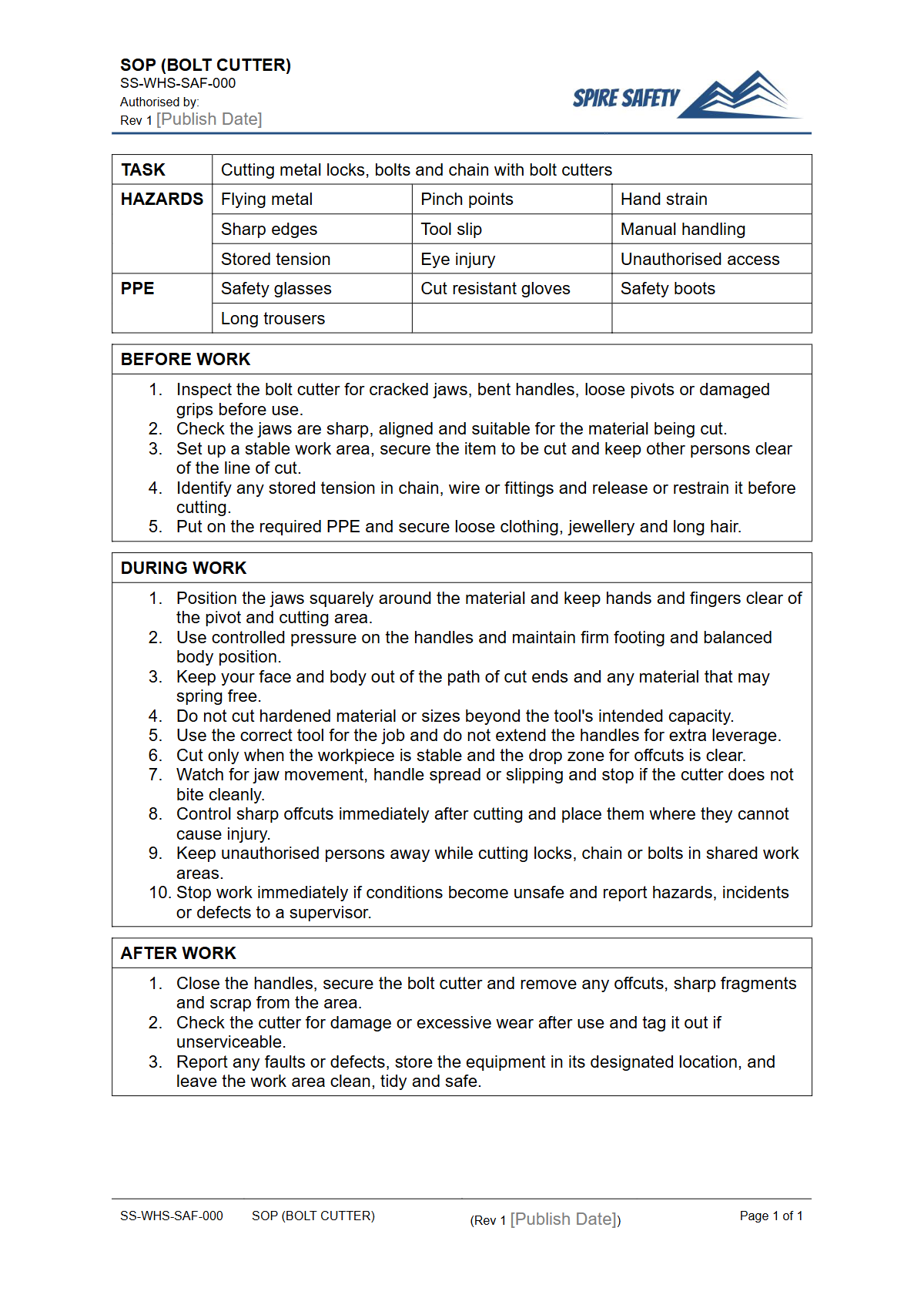
Purpose of the Free Safe Operating Procedure (Bolt Cutter) Template
A Safe Operating Procedure (SOP) is a critical document that provides step-by-step instructions on how to perform a task safely. This free Safe Operating Procedure (Bolt Cutter) Template is designed to help your organisation establish and document the approved method for using manual bolt cutters, minimising risks to workers.
Bolt cutters, while simple, pose significant hazards including projectiles from cut materials, pinch point injuries from the jaws and handles, and musculoskeletal strain from improper use. A documented procedure ensures that every operator understands the required precautions, pre-use checks, and correct cutting techniques.
Implementing formal procedures for all equipment, from simple hand tools to complex machinery, is a cornerstone of an effective safety management system. Just as you would document processes for powered equipment like in our FREE Circular Saw SOP (Safe Operating Procedure) Template, formalising the use of hand tools like bolt cutters reinforces a consistent approach to safety across all workplace activities.
This SOP template serves as a structured starting point, aligned with Australian WHS principles for risk management.
Video walkthrough
How to use the Free Safe Operating Procedure (Bolt Cutter) Template
This resource is available for download in both DOCX and PDF formats. The PDF version is ideal for quick printing and viewing, while the DOCX file is fully editable, allowing you to tailor the content to your specific operational environment.
It is crucial to adapt this template to reflect the unique context of your workplace, including the specific models of bolt cutters used, the types of materials being cut, and your existing emergency procedures.
To use the template effectively:
- Download the DOCX file.
- Replace the placeholder text with your company's name, logo, and relevant site details.
- Review and amend the steps in the procedure to match your equipment and processes.
- Add any site-specific hazards or controls that are not already included.
- Consult with workers and supervisors who regularly use bolt cutters to ensure the SOP is practical and reflects how the work is actually done.
- Finalise the document and use it as part of your training and induction processes.
Important: This is a template only. We have provided a solid foundation based on common practice, but you must customise it to suit the specific needs and risks of your workplace to ensure it is effective.
If you require assistance with customising technical documentation or developing your safety systems, our WHS consulting team can provide expert support.
When to use a Safe Operating Procedure for a Bolt Cutter
An SOP for bolt cutters should be used whenever the tool is required for a task. It forms a key part of the risk management process for activities in construction, demolition, metal fabrication, maintenance, logistics, and even emergency services.
The procedure should be readily available to workers at the point of use, either in a printed copy or digitally accessible.
This SOP is particularly important during worker inductions, new-starter training, and refresher training sessions. It serves as a practical tool for supervisors to verify that workers are competent and following safe work practices.
Integrating this procedure into your broader WHS management systems ensures that the use of bolt cutters is managed with the same level of diligence as any other workplace hazard.
Who should use this Safe Operating Procedure
This Safe Operating Procedure should be used by several key roles within an organisation:
- Workers: As a direct guide for safely performing tasks that involve cutting bolts, chains, rebar, or other materials. It is their primary reference for correct technique and required PPE.
- Supervisors and Team Leaders: To induct and train new workers, conduct toolbox talks, and monitor the safe use of equipment on-site. The SOP provides a clear benchmark against which performance can be measured, which is a key activity verified during a WHS compliance auditing process.
- WHS Managers and Advisors: To ensure a standardised, risk-assessed procedure is in place for the equipment. It serves as evidence that the organisation has a formal process for managing the associated risks.
Ultimately, anyone involved in the lifecycle of the task—from planning and execution to supervision—should be familiar with the contents of the SOP. Like other common equipment found on-site, such as those covered in our FREE Step Ladder SOP Template, it helps build a shared understanding of safety expectations.
Common mistakes
Common mistakes to avoid
- Using a cutter that is too small for the material being cut, leading to excessive force and potential tool failure.
- Failing to wear appropriate PPE, especially safety glasses or goggles, to protect against flying metal fragments.
- Using cutters with visible damage, such as chipped, cracked, or misaligned jaws.
- Attempting to extend the handles with 'cheater bars' or pipes, which overloads the tool and can cause it to break catastrophically.
Legal references
Legal considerations
The following legal requirements may be relevant to this type of work.
- Work Health and Safety Act (Harmonised) — Provides the primary duties for protecting workers and other people from work health and safety risks.
- Work Health and Safety Regulations (Harmonised) — Sets out requirements supporting the management of workplace hazards and risks.
The following codes may be relevant to this type of work.
- Managing WHS Risks Code of Practice — Provides practical guidance on identifying hazards, assessing risks and applying effective controls.
- Work Health and Safety Consultation, Cooperation and Coordination Code of Practice — Provides practical guidance on consulting workers and coordinating with other duty holders.
- Managing the Work Environment and Facilities Code of Practice — Provides practical guidance on safe work environments, workplace facilities and related controls.
Did you know
Force Multiplication
Bolt cutters use a system of compound hinges to multiply the force applied at the handles by many times, allowing a person to generate enough pressure at the jaws to shear through steel.
Not All Steel Is Equal
Standard bolt cutters are designed for soft to medium-hard metals. Attempting to cut hardened steel, such as high-security locks or case-hardened chain, can notch, chip, or break the cutter's jaws.
FAQ
Frequently asked questions
01What are the main hazards of using a bolt cutter?
02Is a Safe Operating Procedure a legal requirement for bolt cutters in Australia?
03How often should an SOP for a bolt cutter be reviewed?
04Can I use this template for other types of cutting equipment?
Share this resource
Free Safe Operating Procedure (Bolt Cutter) Template
Browse Categories
How To Use It
- 1Download and open in Word or PDF.
- 2Replace the placeholders with your business details.
- 3Get it reviewed by a WHS specialist before rollout.
Need it customised?
Our WHS consultants can adapt this template to your site, run a gap analysis, or audit what you already have in place.
Book a Free Consultation WHS consulting servicesor call 1300 156 382
Related templates
- Free Safe Operating Procedure (Bolt Tensioner) Template
- Free Safe Operating Procedure (Boom Deployment) Template
- Free Safe Operating Procedure (Boom Gate Operation) Template
- Free Safe Operating Procedure (Boom Spray Operation) Template
- Free Safe Operating Procedure (Booster Pump Check) Template
- Free Safe Operating Procedure (Border Edging) Template