
Free Safe Operating Procedure (Body Filler Sanding) Template
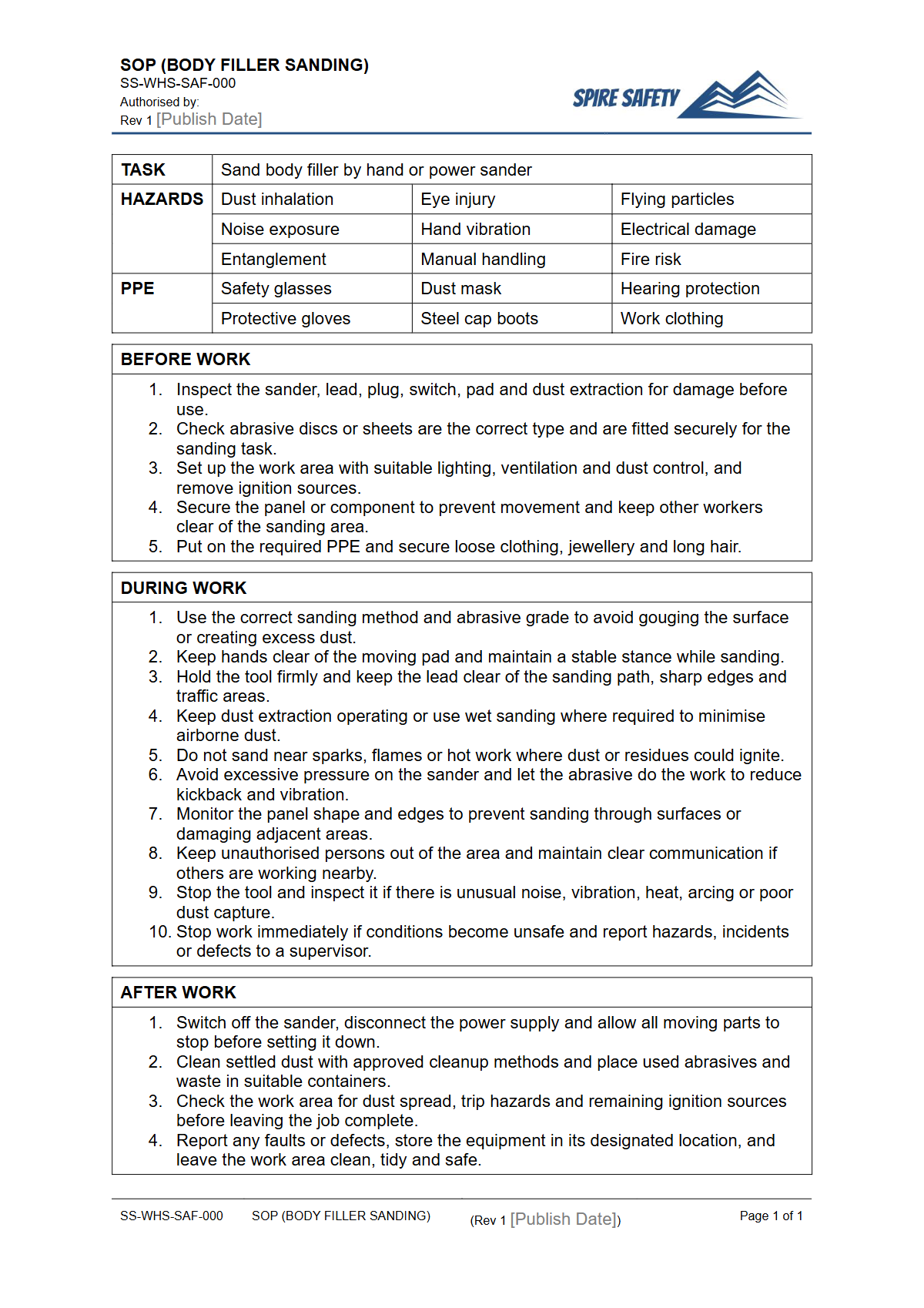
Download our free Safe Operating Procedure (Body Filler Sanding) Template. This customisable DOCX and PDF document helps outline WHS risks and controls.
Free Safe Operating Procedure (Body Filler Sanding) Template
DOCX • 126 KB + PDF
Updated Oct 2026
No signup required
Purpose of the Free Safe Operating Procedure (Body Filler Sanding) Template
Sanding automotive body filler is a common task in vehicle repair and restoration workshops, but it generates airborne contaminants that pose significant health risks. This Free Safe Operating Procedure (Body Filler Sanding) Template provides a structured framework for documenting the safest way to perform this task.
Using a standardised procedure helps your organisation manage WHS obligations by identifying hazards, assessing risks, and implementing effective control measures. A clear SOP ensures that all workers follow a consistent, safe process, reducing the risk of respiratory illness, musculoskeletal injuries, and other workplace incidents.
The primary goal of this SOP is to control worker exposure to hazardous dusts, which can contain styrene, talc, and other chemicals. By outlining steps for preparation, execution, and clean-up, the procedure serves as a vital tool for training, supervision, and ongoing safety management.
It forms a key part of a comprehensive safety system, demonstrating a commitment to protecting your team. Implementing robust procedures is a fundamental component of effective WHS management systems, helping to create a safer and more productive work environment.
Video walkthrough
How to use the Free Safe Operating Procedure (Body Filler Sanding) Template
This template is provided in both DOCX and PDF formats to suit your needs. The DOCX file is fully editable, allowing you to tailor the content to your specific operational context.
It includes sections covering potential hazards, required personal protective equipment (PPE), pre-operational checks, step-by-step instructions for the sanding process, and emergency procedures.
Important: This document is a template, not a finished procedure. To be effective, you must customise it to reflect the unique aspects of your workplace.
We have included prompts and guidance within the document to help you add site-specific details, such as the exact type of sanders used (e.g., dual-action, orbital), the specific body filler products, your dust extraction systems, and your emergency response contacts. A generic procedure cannot account for all variables, so thorough customisation is critical for ensuring worker safety.
Key Hazards in Body Filler Sanding
The most significant hazard is the inhalation of fine dust particles. Body filler dust is not inert; it often contains hazardous substances that can lead to serious long-term health issues, including occupational asthma and other respiratory diseases. Other hazards include:
- Airborne Contaminants: Dust from sanding can contain styrene, isocyanates, fibreglass, and other sensitising agents.
- Ergonomic Risks: Prolonged sanding, awkward postures, and repetitive hand/arm movements can lead to musculoskeletal disorders (MSDs). Hand-arm vibration from pneumatic or electric sanders is also a key risk factor.
- Noise: Power sanders and associated equipment, such as air compressors, can generate noise levels that require hearing protection. A well-written procedure should complement other safety documents, like a free Air Compressor SOP Template.
- Fire and Explosion: Fine organic dusts can be combustible when suspended in the air in sufficient concentration, creating a risk of explosion if an ignition source is present.
- Eye Injuries: Dust and flying particles can cause irritation or serious eye injuries without appropriate safety glasses or goggles.
When to Use This Safe Operating Procedure
A Safe Operating Procedure for body filler sanding should be an active part of your daily operations. It should be used as the primary reference document for anyone performing the task.
Its main applications include training and induction for new employees, ensuring they learn the correct, safe method from the start. It's also essential for refresher training for existing staff to prevent complacency and reinforce safe work habits.
Furthermore, the SOP should be readily available in the work area for quick reference. It also serves as a benchmark during safety observations and formal WHS compliance auditing to verify that established procedures are being followed correctly.
Who Should Use This Safe Operating Procedure
This SOP is intended for multiple roles within an organisation. Workshop managers and supervisors are responsible for customising, implementing, and enforcing the procedure.
They must ensure that all required resources, such as engineering controls and PPE, are available and maintained. WHS officers or safety representatives will use the SOP as a tool for risk assessment, training development, and incident investigation.
Most importantly, the workers who perform the sanding tasks must be thoroughly trained on the SOP and follow its steps every time. Their feedback is also crucial for reviewing and improving the procedure over time, ensuring it remains practical and effective. Similar documentation is required for other high-risk workshop tasks, like those covered in our FREE Plasma Cutter SOP Template.
The process doesn't end with a single task. A safe workshop integrates multiple procedures into a single, cohesive system.
For tasks that require working on larger vehicles or equipment, even simple access needs a documented process, which is why we also provide resources like a FREE Step Ladder SOP Template. You can find these and many more documents in our complete free WHS resources library to help build out your safety framework.
Common mistakes
Common mistakes to avoid
- Using compressed air to blow dust off surfaces or clothing, which re-suspends hazardous particles into the air.
- Relying solely on dust masks without using on-tool or local exhaust ventilation (LEV) systems.
- Wearing respiratory protection incorrectly (e.g., with facial hair breaking the seal) or using the wrong filter type.
- Failing to conduct regular maintenance on dust extraction equipment, reducing its effectiveness.
Legal references
Legal considerations
The following legal requirements may be relevant to this type of work.
- Work Health and Safety Act (Harmonised) — Provides the primary duties for protecting workers and other people from work health and safety risks.
- Work Health and Safety Regulations (Harmonised) — Sets out requirements supporting the management of workplace hazards and risks.
The following codes may be relevant to this type of work.
- Managing WHS Risks Code of Practice — Provides practical guidance on identifying hazards, assessing risks and applying effective controls.
- Work Health and Safety Consultation, Cooperation and Coordination Code of Practice — Provides practical guidance on consulting workers and coordinating with other duty holders.
- Managing the Work Environment and Facilities Code of Practice — Provides practical guidance on safe work environments, workplace facilities and related controls.
Did you know
Dust Particle Size
The most dangerous dust particles are 'respirable'—less than 10 microns in diameter—because they are small enough to travel deep into the lungs. Effective dust extraction systems are designed to capture these invisible particles at the source.
FAQ
Frequently asked questions
01What PPE is required for sanding body filler?
02What are the main health risks from sanding body filler dust?
03How often should an SOP for body filler sanding be reviewed?
04Is a Safe Work Method Statement (SWMS) needed for body filler sanding?
Share this resource
Free Safe Operating Procedure (Body Filler Sanding) Template
Browse Categories
How To Use It
- 1Download and open in Word or PDF.
- 2Replace the placeholders with your business details.
- 3Get it reviewed by a WHS specialist before rollout.
Need it customised?
Our WHS consultants can adapt this template to your site, run a gap analysis, or audit what you already have in place.
Book a Free Consultation WHS consulting servicesor call 1300 156 382
Related templates
- Free Safe Operating Procedure (Bollard Cleaning) Template
- Free Safe Operating Procedure (Bollard Maintenance) Template
- Free Safe Operating Procedure (Bolt Cutter) Template
- Free Safe Operating Procedure (Bolt Tensioner) Template
- Free Safe Operating Procedure (Boom Deployment) Template
- Free Safe Operating Procedure (Boom Gate Operation) Template