
Free Safe Operating Procedure (Boat Retrieval) Template
Download our free Safe Operating Procedure (Boat Retrieval) Template.
Free Safe Operating Procedure (Boat Retrieval) Template
DOCX • 126 KB + PDF
Updated Oct 2026
No signup required
Purpose of the Free Safe Operating Procedure (Boat Retrieval) Template
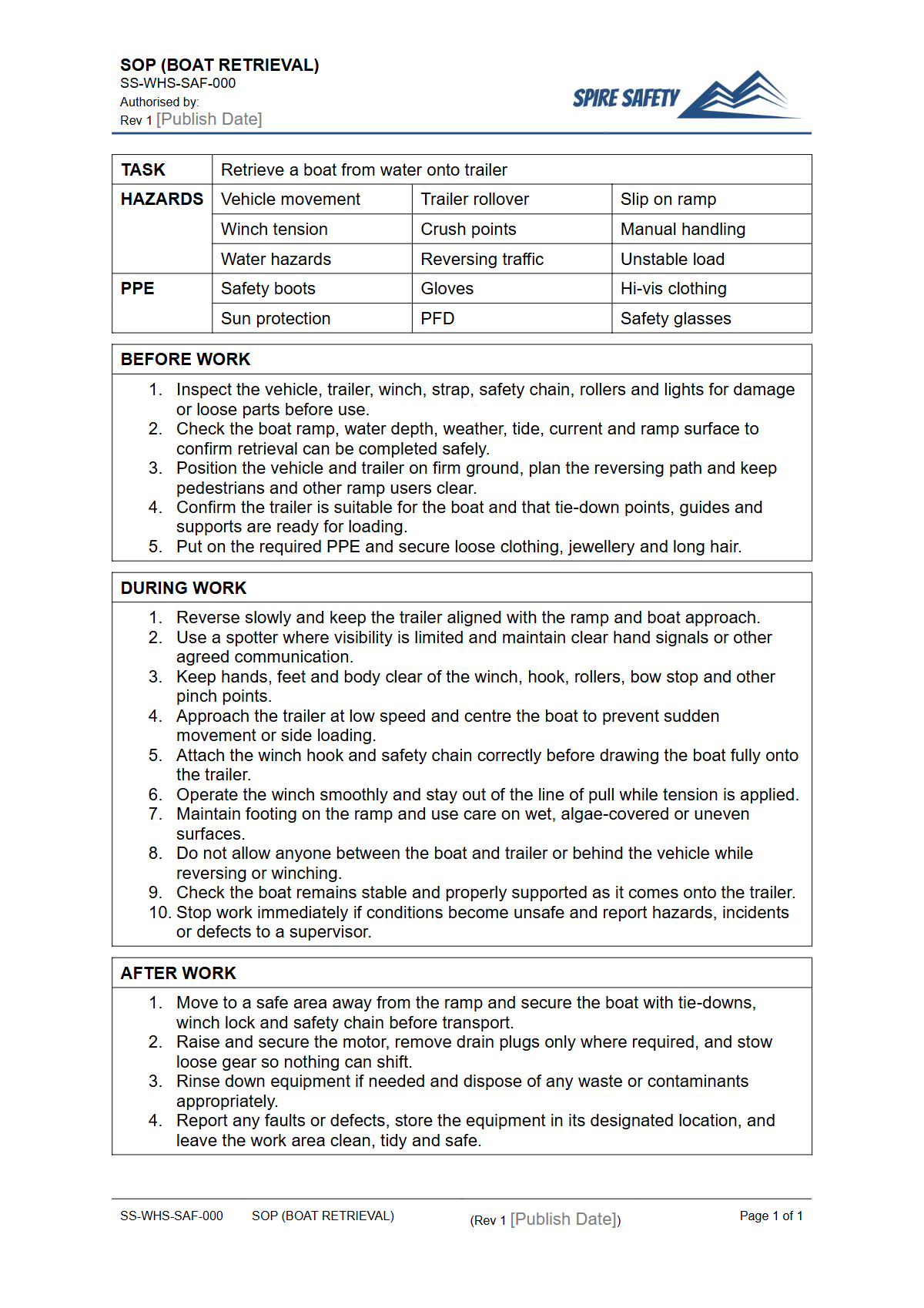
Retrieving a boat, whether from a public ramp or a private marina, involves a sequence of tasks that carry inherent risks. This free Safe Operating Procedure (Boat Retrieval) Template provides a structured framework to document the step-by-step process for safely recovering a vessel from the water onto a trailer.
Its primary purpose is to help your organisation control hazards and minimise the risk of injury to workers and damage to equipment. By clearly defining the required actions, pre-checks, communication protocols, and required Personal Protective Equipment (PPE), this SOP serves as a vital tool for training and operational consistency.
A documented procedure ensures that everyone involved understands their role and the safety measures in place. Key risks addressed in a boat retrieval SOP include slips, trips, and falls on wet surfaces, muscular stress from manual handling, crush injuries from the vehicle or trailer, and entanglement with winch cables or ropes.
Formalising this process is a fundamental part of a robust WHS management system, demonstrating a commitment to proactive safety management.
Video walkthrough
How to use the Free Safe Operating Procedure (Boat Retrieval) Template
This document is a starting point, designed to be adapted to your specific operational context. Download the DOCX file and customise it to reflect the unique details of your workplace.
You must detail the specific type of boat, trailer, and towing vehicle used, as well as the characteristics of the retrieval location (e.g., ramp gradient, tidal influences, traffic). We have provided a comprehensive outline, but it is your responsibility to ensure the final document is a true and accurate reflection of your work practices.
To effectively use this template, consult with the workers who actually perform the task. Their direct experience is invaluable for identifying practical hazards and effective controls.
Your customisation should include specifics on the towing vehicle; if you are using a rigid truck, for example, you may need to integrate controls detailed in a FREE Body Truck SOP (Safe Operating Procedure) Template. Review and approve the final SOP before implementing it through training and toolbox talks.
For larger vessels that may require workers to climb onto the trailer or boat deck during the process, it's crucial to assess fall risks. If portable ladders are used, you should incorporate safety protocols from a specific FREE Step Ladder SOP (Safe Operating Procedure) Template to ensure they are used correctly.
When to use it
A Safe Operating Procedure for boat retrieval should be used in several key situations. It forms the basis for initial training for all new staff involved in the task and is a valuable resource for refresher training to prevent complacency.
The SOP should be readily available at the location where boat retrievals occur, allowing workers to reference it as needed. It is also a critical document to review during incident investigations or near-miss reporting to identify any procedural gaps.
Furthermore, this SOP should be integrated with your risk assessment process. When a risk assessment for boat retrieval is conducted or reviewed, the SOP provides the documented 'control measures' that are in place to manage identified hazards.
Regular reviews, especially after changes in equipment, personnel, or environment, ensure the procedure remains relevant and effective. An external audit may also reference these documents to verify your safety processes, which is a key component of WHS compliance auditing.
Who should use it
This template is intended for a range of personnel within any organisation that performs boat retrievals. This includes commercial fishing operations, marine tourism providers, boat clubs, marinas, and businesses with a fleet of work vessels.
Primary users are the operators themselves—the vehicle drivers, skippers, and deckhands who physically carry out the retrieval. They use the SOP as a guide to performing their job safely.
Supervisors and managers are responsible for ensuring the SOP is implemented, understood, and followed. They use it as a tool for training, monitoring performance, and enforcing safe work standards.
Additionally, Work Health and Safety (WHS) officers or managers will use this template to develop and formalise their organisation's safety procedures as part of their broader duty of care. If your team needs expert guidance in adapting this template, consider engaging external WHS consulting services.
You can browse our entire collection of procedural documents and checklists in our free WHS resources library to support your other operational tasks.
Common mistakes
Common mistakes to avoid
- Failing to conduct pre-retrieval checks on the winch, trailer, and vehicle.
- Poor or non-existent communication between the person driving the tow vehicle and the person guiding the boat.
- Standing in direct line with a winch cable or strap while it is under tension.
- Rushing the process, which increases the likelihood of slips, trips, crush injuries, and mistakes.
Legal references
Legal considerations
The following legal requirements may be relevant to this type of work.
- Work Health and Safety Act (Harmonised) — Provides the primary duties for protecting workers and other people from work health and safety risks.
- Work Health and Safety Regulations (Harmonised) — Sets out requirements supporting the management of workplace hazards and risks.
The following codes may be relevant to this type of work.
- Managing WHS Risks Code of Practice — Provides practical guidance on identifying hazards, assessing risks and applying effective controls.
- Work Health and Safety Consultation, Cooperation and Coordination Code of Practice — Provides practical guidance on consulting workers and coordinating with other duty holders.
- Managing the Work Environment and Facilities Code of Practice — Provides practical guidance on safe work environments, workplace facilities and related controls.
Did you know
Winch Safety
Synthetic winch ropes, while lighter than steel cables, can store a significant amount of kinetic energy. If they break under load, they can whip back with enough force to cause serious injury or death, highlighting the need for defined exclusion zones in any SOP.
Boat Ramp Risks
A significant number of boating incidents occur on land at the boat ramp, not on the water. Common causes include poor communication between the driver and skipper, vehicle rollback, and slips and falls on slick, algae-covered surfaces.
FAQ
Frequently asked questions
01What should be included in a boat retrieval SOP?
02Who is responsible for creating a Safe Operating Procedure for boat retrieval?
03How often should a boat retrieval SOP be reviewed?
04Is an SOP the same as a risk assessment for boat retrieval?
Share this resource
Free Safe Operating Procedure (Boat Retrieval) Template
Browse Categories
How To Use It
- 1Download and open in Word or PDF.
- 2Replace the placeholders with your business details.
- 3Get it reviewed by a WHS specialist before rollout.
Need it customised?
Our WHS consultants can adapt this template to your site, run a gap analysis, or audit what you already have in place.
Book a Free Consultation WHS consulting servicesor call 1300 156 382
Related templates
- Free Safe Operating Procedure (Boat Trailer) Template
- Free Safe Operating Procedure (Boat Waste Removal) Template
- Free Safe Operating Procedure (Bocce Court Grooming) Template
- Free Safe Operating Procedure (Body Bag Handling) Template
- Free Safe Operating Procedure (Body Filler Sanding) Template
- Free Safe Operating Procedure (Bollard Cleaning) Template