
Free Safe Operating Procedure (Boat Trailer) Template
Download our free Safe Operating Procedure (Boat Trailer) template.
Free Safe Operating Procedure (Boat Trailer) Template
DOCX • 126 KB + PDF
Updated Oct 2026
No signup required
Purpose of the Free Safe Operating Procedure (Boat Trailer) Template
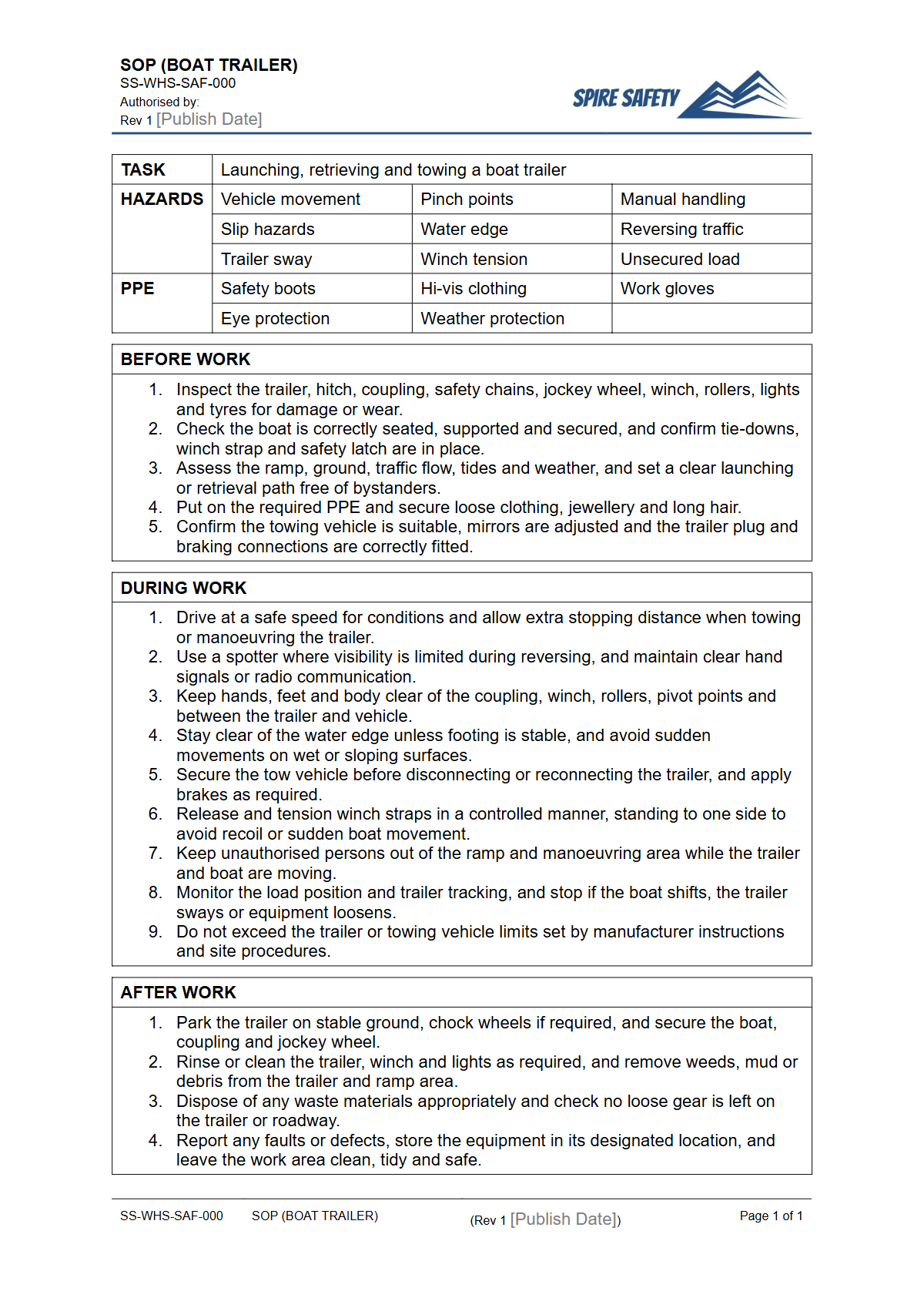
Operating a boat trailer involves more than simply hitching it to a vehicle. To help manage the unique risks associated with towing, reversing, and launching, our team has developed this free Safe Operating Procedure (Boat Trailer) Template.
This resource provides a structured starting point for documenting your organisation's specific processes, helping to ensure tasks are performed safely and consistently.
The primary purpose of this Safe Operating Procedure for boat trailers is to provide a clear, step-by-step guide for workers to follow. It formalises the safe methods for interacting with the trailer at every stage, from pre-start checks to securing the boat after retrieval.
A documented procedure helps minimise risks such as musculoskeletal injuries from manual handling, crush injuries during coupling, and collisions during transport or reversing.
Key Hazards and Control Measures
This template prompts you to identify and control common hazards, including:
- Coupling and Uncoupling: Risks of crushing, pinching, and incorrect attachment. Controls include using correct lifting posture, ensuring the area is clear, and verifying the lock and safety chains.
- Towing and Reversing: Risks of trailer sway, jack-knifing, and collisions. Controls include speed management, correct loading, regular brake checks, and using a spotter where visibility is limited.
- Launching and Retrieval: Risks of slips on wet ramps, falls, and drowning. Controls include wearing appropriate non-slip footwear, using handrails, and ensuring the vehicle's park brake is firmly engaged.
- Maintenance: Risks from working under unsupported equipment or with pressurised tyres. Controls include using vehicle stands, chocking wheels, and following correct tyre inflation procedures.
Documenting these steps provides a consistent benchmark for training and operational conduct. While specific to trailers, the principles of documenting vehicle operations are universal, as seen in our FREE Body Truck SOP (Safe Operating Procedure) Template.
Video walkthrough
How to use the Free Safe Operating Procedure (Boat Trailer) Template
Download the template in your preferred format (DOCX for easy editing or PDF). The document is structured with sections for you to complete, covering everything from required Personal Protective Equipment (PPE) to emergency procedures.
IMPORTANT: This is a template only. We've provided a solid foundation based on Australian WHS principles, but you must customise this Safe Operating Procedure to reflect the specific boat trailers, towing vehicles, launch sites, and work environment at your organisation.
Always consult the manufacturer's operating manual for both the trailer and the boat.
A thorough risk assessment should be conducted to ensure all site-specific hazards are identified and controlled within your final document. If you need expert assistance in adapting templates to your workplace or developing comprehensive safety documentation, our WHS consulting team can provide practical support.
When to use this Safe Operating Procedure
A Safe Operating Procedure (SOP) is a live document that should be integrated into your daily operations. It is not a 'set and forget' piece of paperwork. It should be used:
- As a primary tool for training new staff or members.
- For periodic refresher training with experienced operators to prevent complacency.
- As a reference guide before starting the task.
- During safety observations or internal audits to verify correct procedures are being followed.
- As a key document in any incident investigation involving a boat trailer.
Using SOPs consistently for all types of equipment helps build a strong safety culture. For example, even simple equipment requires a documented process, as shown in our FREE Step Ladder SOP (Safe operating Procedure) Template.
Who should use this Safe Operating Procedure
This SOP should be used by any person required to operate, move, or work around a boat trailer as part of their job or duties. This includes:
- Vehicle operators and drivers
- Marina and yacht club staff
- Commercial fishing operators
- Boat maintenance technicians and mechanics
- Supervisors and managers responsible for overseeing these tasks
Everyone involved must be trained on the contents of the final, customised SOP and be deemed competent to perform the task safely. This procedure forms a critical component of your broader safety framework, which can be strengthened through the implementation of dedicated WHS management systems.
To ensure your procedures remain effective and are being followed correctly, you might consider periodic reviews by a third party. A formal process of WHS compliance auditing can identify gaps in your safety processes before an incident occurs.
The principles outlined here for managing vehicle and trailer operations can be adapted for other types of heavy machinery. For instance, operators of large earthmoving equipment would follow a similarly structured procedure, like the one detailed in our FREE Dozer SOP (Safe Operating Procedure) Template.
If you're looking for other templates to build out your safety documentation, be sure to explore our complete free WHS resources library for a wide range of checklists, procedures, and forms.
Common mistakes
Common mistakes to avoid
- Forgetting to attach the safety chain or crossing chains incorrectly under the coupling.
- Failing to conduct a pre-departure check of tyre pressure, wheel bearings, and lights.
- Not using wheel chocks when unhitching the trailer, especially on any kind of slope.
- Underestimating the impact of side winds or the wake from passing heavy vehicles while towing.
Legal references
Legal considerations
The following legal requirements may be relevant to this type of work.
- Work Health and Safety Act (Harmonised) — Provides the primary duties for protecting workers and other people from work health and safety risks.
- Work Health and Safety Regulations (Harmonised) — Sets out requirements supporting the management of workplace hazards and risks.
The following codes may be relevant to this type of work.
- Managing WHS Risks Code of Practice — Provides practical guidance on identifying hazards, assessing risks and applying effective controls.
- Work Health and Safety Consultation, Cooperation and Coordination Code of Practice — Provides practical guidance on consulting workers and coordinating with other duty holders.
- Managing the Work Environment and Facilities Code of Practice — Provides practical guidance on safe work environments, workplace facilities and related controls.
Did you know
Tow Ball Weight is Critical
The downward force on the tow ball, or 'tow ball mass', should typically be 7-10% of the total trailer weight. Incorrect weight distribution is a leading cause of dangerous trailer sway and loss of control.
Trailer Tyre Age Matters
Trailer tyres often degrade from sun exposure and age, not just from use. Most manufacturers recommend replacing them every 5-7 years, regardless of how much tread is left.
FAQ
Frequently asked questions
01What is a Safe Operating Procedure for a boat trailer?
02Is this template suitable for all types of boat trailers?
03Who is responsible for creating the SOP at a workplace?
04How often should a Boat Trailer SOP be reviewed?
Share this resource
Free Safe Operating Procedure (Boat Trailer) Template
Browse Categories
How To Use It
- 1Download and open in Word or PDF.
- 2Replace the placeholders with your business details.
- 3Get it reviewed by a WHS specialist before rollout.
Need it customised?
Our WHS consultants can adapt this template to your site, run a gap analysis, or audit what you already have in place.
Book a Free Consultation WHS consulting servicesor call 1300 156 382
Related templates
- Free Safe Operating Procedure (Boat Waste Removal) Template
- Free Safe Operating Procedure (Bocce Court Grooming) Template
- Free Safe Operating Procedure (Body Bag Handling) Template
- Free Safe Operating Procedure (Body Filler Sanding) Template
- Free Safe Operating Procedure (Bollard Cleaning) Template
- Free Safe Operating Procedure (Bollard Maintenance) Template