
Free Safe Operating Procedure (Boat Cabin Cleaning) Template
Download our free Safe Operating Procedure (Boat Cabin Cleaning) template. This customisable DOCX & PDF resource helps manage risks for commercial cleaning.
Free Safe Operating Procedure (Boat Cabin Cleaning) Template
DOCX • 126 KB + PDF
Updated Oct 2026
No signup required
Purpose of the Free Safe Operating Procedure (Boat Cabin Cleaning) Template
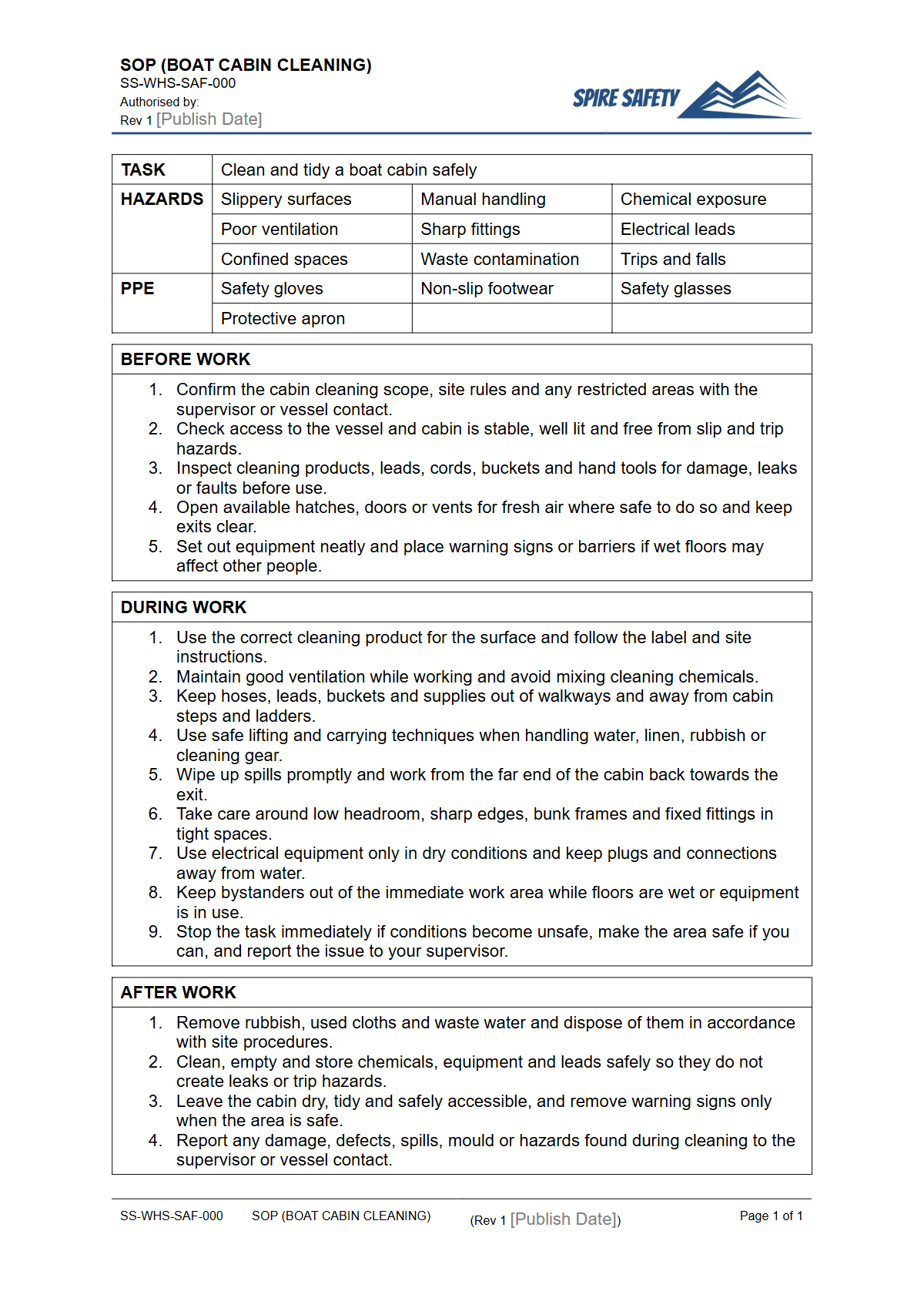
Cleaning the interior of a boat cabin involves a unique set of hazards that require a formalised safety process. Our Free Safe Operating Procedure (Boat Cabin Cleaning) Template provides a structured starting point for your business to document the risks and control measures for this common task.
A well-defined SOP is a critical tool for ensuring workers follow a consistent, safe method every time, reducing the likelihood of incidents and injuries. It forms a key part of a comprehensive WHS management system.
This procedure prompts you to consider specific risks such as exposure to hazardous cleaning chemicals, slips and trips on wet surfaces, manual handling injuries from moving equipment, and ergonomic strains from working in cramped or awkward positions. It also covers the need for adequate ventilation and the correct use of Personal Protective Equipment (PPE). For tasks that involve working at height, such as cleaning high windows or ceilings, a specific process is needed, similar to the one outlined in our FREE Step Ladder SOP Template.
How to use the Free Safe Operating Procedure (Boat Cabin Cleaning) Template
This document is provided in a user-friendly DOCX format, allowing for complete customisation to suit your specific operational needs. To implement it effectively, download the file and systematically work through each section, replacing the placeholder text with details relevant to your vessel, equipment, and cleaning products.
This includes identifying the exact chemicals used (and referencing their Safety Data Sheets), listing the required PPE, and detailing your site-specific emergency response procedures.
Important: Please be aware that this document is a template. It is essential that you customise it to reflect the specific hazards, equipment, and procedures of your workplace.
Spire Safety is not responsible for any incidents that may occur from the use of this template. Regular review is also crucial to ensure the SOP remains current.
An external review as part of a WHS compliance auditing program can help identify any gaps.
Video walkthrough
When to use it
A Safe Operating Procedure for boat cabin cleaning should be used as a primary reference document for all related tasks. It is not a document to be filed away and forgotten. It should be readily accessible to all relevant workers and actively used in several situations:
- Before each job: As a pre-start checklist to ensure all safety measures are in place.
- Worker training and induction: To provide new and existing employees with clear, step-by-step instructions on how to perform the task safely.
- Toolbox talks: As a basis for regular safety discussions, reinforcing key safety behaviours and addressing any recent concerns or near misses.
- Incident investigation: To review whether the established procedure was followed and to identify opportunities for improvement.
- When procedures change: The SOP must be updated whenever new chemicals, equipment, or cleaning methods are introduced. For example, if a new high-powered blower is introduced for drying, its use should be documented in a manner similar to our Free Air Compressor SOP.
Who should use it
This SOP is intended for use by multiple roles within an organisation to foster a collaborative approach to safety. Primary users include:
- Cleaning Personnel: The workers directly performing the cabin cleaning tasks must understand and follow the procedure to protect their health and safety.
- Supervisors and Team Leaders: They are responsible for ensuring their teams are trained on the SOP, have access to the required PPE, and adhere to the documented procedures during their work.
- WHS Managers/Officers: These professionals use the SOP as part of the overall safety management system, using it for risk assessments, training development, and compliance monitoring.
- Vessel Owners and Managers: They hold the ultimate responsibility (as a PCBU) to provide a safe working environment, which includes ensuring adequate safety procedures are developed, implemented, and maintained. For expert guidance in defining these responsibilities, many businesses engage WHS consulting services.
By implementing a clear and specific SOP, your organisation demonstrates a commitment to workplace safety and a proactive approach to risk management. To find other useful templates and checklists, you can browse our full free WHS resources library.
Common mistakes
Common mistakes to avoid
- Using incorrect or unlabelled cleaning chemicals without consulting the Safety Data Sheet (SDS).
- Failing to ensure adequate cross-ventilation, leading to a build-up of hazardous fumes in a confined space.
- Not inspecting electrical equipment like vacuums for damage before use in a wet environment.
- Neglecting to customise the generic SOP template to reflect the specific layout and equipment of the vessel being cleaned.
Legal references
Legal considerations
The following legal requirements may be relevant to this type of work.
- Work Health and Safety Act (Harmonised) — Provides the primary duties for protecting workers and other people from work health and safety risks.
- Work Health and Safety Regulations (Harmonised) — Sets out requirements supporting the management of workplace hazards and risks.
The following codes may be relevant to this type of work.
- Managing WHS Risks Code of Practice — Provides practical guidance on identifying hazards, assessing risks and applying effective controls.
- Work Health and Safety Consultation, Cooperation and Coordination Code of Practice — Provides practical guidance on consulting workers and coordinating with other duty holders.
- Managing the Work Environment and Facilities Code of Practice — Provides practical guidance on safe work environments, workplace facilities and related controls.
Did you know
Chemical Reactions
Mixing common cleaning products like bleach and ammonia-based cleaners can create toxic chloramine gas, which can cause severe respiratory issues. Always read chemical labels and never mix different cleaning agents.
Slips, Trips, and Falls
According to Safe Work Australia, slips, trips, and falls are a leading cause of workplace injury. The risk is significantly heightened in marine environments due to constantly wet and often unstable surfaces.
FAQ
Frequently asked questions
01What are the main hazards involved in boat cabin cleaning?
02How often should a Safe Operating Procedure for boat cabin cleaning be reviewed?
03Is a Safe Work Method Statement (SWMS) required for boat cabin cleaning?
04What PPE is typically required for boat cabin cleaning?
Share this resource
Free Safe Operating Procedure (Boat Cabin Cleaning) Template
Browse Categories
How To Use It
- 1Download and open in Word or PDF.
- 2Replace the placeholders with your business details.
- 3Get it reviewed by a WHS specialist before rollout.
Need it customised?
Our WHS consultants can adapt this template to your site, run a gap analysis, or audit what you already have in place.
Book a Free Consultation WHS consulting servicesor call 1300 156 382
Related templates
- Free Safe Operating Procedure (Boat Fender Handling) Template
- Free Safe Operating Procedure (Boat Launching) Template
- Free Safe Operating Procedure (Boat Line Stowage) Template
- Free Safe Operating Procedure (Boat Refuelling) Template
- Free Safe Operating Procedure (Boat Retrieval) Template
- Free Safe Operating Procedure (Boat Trailer) Template