
Free Safe Operating Procedure (Boat Launching) Template
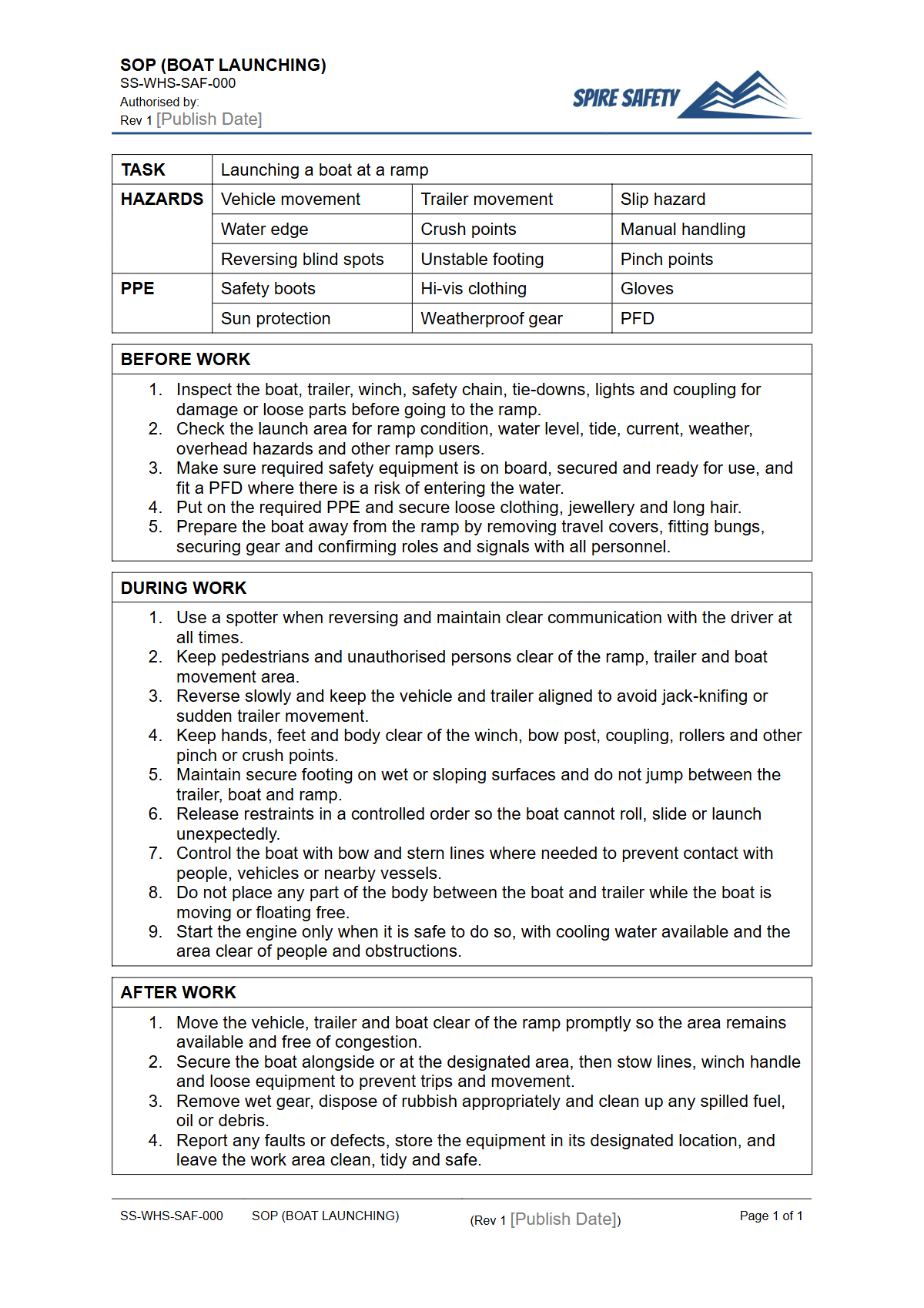
Download our free Safe Operating Procedure (Boat Launching) template. This customisable DOCX helps you define safe work practices for boat launching tasks.
Free Safe Operating Procedure (Boat Launching) Template
DOCX • 126 KB + PDF
Updated Oct 2026
No signup required
Purpose of the Free Safe Operating Procedure (Boat Launching) Template
This Safe Operating Procedure (SOP) for boat launching provides a structured framework for identifying and controlling risks associated with this common but hazardous task. Using a formalised procedure helps organisations meet their duty of care under WHS legislation.
The primary purpose of this free Safe Operating Procedure (Boat Launching) template is to establish a clear, step-by-step guide for workers, ensuring that launching a vessel from a trailer is performed safely and consistently every time. It addresses key hazards such as slips on wet ramps, muscular stress from manual handling, crush injuries between the vehicle and trailer, and the risk of drowning.
By documenting the process, you create a reliable training tool for new staff and a reference point for experienced operators. A well-developed SOP is a fundamental part of comprehensive WHS management systems, demonstrating a proactive approach to workplace safety and risk management.
It formalises expectations and control measures, moving beyond informal or assumed knowledge.
Video walkthrough
How to use the Free Safe Operating Procedure (Boat Launching) Template
Our free Safe Operating Procedure for boat launching is provided as a fully editable DOCX file, allowing for complete customisation. This template is a starting point, not a finished document.
To use it effectively, download the file and adapt it to the specific context of your workplace. You must consider the unique variables at your site, including the types of boats, trailers, and towing vehicles used, the conditions of your boat ramp (e.g., slope, surface material, tidal influence), and the competency of your personnel.
The template guides you through key sections, including:
- Required Personal Protective Equipment (PPE)
- Potential hazards and their associated risks
- A sequence of operations from pre-launch checks to securing the vessel post-launch
- Emergency procedures
Important: We have developed this template to align with Australian WHS principles, but it is impossible for a generic document to cover every specific hazard at your site. You must conduct your own risk assessment and modify this document to reflect your findings.
This might involve adding steps for specific machinery, like those detailed in our FREE Body Truck SOP Template if that's your towing vehicle class.
When to use this Safe Operating Procedure
A boat launching SOP should be implemented and actively used in any commercial or organisational setting where the task is performed. It is not just a document to be filed away; it is a live tool for daily operations.
It should be consulted during worker inductions, used as the basis for practical training and competency assessments, and reviewed before undertaking any non-routine or high-risk launch. Regular toolbox talks can also reference the SOP to reinforce safe work practices.
After implementation, the effectiveness of the procedure should be periodically reviewed as part of your WHS compliance auditing program.
Who should use it
This procedure is designed for use by any Person Conducting a Business or Undertaking (PCBU) whose workers, contractors, or volunteers are required to launch boats. This includes a wide range of industries and organisations:
- Marina and boat harbour operators
- Commercial fishing operations
- Tour boat and water-based tourism providers
- Sailing clubs and aquatic sport organisations
- Environmental monitoring agencies
- Marine construction and maintenance companies
Supervisors and managers are responsible for ensuring the SOP is implemented and followed, while workers are responsible for adhering to the documented procedures. In complex marine environments or for organisations needing tailored safety solutions, engaging specialist WHS consulting services can provide expert guidance in developing robust and effective safety documentation.
During pre-launch checks, operators may need to access parts of the boat while it is still on the trailer. This can introduce risks of falls from height, which should be managed. For tasks involving temporary access equipment, you may need a separate procedure like our FREE Step Ladder SOP Template.
If this document isn't exactly what you need, feel free to browse our complete free WHS resources library for other templates and checklists that may suit your requirements.
Common mistakes
Common mistakes to avoid
- Using a generic template without customising it for the specific boat, trailer, vehicle, and ramp conditions.
- Failing to provide practical, hands-on training for all operators based on the finalised SOP.
- Neglecting to check weather forecasts, tide charts, and ramp conditions before starting the launch.
- Forgetting to include procedures for communication between the vehicle driver and the person guiding the trailer.
Legal references
Legal considerations
The following legal requirements may be relevant to this type of work.
- Work Health and Safety Act (Harmonised) — Provides the primary duties for protecting workers and other people from work health and safety risks.
- Work Health and Safety Regulations (Harmonised) — Sets out requirements supporting the management of workplace hazards and risks.
The following codes may be relevant to this type of work.
- Managing WHS Risks Code of Practice — Provides practical guidance on identifying hazards, assessing risks and applying effective controls.
- Work Health and Safety Consultation, Cooperation and Coordination Code of Practice — Provides practical guidance on consulting workers and coordinating with other duty holders.
- Managing the Work Environment and Facilities Code of Practice — Provides practical guidance on safe work environments, workplace facilities and related controls.
Did you know
The 'Ramp Rush' Risk
A significant number of boat ramp incidents occur due to operators feeling rushed by others waiting to use the facility. A documented SOP helps ensure critical safety steps are never skipped, regardless of pressure.
Trailer Maintenance is Key
The Australian Maritime Safety Authority (AMSA) notes that trailer failure, including issues with brakes, wheel bearings, and couplings, is a common cause of boat launching incidents. Regular maintenance should be a critical part of your procedure.
FAQ
Frequently asked questions
01What is a Safe Operating Procedure for boat launching?
02Is an SOP legally required for launching a boat in Australia?
03What are the main hazards of boat launching?
04Who is responsible for developing a boat launching SOP?
Share this resource
Free Safe Operating Procedure (Boat Launching) Template
Browse Categories
How To Use It
- 1Download and open in Word or PDF.
- 2Replace the placeholders with your business details.
- 3Get it reviewed by a WHS specialist before rollout.
Need it customised?
Our WHS consultants can adapt this template to your site, run a gap analysis, or audit what you already have in place.
Book a Free Consultation WHS consulting servicesor call 1300 156 382
Related templates
- Free Safe Operating Procedure (Boat Line Stowage) Template
- Free Safe Operating Procedure (Boat Refuelling) Template
- Free Safe Operating Procedure (Boat Retrieval) Template
- Free Safe Operating Procedure (Boat Trailer) Template
- Free Safe Operating Procedure (Boat Waste Removal) Template
- Free Safe Operating Procedure (Bocce Court Grooming) Template