
Free Safe Operating Procedure (Boat Line Stowage) Template
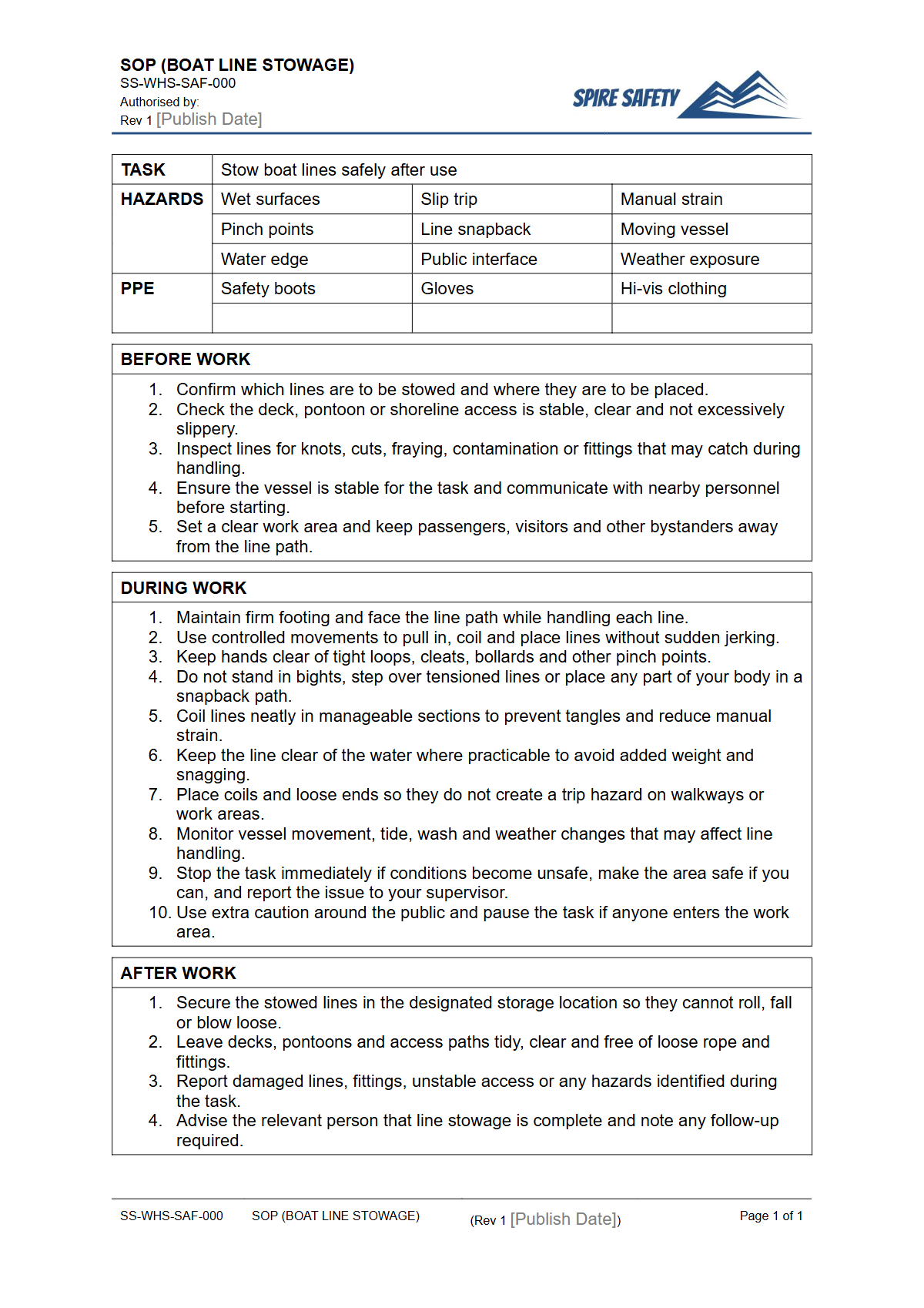
Download our Free Safe Operating Procedure (Boat Line Stowage) Template. This user-friendly DOCX and PDF resource helps outline safe systems of work.
Free Safe Operating Procedure (Boat Line Stowage) Template
DOCX • 126 KB + PDF
Updated Oct 2026
No signup required
Purpose of the Free Safe Operating Procedure (Boat Line Stowage) Template
This Free Safe Operating Procedure (Boat Line Stowage) Template provides a structured framework for documenting the step-by-step process of safely handling and stowing mooring lines, tow lines, and other ropes on a vessel. Proper line stowage is critical for preventing trip hazards, ensuring lines are ready for immediate use, and protecting them from damage.
Unsecured lines on deck present a serious risk of slips, trips, and entanglement, which can lead to severe injuries or man-overboard incidents. This SOP template helps a Person Conducting a Business or Undertaking (PCBU) establish and communicate clear, safe work methods to all crew members.
By formalising the procedure, you can standardise behaviour, assist in training new personnel, and demonstrate a commitment to managing workplace risks. The document serves as a foundation for your site-specific safety protocols, detailing pre-operational checks, the coiling or flaking process, and correct storage methods.
This methodical approach is a core component of an effective safety management system, ensuring that tasks are performed consistently and safely every time.
Video walkthrough
How to use the Free Safe Operating Procedure (Boat Line Stowage) Template
This template is available for download in both DOCX and PDF formats. The DOCX version is fully editable, allowing you to tailor the content to your specific operational needs, including the types of lines used (e.g., nylon, polypropylene, Dyneema), the stowage equipment available (e.g., drums, lockers, hangers), and your vessel’s unique layout.
It is crucial to integrate this procedure into your broader safety framework. A well-documented SOP is a key element when developing comprehensive WHS management systems that protect workers and ensure operational efficiency.
Important: This is a template, not a finished document. We have designed it to be a starting point that you must adapt.
It is your responsibility to ensure the final Safe Operating Procedure is customised to reflect the specific hazards, equipment, vessel, and legal requirements of your unique work environment and operations.
When to use it
A Safe Operating Procedure for boat line stowage should be used as the primary reference document for all personnel involved in line handling tasks. It is essential for inducting and training new crew members to ensure they understand the established safety standards from day one.
The SOP should also be referenced during pre-departure checks, after mooring or anchoring operations, and whenever lines are being tidied or secured on deck. Furthermore, it serves as a critical tool during safety meetings and toolbox talks to reinforce correct procedures and discuss any near misses related to line handling.
Regular reviews of the SOP, especially after an incident or when operational methods change, are vital for maintaining its relevance and effectiveness. This review process can be supported by periodic WHS compliance auditing to verify that documented procedures align with actual practices.
Who should use it
This SOP is intended for a range of personnel within a maritime or port environment. This includes vessel masters, skippers, deckhands, and any crew responsible for mooring, anchoring, and general deck safety.
Supervisors and leading hands should use the SOP to oversee work, enforce safety standards, and deliver on-the-job training. WHS managers and safety officers can use the template to establish a baseline for risk management and ensure consistency across a fleet or organisation.
It provides the detailed, task-specific information needed to support broader ISO 45001 safety management systems by codifying safe practices at the operational level.
Safe access and egress around the vessel are also critical. For tasks requiring work at minor heights, such as inspections or reaching stored equipment, a documented procedure for portable ladders is essential.
Our FREE Step Ladder SOP Template can help formalise these simple but high-risk activities.
Beyond line stowage, a vessel or port environment contains numerous other tasks that require formalised safety procedures. For example, using equipment for maintenance, like an air compressor, requires its own specific instructions.
You can use our free Air Compressor SOP template as a guide for documenting these related procedures. You can explore our entire free WHS resources library to find more templates to support your WHS program.
Common mistakes
Common mistakes to avoid
- Leaving lines coiled loosely on deck instead of hanging them or securing them properly.
- Stowing wet or salty lines in unventilated lockers, which promotes mould, mildew, and fibre degradation.
- Failing to inspect lines for chafe, UV damage, or cuts before stowing them away after use.
- Using a generic procedure without customising it for the specific vessel, line types, and deck layout.
Legal references
Legal considerations
The following legal requirements may be relevant to this type of work.
- Work Health and Safety Act (Harmonised) — Provides the primary duties for protecting workers and other people from work health and safety risks.
- Work Health and Safety Regulations (Harmonised) — Sets out requirements supporting the management of workplace hazards and risks.
The following codes may be relevant to this type of work.
- Managing WHS Risks Code of Practice — Provides practical guidance on identifying hazards, assessing risks and applying effective controls.
- Work Health and Safety Consultation, Cooperation and Coordination Code of Practice — Provides practical guidance on consulting workers and coordinating with other duty holders.
- Managing the Work Environment and Facilities Code of Practice — Provides practical guidance on safe work environments, workplace facilities and related controls.
Did you know
Line Strength Loss
A poorly coiled rope can lose up to 30% of its breaking strength due to kinks, sharp bends, and twists introduced during improper stowage.
A Primary Hazard
Slips, trips, and falls are one of the most common causes of injury in the maritime industry, with loose or improperly stowed lines on deck being a primary contributor.
FAQ
Frequently asked questions
01What is a Safe Operating Procedure for boat line stowage?
02Why is proper boat line stowage important for safety?
03Who is responsible for creating and implementing this SOP?
04How often should a Boat Line Stowage SOP be reviewed?
Share this resource
Free Safe Operating Procedure (Boat Line Stowage) Template
Browse Categories
How To Use It
- 1Download and open in Word or PDF.
- 2Replace the placeholders with your business details.
- 3Get it reviewed by a WHS specialist before rollout.
Need it customised?
Our WHS consultants can adapt this template to your site, run a gap analysis, or audit what you already have in place.
Book a Free Consultation WHS consulting servicesor call 1300 156 382
Related templates
- Free Safe Operating Procedure (Boat Refuelling) Template
- Free Safe Operating Procedure (Boat Retrieval) Template
- Free Safe Operating Procedure (Boat Trailer) Template
- Free Safe Operating Procedure (Boat Waste Removal) Template
- Free Safe Operating Procedure (Bocce Court Grooming) Template
- Free Safe Operating Procedure (Body Bag Handling) Template