
Free Safe Operating Procedure (Boat Fender Handling) Template
Download our free Safe Operating Procedure (Boat Fender Handling) template. This customisable DOCX & PDF helps standardise safe fender deployment and retrieval.
Free Safe Operating Procedure (Boat Fender Handling) Template
DOCX • 126 KB + PDF
Updated Oct 2026
No signup required
Purpose of the Free Safe Operating Procedure (Boat Fender Handling) Template
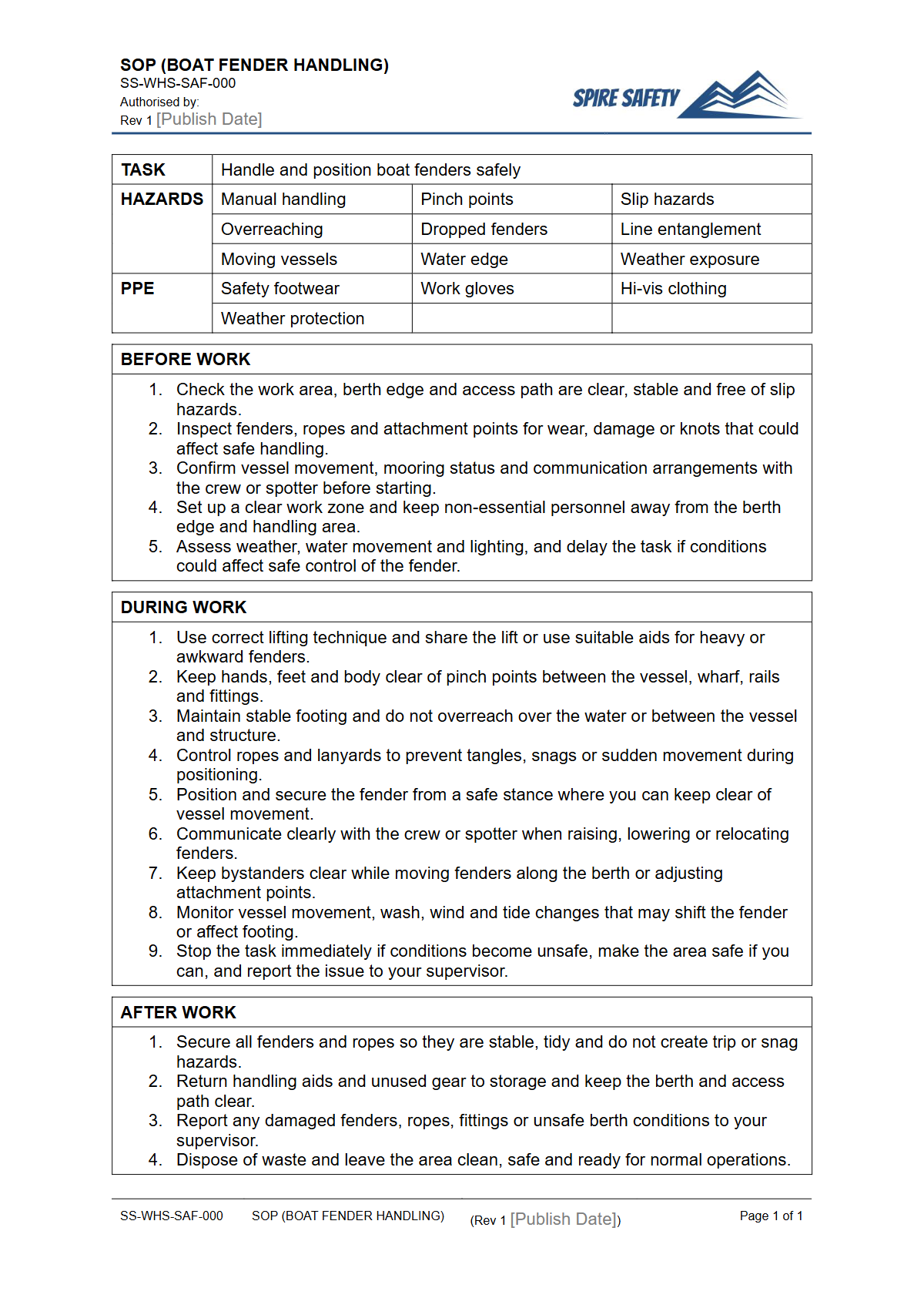
Handling boat fenders, while a routine task, exposes workers to significant risks including manual handling injuries, crushing, and falls overboard. This Free Safe Operating Procedure (Boat Fender Handling) Template provides a structured framework for documenting a safe and consistent method for deploying, adjusting, and retrieving fenders.
Implementing a formal SOP helps reduce the risk of incidents, ensures all crew members follow a standardised process, and serves as a vital training tool. It is a fundamental component for any organisation looking to develop robust WHS management systems for their maritime operations.
Video walkthrough
How to use the Free Safe Operating Procedure (Boat Fender Handling) Template
This resource is available for immediate download in both DOCX and PDF formats. The DOCX file is fully editable, allowing you to tailor the content to your specific operational needs.
A Safe Operating Procedure is not a 'one-size-fits-all' document; its effectiveness depends entirely on how well it reflects your actual work environment. You must adapt this template to account for your vessel's size and design, the types of fenders used, typical berthing conditions, and the competency of your crew.
The procedure should include sections covering:
- Required Personal Protective Equipment (PPE) such as gloves and non-slip footwear.
- Pre-operational checks, including inspection of fenders and lines for wear and tear.
- A clear, step-by-step guide for deploying and retrieving fenders, including communication protocols between the helm and deck.
- Emergency procedures in case of a person falling overboard or becoming entangled.
Please note: this document is a template and must be customised to your specific workplace, vessel, and operational context. We recommend seeking specialist WHS consulting if you are unsure how to conduct the risk assessment or tailor the procedure effectively.
When to use it
A Safe Operating Procedure for boat fender handling should be a live document, actively used in daily operations. It is not meant to be filed away and forgotten.
Use this SOP as a primary reference during crew training and induction to establish baseline safety standards from day one. It should also be used as a pre-start checklist or toolbox talk topic before any mooring or unberthing manoeuvre to reinforce safe work practices.
Alongside other key documents, like a Safe Operating Procedure for step ladder use on deck, it builds a comprehensive safety profile for your operations.
Who should use it
This template is designed for a range of personnel involved in maritime activities, including:
- Vessel Masters and Skippers: To implement and enforce safe work methods on board.
- Deckhands and Crew: As a clear guide for performing the task safely and consistently.
- Marina and Port Operators: To standardise procedures for their staff or provide guidance to visiting vessels.
- WHS Managers and Safety Officers: As a tool for risk management and to ensure procedures are documented and followed. The final document becomes a key piece of evidence during any formal WHS compliance auditing.
By formalising the process of handling boat fenders, your organisation can better meet its duty of care obligations under Australian WHS laws. Explore our free WHS resources library to find more templates to support your safety management system.
Common mistakes
Common mistakes to avoid
- Using the template without customising it for the specific vessel and mooring environment.
- Neglecting to provide hands-on training and competency checks for all crew members.
- Failing to inspect fenders for damage, wear, or incorrect inflation before use.
- Poor communication between the helm and deck crew during deployment and retrieval.
Legal references
Legal considerations
The following legal requirements may be relevant to this type of work.
- Work Health and Safety Act (Harmonised) — Provides the primary duties for protecting workers and other people from work health and safety risks.
- Work Health and Safety Regulations (Harmonised) — Sets out requirements supporting the management of workplace hazards and risks.
The following codes may be relevant to this type of work.
- Managing WHS Risks Code of Practice — Provides practical guidance on identifying hazards, assessing risks and applying effective controls.
- Work Health and Safety Consultation, Cooperation and Coordination Code of Practice — Provides practical guidance on consulting workers and coordinating with other duty holders.
- Managing the Work Environment and Facilities Code of Practice — Provides practical guidance on safe work environments, workplace facilities and related controls.
Did you know
Manual Task Risk
Hazardous manual tasks, including lifting and handling equipment like fenders, account for a significant portion of all serious workers' compensation claims in Australia.
FAQ
Frequently asked questions
01What are the main hazards of handling boat fenders?
02Why is a formal SOP needed for a simple task like handling fenders?
03How often should an SOP for boat fender handling be reviewed?
04Can this template be used for commercial vessels under AMSA regulations?
Share this resource
Free Safe Operating Procedure (Boat Fender Handling) Template
Browse Categories
How To Use It
- 1Download and open in Word or PDF.
- 2Replace the placeholders with your business details.
- 3Get it reviewed by a WHS specialist before rollout.
Need it customised?
Our WHS consultants can adapt this template to your site, run a gap analysis, or audit what you already have in place.
Book a Free Consultation WHS consulting servicesor call 1300 156 382
Related templates
- Free Safe Operating Procedure (Boat Launching) Template
- Free Safe Operating Procedure (Boat Line Stowage) Template
- Free Safe Operating Procedure (Boat Refuelling) Template
- Free Safe Operating Procedure (Boat Retrieval) Template
- Free Safe Operating Procedure (Boat Trailer) Template
- Free Safe Operating Procedure (Boat Waste Removal) Template