
Free Safe Operating Procedure (Boarding Gate Setup) Template
Download our free Safe Operating Procedure (SOP) for boarding gate setup. This editable DOCX/PDF template helps document risks and controls. Customise it now.
Free Safe Operating Procedure (Boarding Gate Setup) Template
DOCX • 126 KB + PDF
Updated Oct 2026
No signup required
Purpose of the Free Safe Operating Procedure (Boarding Gate Setup) Template
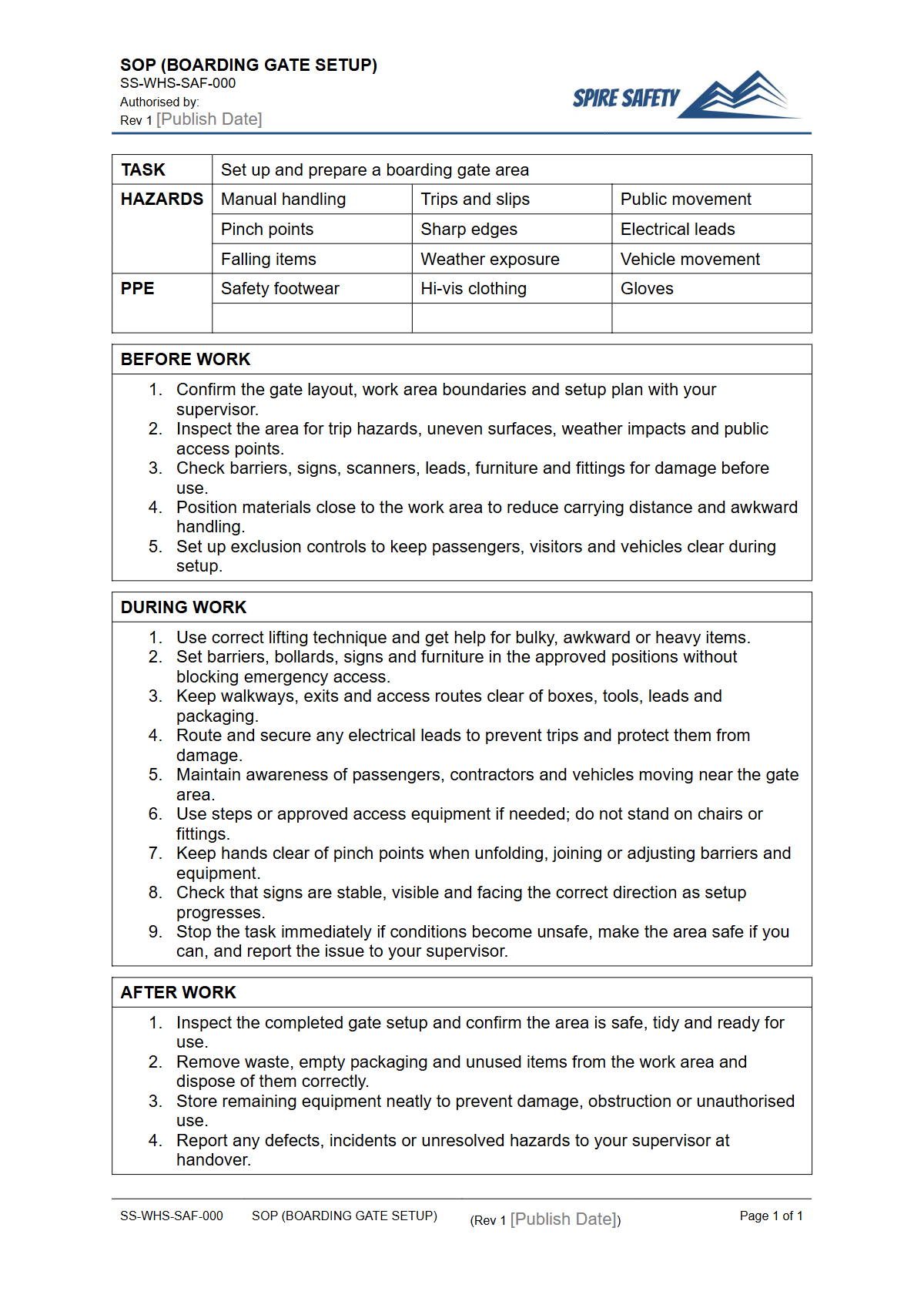
Setting up boarding gates is a critical task for preventing falls into open pits, excavations, or from elevated platforms in industries like mining and construction. This Free Safe Operating Procedure (Boarding Gate Setup) Template provides a structured framework to help your organisation document a safe system of work for this activity.
A documented SOP ensures that the process is carried out consistently and safely every time, reducing the risk of incidents and injuries. It formalises pre-start checks, operational steps, and emergency responses, forming a vital part of your overall WHS management systems.
Video walkthrough
How to use the Free Safe Operating Procedure (Boarding Gate Setup) Template
This template is designed for ease of use. Simply download the editable DOCX file and adapt it to the specific context of your worksite.
It is crucial to walk through the procedure on-site, consulting with the workers who will be performing the task. Identify the specific models of boarding gates used, the equipment involved in their transport and placement, and the unique environmental conditions of the work area.
This collaborative approach ensures the final document is practical, accurate, and reflects the real-world hazards your team faces, such as those covered in a specific telehandler SOP when moving materials.
Important: This document is a template and must be customised to suit the specific equipment, environment, and tasks at your workplace. We recommend a thorough consultation process with the workers who will perform the task to ensure the procedure is relevant and effective.
When to use this Safe Operating Procedure
A Safe Operating Procedure for boarding gate setup should be developed before the task is ever performed. It serves as a primary planning document and a key training resource for new team members or those unfamiliar with the process.
The SOP should be readily available at the work location for quick reference. It also becomes an essential reference document during safety audits, toolbox talks, and in the unfortunate event of an incident investigation. For guidance on integrating SOPs effectively into your safety framework, consider engaging our general WHS consulting services.
Who should use it
This SOP is intended for a range of personnel within an organisation. Site Supervisors and Project Managers use it to plan, instruct, and supervise the work safely.
WHS Advisors and Safety Officers use it to ensure risk controls are documented and aligned with legislative requirements. Most importantly, the Operators and workers performing the installation use it as a guide to follow the correct, safe sequence of steps.
A well-written procedure, much like a dozer safe operating procedure for heavy machinery, empowers workers by giving them clear instructions for managing risk.
Key Elements of a Robust SOP
Our template prompts you to consider all critical safety aspects of the task. A comprehensive SOP for boarding gate setup should include several key sections to be effective.
Pre-Operational Checks
This section outlines inspections to be performed before work begins. This includes checking the structural integrity of the boarding gate, ensuring the ground is stable and level, verifying that lifting equipment is in good working order, and confirming the work area is clear of unauthorised personnel and other mobile plant.
Step-by-Step Procedure
Document the logical sequence of tasks from start to finish. This covers receiving the gate on-site, safely lifting and moving it into position, and securely fastening it.
This section should detail correct manual handling techniques and specify when mechanical aids are required. For tasks involving minor heights, such as securing top latches, referencing a step ladder safe operating procedure can ensure even small risks are managed.
Required PPE
List all mandatory personal protective equipment required for the task. This will typically include a hard hat, steel-capped boots, high-visibility clothing, and gloves.
Depending on the site and associated tasks, safety glasses or hearing protection may also be necessary.
Continual Improvement
An SOP is a living document. The template includes space to record reviews and updates.
Procedures should be reviewed periodically, after any incident, or when changes to equipment or processes occur. Regularly reviewing your safety documents helps foster a culture of proactive safety management. You can find more templates and tools to support this process in our free WHS resources library.
Common mistakes
Common mistakes to avoid
- Using a generic SOP without customising it for site-specific conditions and equipment.
- Failing to adequately train workers on the finalised procedure before they perform the task.
- Neglecting to review and update the SOP after an incident, near miss, or change in process.
- Not ensuring the gate is installed on stable, level ground, leading to potential instability.
Legal references
Legal considerations
The following legal requirements may be relevant to this type of work.
- Work Health and Safety Act (Harmonised) — Provides the primary duties for protecting workers and other people from work health and safety risks.
- Work Health and Safety Regulations (Harmonised) — Sets out requirements supporting the management of workplace hazards and risks.
The following codes may be relevant to this type of work.
- Managing WHS Risks Code of Practice — Provides practical guidance on identifying hazards, assessing risks and applying effective controls.
- Work Health and Safety Consultation, Cooperation and Coordination Code of Practice — Provides practical guidance on consulting workers and coordinating with other duty holders.
- Managing the Work Environment and Facilities Code of Practice — Provides practical guidance on safe work environments, workplace facilities and related controls.
Did you know
Hierarchy of Control
Boarding gates are an 'engineering control' in the hierarchy of control. They are designed to isolate people from the hazard (e.g., a fall from height), which is more effective than relying on administrative controls or PPE alone.
Consultation is Key
Under model WHS laws, employers must consult with workers on matters affecting their health and safety. Developing an SOP for a task like this is a perfect opportunity for meaningful consultation.
FAQ
Frequently asked questions
01What is a boarding gate in a WHS context?
02Is a Safe Operating Procedure legally required for boarding gate setup?
03Who should be involved in developing this SOP?
04How often should this boarding gate setup SOP be reviewed?
Share this resource
Free Safe Operating Procedure (Boarding Gate Setup) Template
Browse Categories
How To Use It
- 1Download and open in Word or PDF.
- 2Replace the placeholders with your business details.
- 3Get it reviewed by a WHS specialist before rollout.
Need it customised?
Our WHS consultants can adapt this template to your site, run a gap analysis, or audit what you already have in place.
Book a Free Consultation WHS consulting servicesor call 1300 156 382
Related templates
- Free Safe Operating Procedure (Boat Cabin Cleaning) Template
- Free Safe Operating Procedure (Boat Fender Handling) Template
- Free Safe Operating Procedure (Boat Launching) Template
- Free Safe Operating Procedure (Boat Line Stowage) Template
- Free Safe Operating Procedure (Boat Refuelling) Template
- Free Safe Operating Procedure (Boat Retrieval) Template