
Free Safe Operating Procedure (Blockage Clearing) Template
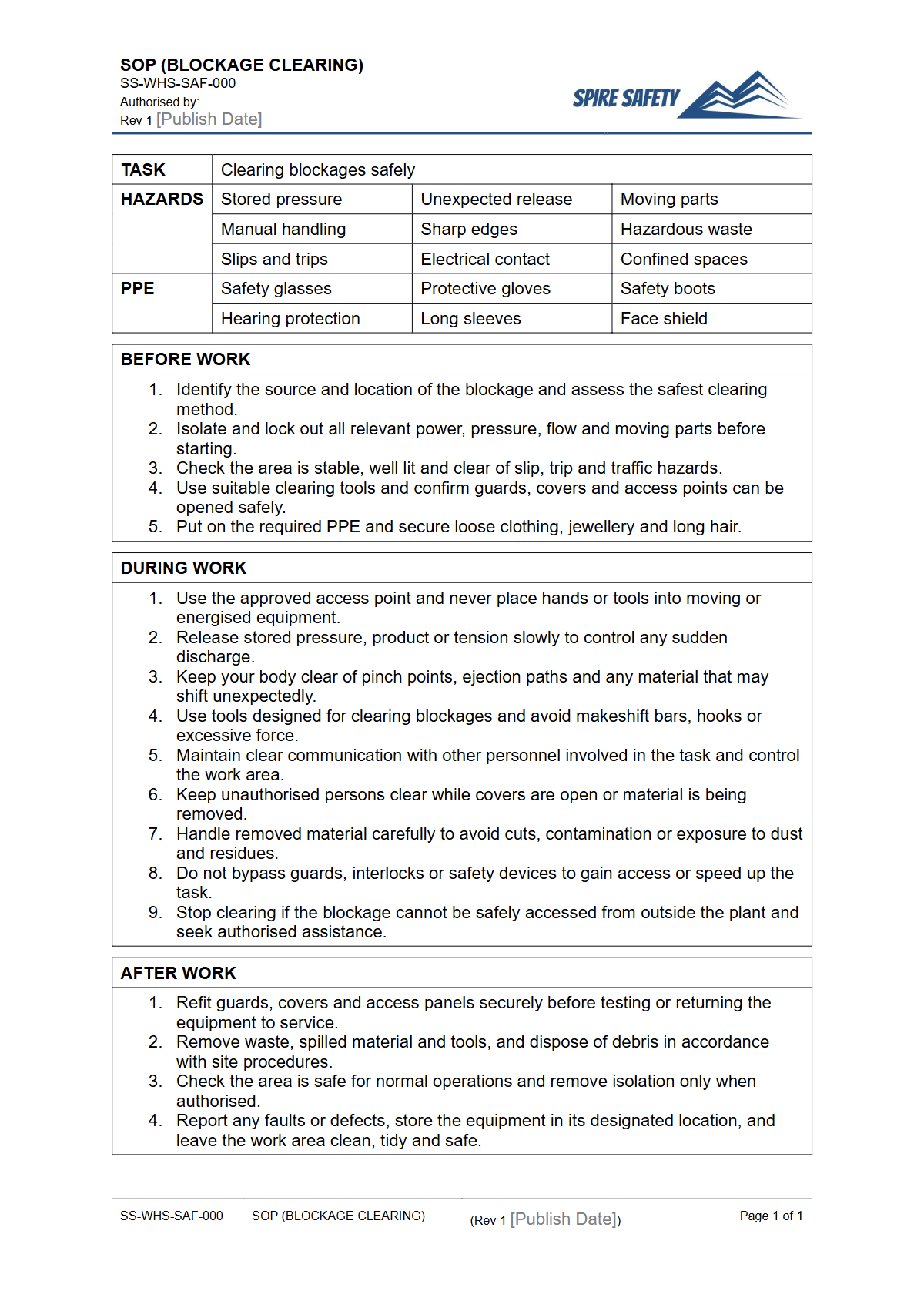
Download a free Safe Operating Procedure (Blockage Clearing) template. This customisable DOCX and PDF helps outline safe work practices for clearing equipment.
Free Safe Operating Procedure (Blockage Clearing) Template
DOCX • 126 KB + PDF
Updated Oct 2026
No signup required
Purpose of the Free Safe Operating Procedure (Blockage Clearing) Template
Clearing blockages from machinery and equipment is a high-risk maintenance task that contributes to a significant number of serious workplace injuries. This Free Safe Operating Procedure (Blockage Clearing) Template provides a structured framework for documenting a safe system of work to control these risks.
By formalising the process, organisations can standardise safety protocols, reduce the likelihood of human error, and demonstrate a commitment to proactive WHS management.
The primary purpose of this SOP is to guide workers through the critical safety steps required before, during, and after clearing a blockage. It focuses on energy isolation and lockout/tagout (LOTO) procedures, which are essential for preventing the unexpected start-up of machinery or the release of stored energy.
Implementing a clear SOP helps protect workers from hazards like amputation, crushing, entanglement, and electrical shock. This document serves as a vital training tool and an on-the-job reference for ensuring the task is performed safely and consistently every time.
Video walkthrough
How to use the Free Safe Operating Procedure (Blockage Clearing) Template
This template is provided in both DOCX and PDF formats for your convenience. To use it effectively, download the file and customise it to reflect the specific machinery, processes, and hazards present in your workplace.
A generic procedure is not sufficient; you must adapt the content to your unique operational context.
Follow these steps to implement the template:
- Assess Your Equipment: Identify each piece of plant or machinery that has a risk of blockages. Analyse the types of blockages that can occur and the specific energy sources (electrical, hydraulic, pneumatic, gravitational) that need to be isolated.
- Customise the Content: Edit the DOCX file to detail the step-by-step procedure for each machine. Name specific isolation points, required tools, and the personal protective equipment (PPE) workers must wear.
- Consult Your Workers: Involve the operators and maintenance personnel who perform the task. Their hands-on experience is invaluable for creating a practical and effective procedure.
- Train Your Team: Once finalised, use the SOP as a central document for training all relevant personnel. Ensure everyone understands the steps and the severe consequences of deviation.
- Review Regularly: Procedures should be reviewed periodically and updated whenever a machine is modified, a process changes, or an incident occurs.
Important Note: This document is a template only. We provide it as a starting point, but it is your responsibility to ensure the final, customised document is suitable for your workplace and meets all relevant WHS obligations.
Integrating this SOP into your broader WHS management systems ensures it is part of a holistic approach to safety, rather than a standalone document.
When to use it
A Safe Operating Procedure for blockage clearing should be used proactively, not just after an incident has occurred. It is a critical component of a preventative safety culture.
The SOP should be referenced whenever a machine or production line becomes jammed, clogged, or otherwise obstructed, requiring human intervention to resolve.
Key times to use the SOP include:
- During Worker Training: Use the SOP as the foundation for training new operators and providing refresher courses for experienced staff. This is particularly important for high-risk tasks like clearing a jammed concrete hose, a procedure that would be detailed in a specific document like our FREE Boom Pump SOP (Safe Operating Procedure) Template.
- Before Starting a Task: Workers should review the procedure before commencing any non-routine blockage clearing, especially if they perform the task infrequently.
- For Audits and Inspections: The SOP serves as evidence that your organisation has a formal, documented process for managing a known high-risk task.
Who should use it
This SOP is intended for a range of personnel within an organisation, each with different responsibilities for its implementation and use. Effective risk management requires that everyone involved understands their role in the process.
Machine Operators and Maintenance Staff
These are the primary users of the SOP. They must follow the documented steps precisely every time they clear a blockage to protect themselves and their colleagues. For example, an operator using a machine with powerful clamping or bending forces should always refer to the relevant procedure, such as the one outlined in a Free Brake Press SOP (Safe Operating Procedure) Template.
Supervisors and Team Leaders
Supervisors are responsible for ensuring their team members are trained on the SOP and follow it correctly. They must enforce the procedure, provide the necessary tools and PPE, and monitor compliance on the shop floor.
Regular verification is a key supervisory duty.
WHS Managers and Officers
Health and Safety professionals use the SOP as a tool for risk management. They are typically responsible for developing and reviewing the procedure in consultation with workers, integrating it into the overall safety system, and using it as a benchmark during safety assessments.
The existence and quality of such procedures are a key focus of any WHS compliance auditing program.
Ultimately, having machine-specific SOPs is crucial for managing hazards effectively. Whether it's for fabrication equipment like that covered in our FREE CNC Machine SOP (Safe Operating Procedure) Template or any other plant, a documented procedure is non-negotiable.
You can explore our entire free WHS resources library for more templates to support your safety management system.
Common mistakes
Common mistakes to avoid
- Failing to isolate the machine from all energy sources before starting work.
- Bypassing safety interlocks or removing guards to save time.
- Using hands or incorrect tools to clear the blockage, leading to entanglement.
- Neglecting to test that the energy isolation was successful ('test for dead') before touching any parts.
Legal references
Legal considerations
The following legal requirements may be relevant to this type of work.
- Work Health and Safety Act (Harmonised) — Provides the primary duties for protecting workers and other people from work health and safety risks.
- Work Health and Safety Regulations (Harmonised) — Sets out requirements supporting the management of workplace hazards and risks.
The following codes may be relevant to this type of work.
- Managing WHS Risks Code of Practice — Provides practical guidance on identifying hazards, assessing risks and applying effective controls.
- Work Health and Safety Consultation, Cooperation and Coordination Code of Practice — Provides practical guidance on consulting workers and coordinating with other duty holders.
- Managing the Work Environment and Facilities Code of Practice — Provides practical guidance on safe work environments, workplace facilities and related controls.
Did you know
The Hazard of Stored Energy
Even after a machine is switched off, it can hold dangerous stored energy (mechanical, hydraulic, pneumatic, or electrical). Lockout/Tagout procedures are essential to control these invisible hazards before any work begins.
A Leading Cause of Injury
Contact with machinery is a leading cause of serious workplace injuries in Australia. A significant portion of these incidents occur not during normal operation, but during maintenance, cleaning, and clearing machine blockages.
FAQ
Frequently asked questions
01What is a Safe Operating Procedure for blockage clearing?
02Is a SWMS required for clearing a blockage?
03What are the key steps in a blockage clearing procedure?
04Why is clearing machinery blockages so dangerous?
Share this resource
Free Safe Operating Procedure (Blockage Clearing) Template
Browse Categories
How To Use It
- 1Download and open in Word or PDF.
- 2Replace the placeholders with your business details.
- 3Get it reviewed by a WHS specialist before rollout.
Need it customised?
Our WHS consultants can adapt this template to your site, run a gap analysis, or audit what you already have in place.
Book a Free Consultation WHS consulting servicesor call 1300 156 382
Related templates
- Free Safe Operating Procedure (Blower Vacuum) Template
- Free Safe Operating Procedure (Boarding Gate Setup) Template
- Free Safe Operating Procedure (Boat Cabin Cleaning) Template
- Free Safe Operating Procedure (Boat Fender Handling) Template
- Free Safe Operating Procedure (Boat Launching) Template
- Free Safe Operating Procedure (Boat Line Stowage) Template