
Free Safe Operating Procedure (Bitumen Sprayer) Template
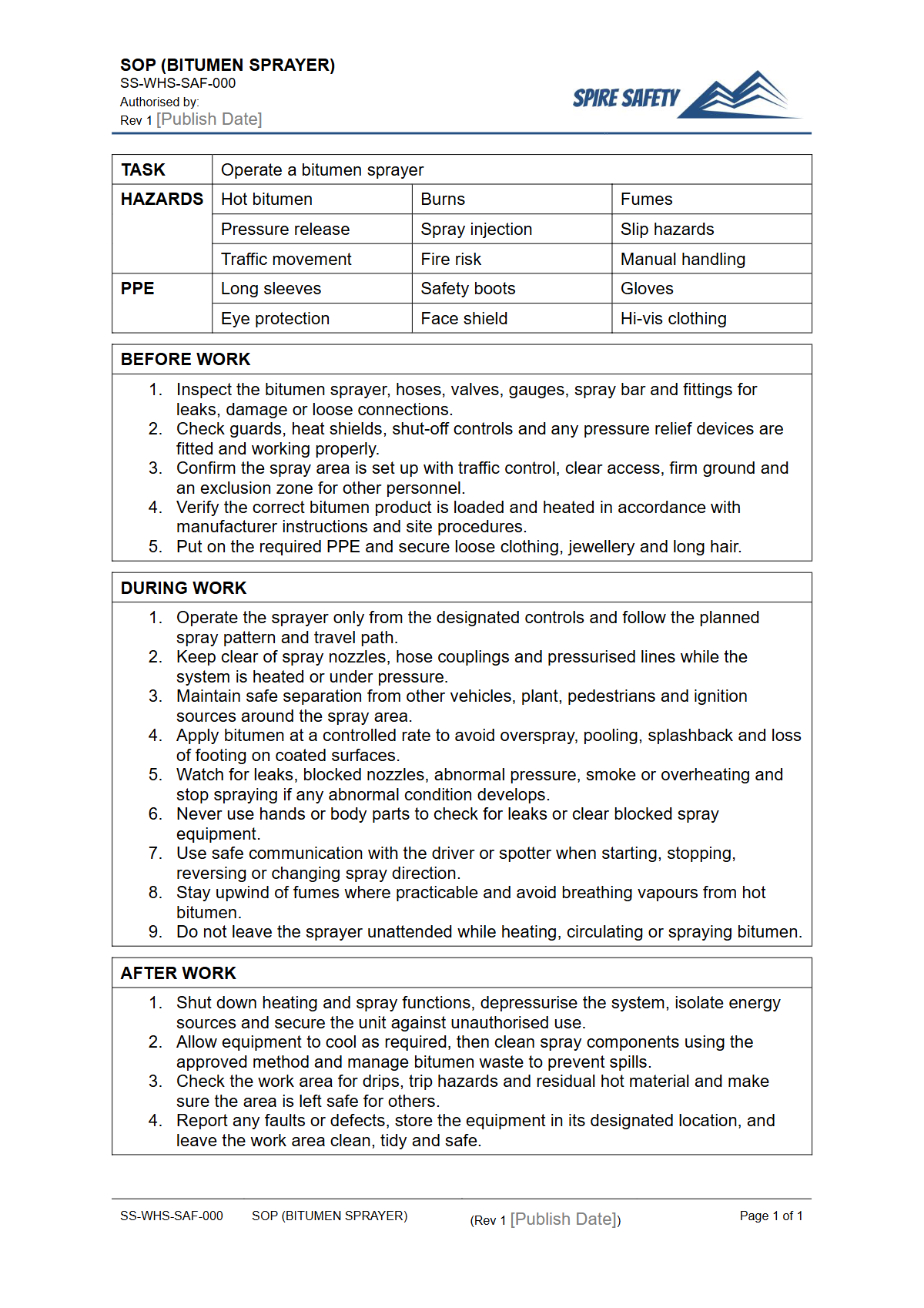
Download our free Safe Operating Procedure (Bitumen Sprayer) Template to formalise safety processes for high-risk road surfacing and construction tasks.
Free Safe Operating Procedure (Bitumen Sprayer) Template
DOCX • 126 KB + PDF
Updated Oct 2026
No signup required
Purpose of the Free Safe Operating Procedure (Bitumen Sprayer) Template
Operating a bitumen sprayer involves significant risks, including severe thermal burns, exposure to hazardous fumes, and potential traffic incidents. This Free Safe Operating Procedure (Bitumen Sprayer) Template provides a structured framework for documenting the essential safety steps required to manage these hazards effectively.
It is designed to help your organisation establish and communicate a clear, step-by-step process for the safe operation of bitumen sprayers, from pre-start checks to shutdown procedures.
Using a documented Safe Operating Procedure helps formalise your approach to risk management. It prompts consideration of specific hazards like hot liquid handling, pressure systems, fire risks, and interaction with other mobile plant on site.
A comprehensive SOP is a key tool in meeting your primary duty of care under Australian WHS legislation and is fundamental to preventing incidents. It ensures that all operators, supervisors, and associated workers understand the required safety controls, such as exclusion zones for personnel and other vehicles, which might be detailed in a separate Body Truck SOP for transport vehicles.
Video walkthrough
How to use the Free Safe Operating Procedure (Bitumen Sprayer) Template
This template is provided in DOCX format for easy editing and customisation, with a PDF version available for straightforward distribution and printing. To use it effectively, you must adapt its contents to the specific make and model of the bitumen sprayer used at your workplace, the type of bitumen product being applied, and the unique environmental conditions of your site.
Important: This document is a template and is not a complete or ready-to-use Safe Operating Procedure. To be effective and assist in your compliance efforts, you must add specific details relevant to your operations.
This includes specifying required personal protective equipment (PPE), detailing your site's emergency procedures for burns and spills, and outlining lockout/tagout processes. Integrating this customised SOP into your broader WHS management systems ensures it works alongside your other safety documentation, like risk assessments and training records.
Key Elements to Customise
When customising the template, ensure you address the following critical areas:
- Pre-operational Checks: Detail the visual and functional checks required before starting the sprayer, including inspecting hoses, nozzles, safety valves, and heating systems.
- Personal Protective Equipment (PPE): List all mandatory PPE, such as heat-resistant gloves, full-face shields, long-sleeved clothing, and appropriate respiratory protection for fumes.
- Safe Operation Steps: Provide a sequential guide for operation, covering ignition, heating the binder, charging the sprayer, application techniques, and managing spray bar positioning.
- Traffic Management: Reference your site's traffic management plan, especially for work on public roads or in congested construction zones where other plant like a dozer may be operating, which would be covered by a specific dozer SOP.
- Emergency Procedures: Outline clear, actionable steps for responding to emergencies like fires, major spills, equipment malfunction, or first aid for thermal burns.
- Shutdown and Cleaning: Describe the correct procedure for safely shutting down, depressurising, and cleaning the equipment to prevent blockages and minimise exposure risks.
When to use this Safe Operating Procedure
A Safe Operating Procedure for a bitumen sprayer should be a living document integrated into daily operations. It is not a 'set and forget' piece of paperwork.
It should be used as a primary reference during the training and competency assessment of new operators. It also serves as an essential guide for pre-start meetings and toolbox talks, helping to refresh workers' knowledge of the risks and controls before work begins.
Furthermore, the SOP is a critical reference document following any incident or near-miss, helping to inform the investigation and identify areas for procedural improvement. Consistency across all mobile plant is key, which is why similar procedures, like a scraper SOP, are vital for other high-risk machinery on site.
Who should use it
This template is designed for use by a range of personnel within an organisation. WHS Managers and Safety Officers can use it as a foundational document to build out a robust safety process aligned with industry best practice.
Site Supervisors and Foremen are responsible for ensuring operators adhere to the procedures outlined in the finalised SOP and for providing the necessary supervision. For Plant Operators, the SOP is their guide to performing their job safely and consistently every time.
The document also provides clarity for other workers on site, helping them understand the hazards of the equipment and the control measures in place, such as exclusion zones. The existence and proper use of such SOPs are often a key point of focus during formal WHS compliance auditing.
By thoroughly customising and implementing this procedure, your organisation can take a significant step towards managing the high-risk activity of bitumen spraying. You can explore more templates and safety documents in our free WHS resources library.
Common mistakes
Common mistakes to avoid
- Using a generic SOP without customising it for the specific sprayer and site conditions.
- Failing to wear appropriate heat-resistant PPE, especially gloves and face shields.
- Neglecting to implement and enforce exclusion zones for pedestrians and other vehicles.
- Inadequate pre-operational checks of safety-critical components like pressure relief valves and hoses.
Legal references
Legal considerations
The following legal requirements may be relevant to this type of work.
- Work Health and Safety Act (Harmonised) — Provides the primary duties for protecting workers and other people from work health and safety risks.
- Work Health and Safety Regulations (Harmonised) — Sets out requirements supporting the management of workplace hazards and risks.
The following codes may be relevant to this type of work.
- Managing WHS Risks Code of Practice — Provides practical guidance on identifying hazards, assessing risks and applying effective controls.
- Work Health and Safety Consultation, Cooperation and Coordination Code of Practice — Provides practical guidance on consulting workers and coordinating with other duty holders.
- Managing the Work Environment and Facilities Code of Practice — Provides practical guidance on safe work environments, workplace facilities and related controls.
Did you know
Extreme Temperatures
Hot mix asphalt is applied at temperatures between 150°C and 180°C. A thermal burn from contact at this temperature can cause immediate, severe third-degree burns.
Fume Hazards
Bitumen fumes contain hydrogen sulfide (H₂S) and other volatile organic compounds. Prolonged or high-concentration exposure can cause respiratory irritation, headaches, and other long-term health effects.
FAQ
Frequently asked questions
01What are the primary hazards when operating a bitumen sprayer?
02Is an SOP the same as a Safe Work Method Statement (SWMS)?
03How often should a Safe Operating Procedure for a bitumen sprayer be reviewed?
04Does this bitumen sprayer SOP template cover traffic management?
Share this resource
Free Safe Operating Procedure (Bitumen Sprayer) Template
Browse Categories
How To Use It
- 1Download and open in Word or PDF.
- 2Replace the placeholders with your business details.
- 3Get it reviewed by a WHS specialist before rollout.
Need it customised?
Our WHS consultants can adapt this template to your site, run a gap analysis, or audit what you already have in place.
Book a Free Consultation WHS consulting servicesor call 1300 156 382
Related templates
- Free Safe Operating Procedure (Blade Change) Template
- Free Safe Operating Procedure (Blast Chiller) Template
- Free Safe Operating Procedure (Blast Hole Drill) Template
- Free Safe Operating Procedure (Bleacher Cleaning) Template
- Free Safe Operating Procedure (Blockage Clearing) Template
- Free Safe Operating Procedure (Blower Vacuum) Template