
Free Safe Operating Procedure (Blade Change) Template
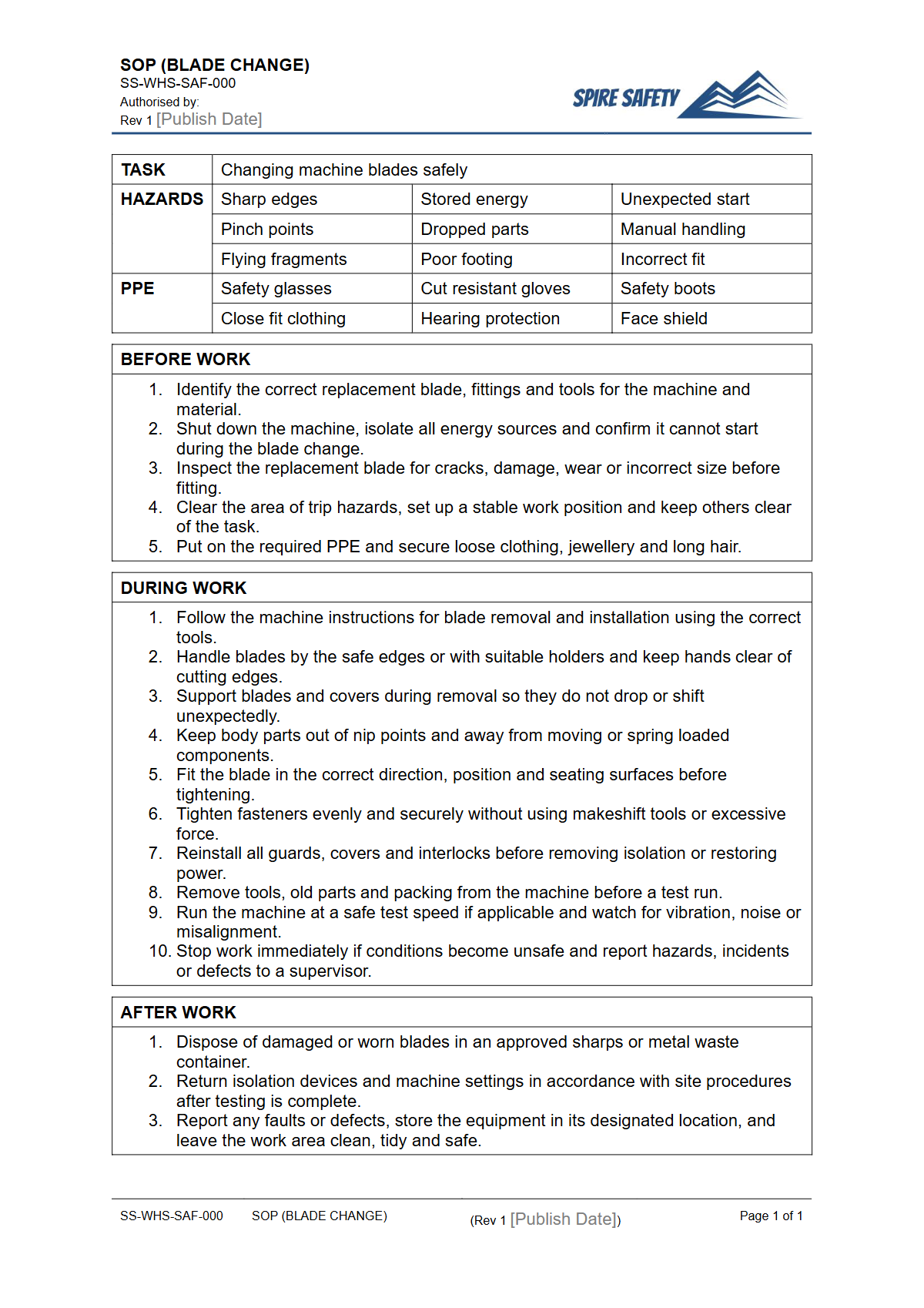
Download our free Safe Operating Procedure (Blade Change) Template. This customisable Word (DOCX) and PDF resource provides a structured guide for workers.
Free Safe Operating Procedure (Blade Change) Template
DOCX • 126 KB + PDF
Updated Oct 2026
No signup required
Purpose of the Free Safe Operating Procedure (Blade Change) Template
Changing blades on machinery, whether it's a saw, cutter, or grinder, is a high-risk maintenance task that presents significant hazards, primarily severe cuts and amputations. A documented procedure is a critical control measure for managing this risk.
This free Safe Operating Procedure (Blade Change) Template provides a structured framework to ensure the task is performed safely and consistently every time. It serves as a vital tool for worker training, competency assessment, and demonstrating due diligence in your safety management practices. By standardising the process, you reduce the likelihood of errors, injuries, and incidents, regardless of the equipment, from a simple bench saw to specialised machinery like that covered in our free Plasma Cutter SOP template.
Video walkthrough
How to use the Free Safe Operating Procedure (Blade Change) Template
This template is provided in both DOCX and PDF formats for your convenience. The DOCX file is fully editable, allowing you to tailor it to your specific operational needs.
A robust SOP for blade changing should be clear, concise, and easy for any worker to follow. We have structured this document to guide you through the essential components of a procedure.
Key sections include:
- Required Personal Protective Equipment (PPE)
- Hazard identification and risk assessment specific to the task
- Pre-change safety checks and energy isolation (Lock-Out, Tag-Out)
- A clear, sequential step-by-step guide for removing the old blade and installing the new one
- Post-change checks and recommissioning steps
- Emergency procedures
Please note: This document is a template and must be customised. We've provided a solid foundation based on Australian WHS principles, but you are responsible for adapting it to reflect the specific machinery, blade types, tools, hazards, and control measures present in your workplace.
Once customised, it should be integrated into your overall WHS management systems for proper version control and distribution.
When to use this Safe Operating Procedure
This SOP should be the primary reference document used by any worker tasked with changing a blade. It must be readily accessible at or near the point of use.
Beyond the task itself, the document is essential for several other key safety functions. Use it during new worker inductions, for refresher training sessions, and as a basis for conducting competency assessments.
The procedure should be followed every time a blade change is required, just as specific operational steps are followed when using equipment detailed in our FREE Waterjet Cutter SOP Template. It should also be reviewed as part of any incident investigation involving the task.
Who should use it
This procedure is designed for multiple roles within an organisation. Primarily, it is for the operators and maintenance personnel who physically perform the blade change.
They must be trained on the procedure and deemed competent before undertaking the task unsupervised. Supervisors and managers should also use the SOP to oversee the work, ensuring it is performed correctly and safely.
Furthermore, WHS professionals and management can use the documented procedure as evidence of risk management, and its effectiveness can be verified during a formal WHS compliance auditing process.
Implementing the SOP effectively
Effective implementation goes beyond just writing the document. Ensure all relevant workers receive hands-on training that walks them through the SOP's steps on the actual equipment they will be using.
Displaying a laminated copy near the machinery can serve as a constant reminder. The principles outlined here apply broadly, whether you're working with the tools described in our FREE Circular Saw SOP Template or other bladed equipment.
Regular review and feedback from the workers who use the SOP are crucial for its continuous improvement. For a wider selection of safety documentation, you can browse our complete free WHS resources library.
Common mistakes
Common mistakes to avoid
- Forgetting to isolate the energy source (Lock-Out, Tag-Out) before starting work.
- Using incorrect or improvised tools for the blade change, leading to slips, damage, or injury.
- Failing to wear appropriate PPE, especially task-specific cut-resistant gloves and eye protection.
- Not inspecting the new blade for cracks, warping, or other defects before installation.
Legal references
Legal considerations
The following legal requirements may be relevant to this type of work.
- Work Health and Safety Act (Harmonised) — Provides the primary duties for protecting workers and other people from work health and safety risks.
- Work Health and Safety Regulations (Harmonised) — Sets out requirements supporting the management of workplace hazards and risks.
The following codes may be relevant to this type of work.
- Managing WHS Risks Code of Practice — Provides practical guidance on identifying hazards, assessing risks and applying effective controls.
- Work Health and Safety Consultation, Cooperation and Coordination Code of Practice — Provides practical guidance on consulting workers and coordinating with other duty holders.
- Managing the Work Environment and Facilities Code of Practice — Provides practical guidance on safe work environments, workplace facilities and related controls.
Did you know
Lock-Out, Tag-Out (LOTO)
The LOTO process is a critical safety procedure used to ensure dangerous machines are properly de-energised and cannot be started up again before maintenance or servicing work is complete.
Blade Inspection
Regularly inspecting blades for dullness, cracks, or missing teeth is vital. A dull or damaged blade requires more force to cut, increasing the risk of machine kickback, poor performance, and worker injury.
FAQ
Frequently asked questions
01What is the most critical hazard during a blade change?
02Why do I need a specific SOP just for changing blades?
03Can this blade change SOP be used for any machine in my workshop?
04How often should a Safe Operating Procedure be reviewed?
Share this resource
Free Safe Operating Procedure (Blade Change) Template
Browse Categories
How To Use It
- 1Download and open in Word or PDF.
- 2Replace the placeholders with your business details.
- 3Get it reviewed by a WHS specialist before rollout.
Need it customised?
Our WHS consultants can adapt this template to your site, run a gap analysis, or audit what you already have in place.
Book a Free Consultation WHS consulting servicesor call 1300 156 382
Related templates
- Free Safe Operating Procedure (Blast Chiller) Template
- Free Safe Operating Procedure (Blast Hole Drill) Template
- Free Safe Operating Procedure (Bleacher Cleaning) Template
- Free Safe Operating Procedure (Blockage Clearing) Template
- Free Safe Operating Procedure (Blower Vacuum) Template
- Free Safe Operating Procedure (Boarding Gate Setup) Template