
Free Safe Operating Procedure (Biscuit Jointer) Template
Download our free Safe Operating Procedure (Biscuit Jointer) template.
Free Safe Operating Procedure (Biscuit Jointer) Template
DOCX • 126 KB + PDF
Updated Oct 2026
No signup required
Purpose of the Free Safe Operating Procedure (Biscuit Jointer) Template
A biscuit jointer is a specialised woodworking power tool used to cut crescent-shaped slots in the edges of wooden pieces to create strong, concealed joints. While highly effective, it introduces specific workplace hazards including cuts, projectiles, airborne dust, and electrical risks.
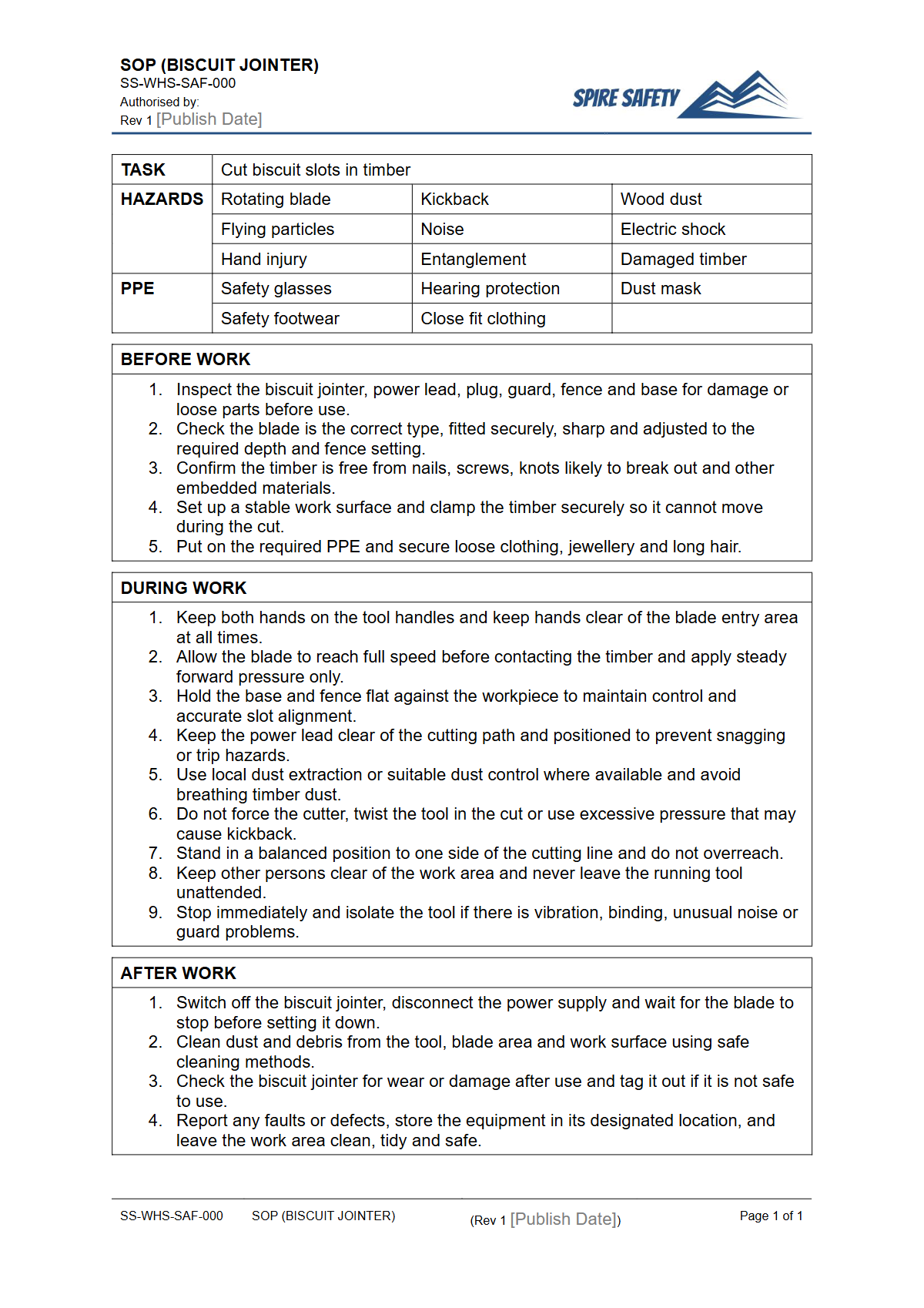
This Free Safe Operating Procedure (Biscuit Jointer) Template provides a structured starting point for documenting the essential health and safety information needed to manage these risks effectively.
The purpose of this Safe Operating Procedure is to formalise a safe system of work for all personnel. It guides users through pre-operational checks, step-by-step operating instructions, and post-operational clean-up.
By clearly defining risks and control measures, the SOP helps your organisation meet its duty of care under Australian WHS laws. Documenting procedures for tools like this is as critical as it is for larger equipment, which is why we also offer resources like our free Circular Saw SOP to cover a range of workshop tools.
Video walkthrough
How to use the Free Safe Operating Procedure (Biscuit Jointer) Template
This template is provided in both DOCX and PDF formats for your convenience. The DOCX version is fully editable, allowing you to tailor the content to the specific make and model of biscuit jointer used in your workshop, as well as your unique operational environment and existing safety protocols. A well-customised SOP is a fundamental component of proactive WHS management systems.
Important: This document is a template only. It is not a complete or ready-to-use Safe Operating Procedure.
To be effective and assist in compliance, you must customise it to reflect the specific hazards, risks, and control measures relevant to your workplace. We recommend a consultation process involving operators and supervisors to ensure the final SOP is practical, comprehensive, and understood by everyone who will use it.
When to use a Biscuit Jointer SOP
A Safe Operating Procedure for a biscuit jointer should be a core part of your workshop's safety framework. It is used in several key situations:
- Training and Induction: The SOP serves as a primary training document for new workers or employees unfamiliar with the specific equipment. It ensures they learn the correct, safe method from the outset.
- Day-to-Day Operations: It acts as a ready reference for operators to refresh their knowledge of safe work steps, particularly for tasks that are not performed frequently.
- Risk Management: The process of developing and reviewing the SOP is an active form of risk assessment, helping to identify and control hazards before they cause harm. It is a vital document for any specialised cutting tool, similar in principle to a free Plasma Cutter SOP.
- Incident Investigation: Following an incident or near-miss, the SOP should be reviewed to determine if the procedure was adequate and if it was followed correctly. This review often leads to vital improvements.
Who should use this Safe Operating Procedure
The responsibility for using and maintaining a Safe Operating Procedure for a biscuit jointer extends across multiple roles within an organisation:
- Workers/Operators: The primary users of the SOP. They must be trained on its contents and are responsible for following the documented procedures every time they operate the equipment.
- Supervisors and Managers: Responsible for ensuring workers are trained, deemed competent, and adhere to the SOP. They also lead the development and regular review of the procedure.
- WHS/HSE Officers: Health and safety professionals use the SOP as a tool for risk assessment, training verification, and compliance checks. It forms part of the evidence trail during safety inspections or WHS compliance auditing.
- Persons Conducting a Business or Undertaking (PCBUs): The PCBU holds the ultimate legal responsibility to provide safe systems of work, and a well-implemented SOP is a key part of fulfilling that duty.
Beyond the primary cutting task, workshop safety involves managing the entire environment. Procedures for accessing items at height are just as important, which is why a Step Ladder SOP is another crucial document for maintaining a safe workspace.
Integrating various SOPs creates a more holistic safety culture. If you need other templates, you can browse our complete free WHS resources library for a wide range of documents.
Common mistakes
Common mistakes to avoid
- Failing to disconnect the power source before changing the blade or making adjustments.
- Using a dull, chipped, or incorrect-sized blade, which increases the risk of kickback and produces poor-quality joints.
- Not using appropriate personal protective equipment (PPE), especially safety glasses and a suitable dust mask.
- Neglecting to firmly secure the workpiece with clamps, leading to movement and inaccurate or unsafe cuts.
Legal references
Legal considerations
The following legal requirements may be relevant to this type of work.
- Work Health and Safety Act (Harmonised) — Provides the primary duties for protecting workers and other people from work health and safety risks.
- Work Health and Safety Regulations (Harmonised) — Sets out requirements supporting the management of workplace hazards and risks.
The following codes may be relevant to this type of work.
- Managing WHS Risks Code of Practice — Provides practical guidance on identifying hazards, assessing risks and applying effective controls.
- Work Health and Safety Consultation, Cooperation and Coordination Code of Practice — Provides practical guidance on consulting workers and coordinating with other duty holders.
- Managing the Work Environment and Facilities Code of Practice — Provides practical guidance on safe work environments, workplace facilities and related controls.
Did you know
The "Biscuit"
The small, oval-shaped piece of compressed beechwood used in this joinery method is called a 'biscuit'. It is designed to expand when it absorbs water-based wood glue, creating an incredibly strong, hidden joint.
Material Matters
Biscuit jointers are designed for specific materials, primarily solid wood and wood composites. Using them on incorrect materials like metal, plasterboard, or plastic can damage the blade, overheat the motor, and create significant safety risks.
FAQ
Frequently asked questions
01What are the main hazards of using a biscuit jointer?
02Does this SOP template cover all legal WHS requirements?
03How often should a Safe Operating Procedure for a biscuit jointer be reviewed?
04Who is responsible for creating a Biscuit Jointer SOP?
Share this resource
Free Safe Operating Procedure (Biscuit Jointer) Template
Browse Categories
How To Use It
- 1Download and open in Word or PDF.
- 2Replace the placeholders with your business details.
- 3Get it reviewed by a WHS specialist before rollout.
Need it customised?
Our WHS consultants can adapt this template to your site, run a gap analysis, or audit what you already have in place.
Book a Free Consultation WHS consulting servicesor call 1300 156 382
Related templates
- Free Safe Operating Procedure (Bitumen Kettle) Template
- Free Safe Operating Procedure (Bitumen Sprayer) Template
- Free Safe Operating Procedure (Blade Change) Template
- Free Safe Operating Procedure (Blast Chiller) Template
- Free Safe Operating Procedure (Blast Hole Drill) Template
- Free Safe Operating Procedure (Bleacher Cleaning) Template