
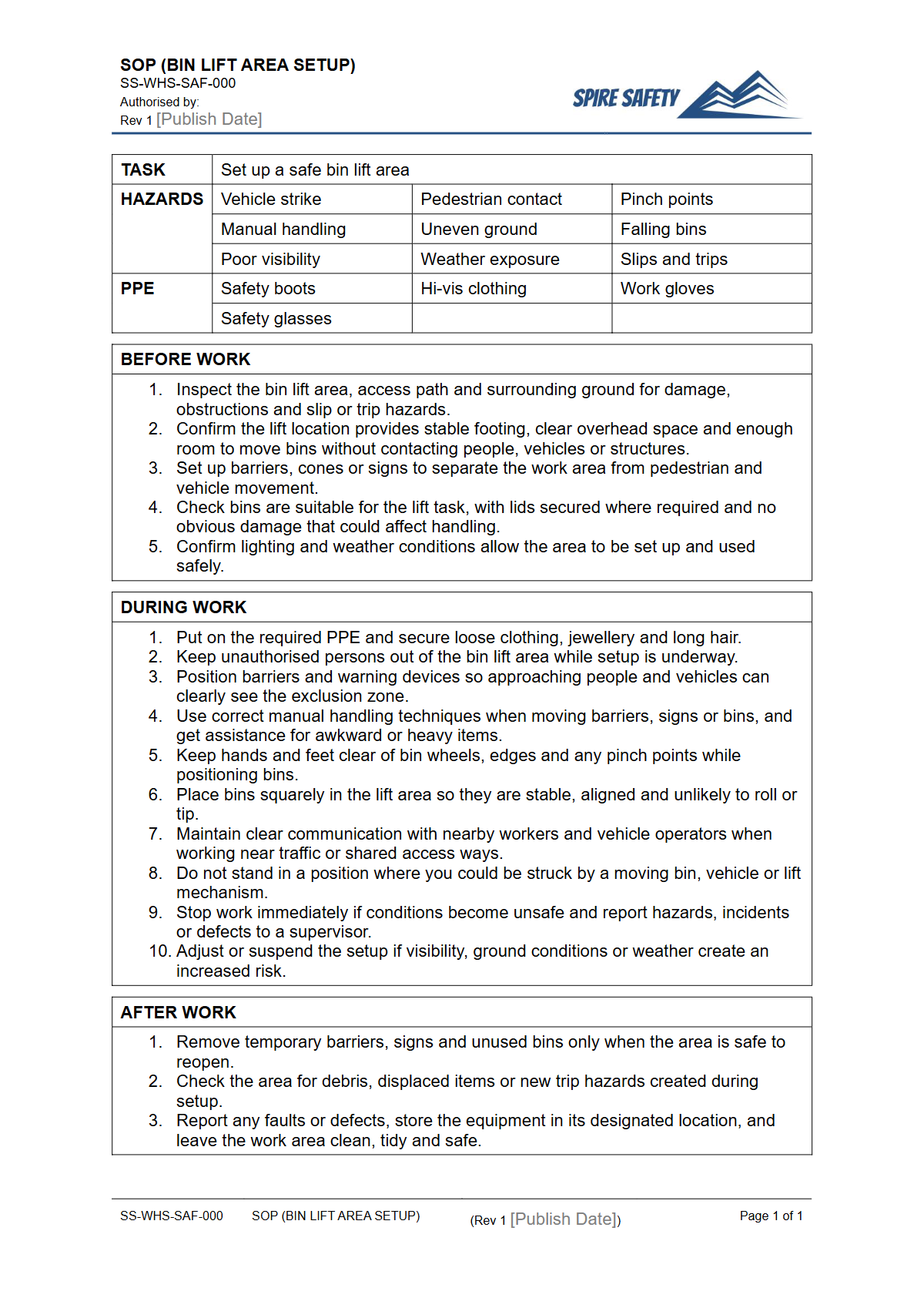
Free Safe Operating Procedure (Bin Lift Area Setup) Template
Download our free Safe Operating Procedure (Bin Lift Area Setup) Template.
Free Safe Operating Procedure (Bin Lift Area Setup) Template
DOCX • 126 KB + PDF
Updated Oct 2026
No signup required
Purpose of the Free Safe Operating Procedure (Bin Lift Area Setup) Template
Establishing and maintaining a safe environment around bin lifting equipment is crucial for preventing serious injuries. This free Safe Operating Procedure (Bin Lift Area Setup) Template provides a structured framework for documenting the required steps to safely prepare, use, and shut down bin lifting zones.
It is designed to help persons conducting a business or undertaking (PCBUs) fulfil their primary duty of care by outlining controls for hazards such as moving vehicles, hydraulic failures, crush points, and ergonomic strains. Using this SOP helps ensure that tasks are performed consistently and safely by all personnel, reducing the risk of incidents associated with waste collection and management activities.
This document serves as a practical tool for risk management, guiding workers through pre-operational checks, operational steps, and emergency responses. Integrating this procedure is a key component of developing robust WHS management systems that proactively address workplace risks.
By formalising the process for setting up a bin lift area, you create a clear standard for worker training, supervision, and performance monitoring.
Video walkthrough
How to use the Free Safe Operating Procedure (Bin Lift Area Setup) Template
This Safe Operating Procedure template is a starting point, delivered in an editable DOCX format for easy adaptation. It is essential that you customise this document to reflect the specific equipment, environment, and processes unique to your workplace.
Generic procedures are insufficient for managing site-specific risks.
To effectively use this template, you must:
- Consult with workers and health and safety representatives (HSRs) who perform the task. Their direct experience is invaluable for identifying all potential hazards and practical control measures.
- Incorporate the make and model of your specific bin lifting equipment, including waste collection vehicles, static compactors, or other machinery. Reference the manufacturer’s operating manual for critical safety information.
- Define the physical characteristics of your bin lift areas, including traffic flow, ground stability, lighting conditions, and required exclusion zones.
- Detail the Personal Protective Equipment (PPE) required, such as high-visibility clothing, safety footwear, gloves, and eye protection.
- Once customised, use the SOP as a basis for training and competency assessments. Ensure all relevant workers read, understand, and sign off on the procedure before undertaking the task.
This SOP can be used alongside other key safety documents. For example, if the collection vehicle is a key part of the process, you may also need a specific FREE Body Truck SOP Template to cover vehicle-specific hazards.
Regular review and updates are necessary to keep the procedure relevant, especially after an incident or when new equipment is introduced.
When to use this Safe Operating Procedure
This SOP should be used every time a bin lift area is established and operated, particularly in environments with shared vehicle and pedestrian access. It is essential for tasks involving commercial waste collection vehicles (front-lift, rear-lift, and side-lift trucks), static compactors, and balers at manufacturing sites, shopping centres, hospitals, and waste transfer stations.
It is also applicable for smaller-scale operations where mobile bins are mechanically lifted and emptied. Implementing the SOP is a critical step before work commences to ensure all safety controls, such as exclusion zones and communication protocols, are in place.
Beyond daily operations, this procedure should be a core document for worker inductions, refresher training, and job safety analyses (JSAs). Regular WHS compliance auditing can verify that the steps outlined in the SOP are being consistently followed on the ground, helping to identify any gaps between procedure and practice.
Who should use it
This Safe Operating Procedure is intended for a range of personnel within an organisation. Primarily, it is for the operators of bin lifting equipment and the spotters or assistants who work with them.
These workers must be thoroughly trained on the contents of the customised SOP and deemed competent to perform the task safely. Additionally, supervisors and managers are responsible for implementing the SOP, ensuring resources are available (e.g., traffic cones, signage, PPE), and monitoring compliance.
Workplace Health and Safety (WHS) managers and advisors will use this template as a foundation for developing their site-specific documentation. It can also be a valuable resource for those involved in procurement to understand the operational safety requirements when purchasing new waste management equipment.
For more complex scenarios or for a comprehensive review of your existing procedures, engaging specialist WHS consulting can provide expert guidance and ensure alignment with best practice.
In some situations, work may require accessing elevated areas of the lifting mechanism for inspection or maintenance. In such cases, procedures for working at height must also be followed, which may involve using documents like our FREE Step Ladder SOP Template for minor tasks.
For a broader selection of safety documents, you can explore our complete free WHS resources library, which contains templates for a wide variety of plant and equipment.
Common mistakes
Common mistakes to avoid
- Failing to establish and enforce clear, well-marked exclusion zones for pedestrians and other vehicles.
- Using a generic procedure without customising it for the specific bin-lifting machinery and work environment.
- Neglecting pre-operational checks of the vehicle's lifting mechanism, hydraulics, and safety features.
- Inadequate communication between the equipment operator and any assistants or spotters during the lifting cycle.
Legal references
Legal considerations
The following legal requirements may be relevant to this type of work.
- Work Health and Safety Act (Harmonised) — Provides the primary duties for protecting workers and other people from work health and safety risks.
- Work Health and Safety Regulations (Harmonised) — Sets out requirements supporting the management of workplace hazards and risks.
The following codes may be relevant to this type of work.
- Managing WHS Risks Code of Practice — Provides practical guidance on identifying hazards, assessing risks and applying effective controls.
- Work Health and Safety Consultation, Cooperation and Coordination Code of Practice — Provides practical guidance on consulting workers and coordinating with other duty holders.
- Managing the Work Environment and Facilities Code of Practice — Provides practical guidance on safe work environments, workplace facilities and related controls.
Did you know
Waste Industry Risks
The waste collection industry has one of the highest rates of serious injuries among all sectors in Australia. Incidents involving vehicles and being hit by moving objects are significant contributors to these statistics.
FAQ
Frequently asked questions
01What are the main hazards in a bin lift area?
02Who is responsible for developing a Safe Operating Procedure for a bin lift area?
03How often should an SOP for bin lift areas be reviewed?
04Does this SOP template cover maintenance and cleaning of the equipment?
Share this resource
Free Safe Operating Procedure (Bin Lift Area Setup) Template
Browse Categories
How To Use It
- 1Download and open in Word or PDF.
- 2Replace the placeholders with your business details.
- 3Get it reviewed by a WHS specialist before rollout.
Need it customised?
Our WHS consultants can adapt this template to your site, run a gap analysis, or audit what you already have in place.
Book a Free Consultation WHS consulting servicesor call 1300 156 382
Related templates
- Free Safe Operating Procedure (Bin Wash Station) Template
- Free Safe Operating Procedure (Biohazard Spill Cleanup) Template
- Free Safe Operating Procedure (Biosafety Cabinet) Template
- Free Safe Operating Procedure (Biosolids Handling) Template
- Free Safe Operating Procedure (Bird Net Installation) Template
- Free Safe Operating Procedure (Biscuit Jointer) Template