
Free Safe Operating Procedure (Biosafety Cabinet) Template
Download our free Safe Operating Procedure (Biosafety Cabinet) template.
Free Safe Operating Procedure (Biosafety Cabinet) Template
DOCX • 126 KB + PDF
Updated Oct 2026
No signup required
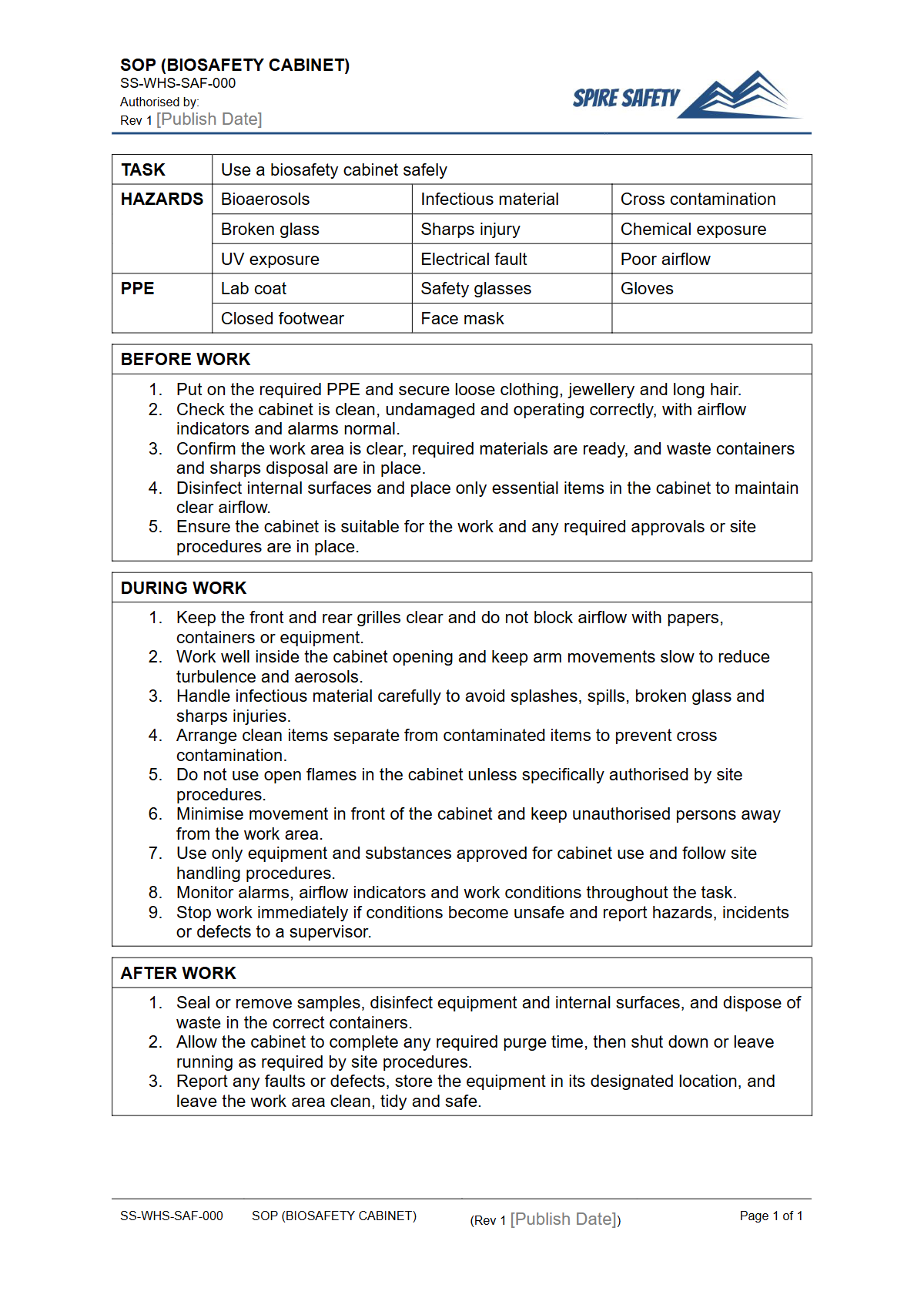
Purpose of the Free Safe Operating Procedure (Biosafety Cabinet) Template
A Biosafety Cabinet (BSC) is a critical piece of containment equipment used in laboratories to handle hazardous biological materials safely. Establishing a clear, documented process is essential for protecting personnel from biohazardous agents, preventing product contamination, and safeguarding the surrounding environment.
This Free Safe Operating Procedure (Biosafety Cabinet) Template provides a structured starting point for Australian organisations to develop their own site-specific procedures.
This template is designed to guide you in creating a comprehensive SOP that outlines the necessary steps for the safe use of a BSC. Formalising these procedures is a key element in any effective safety framework, demonstrating a commitment to risk management and operational excellence. Implementing robust SOPs is a fundamental part of well-developed WHS management systems.
Video walkthrough
How to use the Free Safe Operating Procedure (Biosafety Cabinet) Template
Download the template in your preferred format (DOCX for easy editing or PDF for reference) and use it as a foundation for your internal safety document. A Safe Operating Procedure is not a generic document; it requires customisation to be effective and relevant.
Important: This is a template only. We provide it as a starting point, but you must adapt it to your specific workplace.
You need to include details such as the specific make, model, and class of your Biosafety Cabinet (e.g., Class I, Class II Type A2, Class III), the biological agents being handled, site-specific decontamination protocols, emergency contacts, and the names of responsible personnel. Failure to customise the SOP for your unique circumstances can render it ineffective.
When to use this Safe Operating Procedure
A Safe Operating Procedure for a Biosafety Cabinet should be a core part of daily laboratory work. It should be used consistently during several key activities:
- Training and Induction: For any new personnel, students, or researchers who will be operating the BSC.
- Pre-Operational Reference: As a checklist before commencing work to ensure all safety and operational steps are followed correctly.
- Competency Assessments: To provide a clear standard against which operator competency can be regularly assessed and verified.
- Incident Investigation: As a reference document when investigating spills, exposures, or equipment malfunctions to determine if procedures were followed.
- Procedure Review: During annual or biennial reviews of your lab's safety protocols, or after any changes to equipment or the types of agents being handled.
Who should use this Safe Operating Procedure
This document is intended for use by all individuals involved with the use and management of Biosafety Cabinets within an organisation. This includes:
- Laboratory Technicians and Research Assistants: The primary operators who must follow the procedure for every use.
- Principal Investigators and Laboratory Managers: Those responsible for ensuring safe practices are implemented, staff are trained, and procedures are up-to-date.
- WHS/OHS Managers and Advisors: Professionals responsible for overseeing the development, implementation, and review of safety procedures across the organisation.
- Maintenance and Certification Personnel: As a reference for understanding the operational context of the equipment they service.
Ultimately, the Person Conducting a Business or Undertaking (PCBU) has the primary duty of care to ensure safe systems of work are in place for all plant and equipment. This SOP is a tool to help meet that obligation. For other complex equipment, similar documented procedures are essential, such as our free CNC Machine SOP template.
Elements of a robust Biosafety Cabinet SOP
A thorough SOP for a BSC goes beyond simple on/off instructions. Our template guides you to consider several critical phases of operation to ensure a complete and safe workflow. Key sections to detail include:
- Pre-operational Checks: Verifying certification status, checking sash height, and ensuring the area is clear.
- Start-up Sequence: Correct procedure for turning on the motor, allowing the cabinet to purge, and decontaminating the work surface.
- Aseptic Technique and Work Practices: Guidelines on how to work within the cabinet, including slow movements, organising materials from clean to dirty, and avoiding blockage of air grilles.
- Shutdown Sequence: Procedures for decontaminating and removing materials, surface decontamination, and turning off the cabinet.
- Emergency Procedures: Specific, actionable steps to take in the event of a spill, power failure, or alarm activation.
- Routine Maintenance: Notes on daily, weekly, or monthly cleaning and user-level checks.
Developing comprehensive procedures for specialised machinery is a common challenge. For comparison, you can see how tasks are broken down in our free brake press SOP template.
While this template provides a solid structure, professional guidance can be invaluable for complex laboratory environments. If you need assistance developing or reviewing your safety documentation, our WHS consulting services can provide expert support tailored to your specific needs.
Whether in a laboratory, workshop, or on a construction site, procedural discipline is key to safety. From complex biological work to simple tasks at height, a clear SOP reduces risk. For another example of a procedural document for common equipment, see our FREE Step Ladder SOP Template.
We encourage you to explore our entire free WHS resources library for more templates, checklists, and guides to support your safety management system.
Common mistakes
Common mistakes to avoid
- Overloading the cabinet with equipment and materials, which blocks airflow grilles and compromises containment.
- Using rapid, sweeping arm movements inside the cabinet, which disrupts the protective air curtain.
- Working with the sash in the incorrect position (too high or too low), affecting airflow velocity.
- Failing to decontaminate surfaces effectively with an appropriate disinfectant before and after each use.
Legal references
Legal considerations
The following legal requirements may be relevant to this type of work.
- Work Health and Safety Act (Harmonised) — Provides the primary duties for protecting workers and other people from work health and safety risks.
- Work Health and Safety Regulations (Harmonised) — Sets out requirements supporting the management of workplace hazards and risks.
The following codes may be relevant to this type of work.
- Managing WHS Risks Code of Practice — Provides practical guidance on identifying hazards, assessing risks and applying effective controls.
- Work Health and Safety Consultation, Cooperation and Coordination Code of Practice — Provides practical guidance on consulting workers and coordinating with other duty holders.
- Managing the Work Environment and Facilities Code of Practice — Provides practical guidance on safe work environments, workplace facilities and related controls.
Did you know
BSC Classes
Biosafety cabinets are categorised into three classes. Class I protects the user and environment; Class II protects the user, environment, and product; and Class III is a gas-tight glove box providing the highest level of protection.
Air Curtain
The protective 'air curtain' at the front of a Class II BSC is fragile. Moving your arms in and out of the cabinet too quickly can disrupt this barrier, potentially allowing contaminants to escape or enter.
FAQ
Frequently asked questions
01What is the difference between a biosafety cabinet and a fume hood?
02How often should a biosafety cabinet be certified?
03What personal protective equipment (PPE) is needed when using a BSC?
04Can I use a Bunsen burner inside a Class II biosafety cabinet?
Share this resource
Free Safe Operating Procedure (Biosafety Cabinet) Template
Browse Categories
How To Use It
- 1Download and open in Word or PDF.
- 2Replace the placeholders with your business details.
- 3Get it reviewed by a WHS specialist before rollout.
Need it customised?
Our WHS consultants can adapt this template to your site, run a gap analysis, or audit what you already have in place.
Book a Free Consultation WHS consulting servicesor call 1300 156 382
Related templates
- Free Safe Operating Procedure (Biosolids Handling) Template
- Free Safe Operating Procedure (Bird Net Installation) Template
- Free Safe Operating Procedure (Biscuit Jointer) Template
- Free Safe Operating Procedure (Bitumen Kettle) Template
- Free Safe Operating Procedure (Bitumen Sprayer) Template
- Free Safe Operating Procedure (Blade Change) Template