
Free Safe Operating Procedure (Biohazard Spill Cleanup) Template
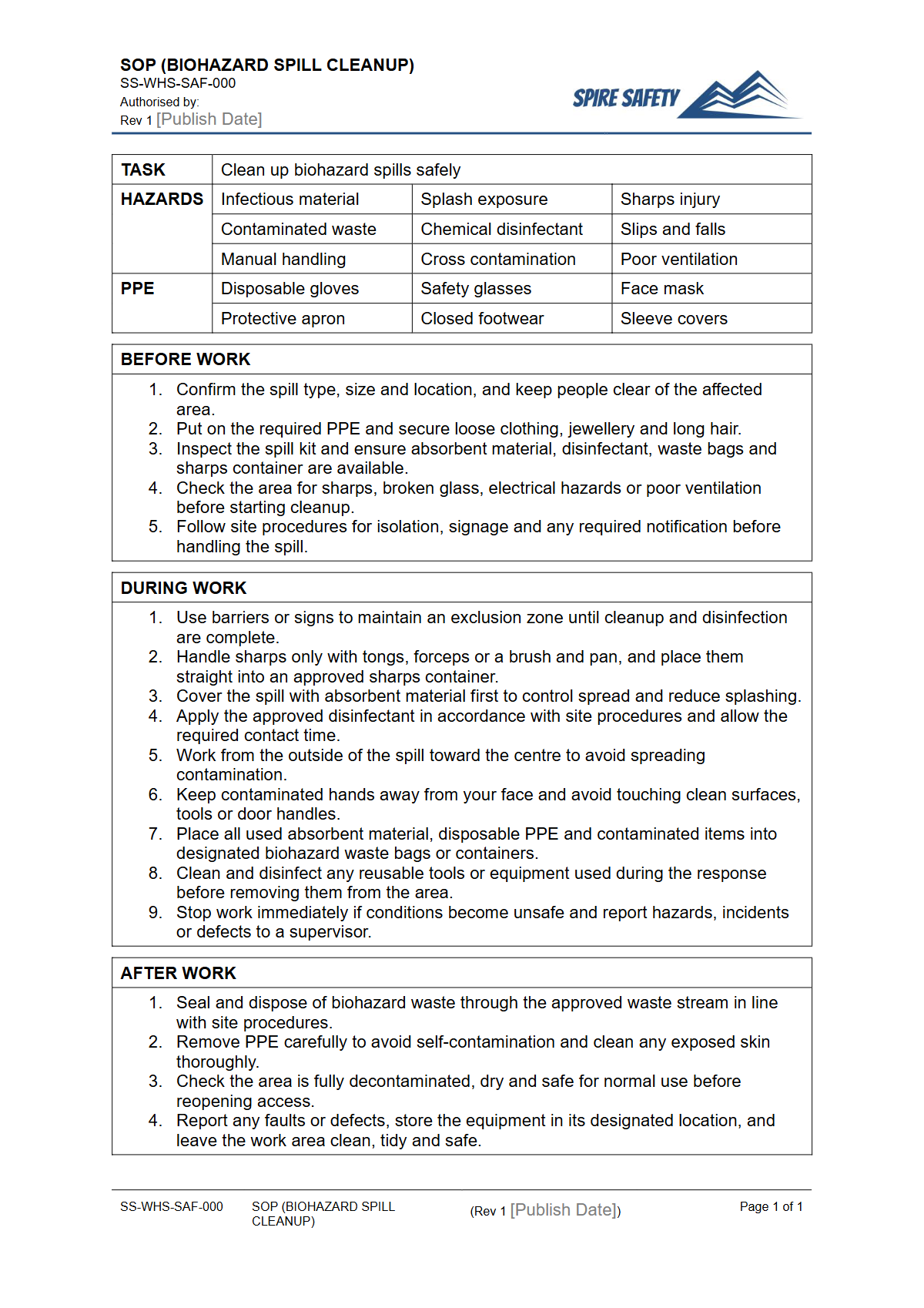
Download our free Safe Operating Procedure (Biohazard Spill Cleanup) template. This Word & PDF document provides a framework for managing biological spills.
Free Safe Operating Procedure (Biohazard Spill Cleanup) Template
DOCX • 126 KB + PDF
Updated Oct 2026
No signup required
Purpose of the Free Safe Operating Procedure (Biohazard Spill Cleanup) Template
Effectively managing exposure to biological hazards is a critical part of workplace safety, particularly in industries like healthcare, laboratories, and emergency services. This free Safe Operating Procedure (Biohazard Spill Cleanup) template provides a structured framework for responding to spills of blood, body fluids, and other potentially infectious materials.
The primary purpose is to guide workers through a step-by-step process for safely containing, cleaning, and disinfecting a contaminated area. Following a documented procedure helps minimise the risk of exposure to bloodborne pathogens and ensures a consistent, safe response every time.
A clear SOP is a fundamental part of building robust WHS management systems that protect your team.
Video walkthrough
How to use the Free Safe Operating Procedure (Biohazard Spill Cleanup) Template
This Safe Operating Procedure (Biohazard Spill Cleanup) template is available for download as a DOCX file for easy editing or as a PDF for quick reference. It is designed as a comprehensive starting point aligned with Australian WHS principles.
To make it effective, you must adapt it to your specific operational context. This involves a thorough review and the inclusion of site-specific details.
A generic document is not sufficient for ensuring safety. For more complex procedural gaps or implementation challenges, engaging in expert WHS consulting can provide valuable clarity and direction.
Important Customisation Note
This template provides a solid foundation based on established safety practices. However, to make it truly effective for your organisation, we stress that you must customise it. This includes adding details such as:
- Specific types of biohazards present in your workplace.
- Location and inventory of biohazard spill kits.
- Site-specific emergency contact numbers and personnel.
- Procedures for cordoning off different areas of your facility.
- Details of your organisation's third-party clinical waste disposal provider.
- Requirements for post-cleanup incident reporting.
When should this Safe Operating Procedure be used?
This SOP should be activated immediately following any uncontrolled spill of biological material that has the potential to cause harm. It is not limited to hospital or laboratory settings.
Common scenarios include blood spills from a first aid incident in an office or workshop, leakage from a specimen container during transport, or an accident in an aged care facility or veterinary clinic. Any situation where workers may come into contact with blood or other body fluids requires a formal, systematic cleanup process to control the hazard.
Regular reviews of such procedures are often a key part of a thorough WHS compliance auditing program.
Who should use this SOP?
This procedure is intended for use by all personnel who are tasked with responding to and cleaning up biohazardous spills. This typically includes designated first aid officers, specialised cleaning staff, laboratory technicians, or members of a dedicated site emergency response team.
It is essential that these individuals receive specific training on the procedure and the correct use of a biohazard spill kit. Furthermore, supervisors and managers must also be familiar with this SOP to ensure it is implemented correctly, that workers are adequately trained, and that all necessary resources, including PPE and disposal services, are readily available. For more documents to support your safety framework, browse our complete free WHS resources library.
Common mistakes
Common mistakes to avoid
- Using the wrong type of Personal Protective Equipment (PPE) or removing it incorrectly.
- Failing to properly cordon off the spill area, allowing others to walk through and spread contamination.
- Disposing of contaminated materials in general waste instead of designated biohazard bins.
- Using an incorrect disinfectant or not allowing sufficient contact time for it to work effectively.
Legal references
Legal considerations
The following legal requirements may be relevant to this type of work.
- Work Health and Safety Act (Harmonised) — Provides the primary duties for protecting workers and other people from work health and safety risks.
- Work Health and Safety Regulations (Harmonised) — Sets out requirements supporting the management of workplace hazards and risks.
The following codes may be relevant to this type of work.
- Managing WHS Risks Code of Practice — Provides practical guidance on identifying hazards, assessing risks and applying effective controls.
- Work Health and Safety Consultation, Cooperation and Coordination Code of Practice — Provides practical guidance on consulting workers and coordinating with other duty holders.
- Managing the Work Environment and Facilities Code of Practice — Provides practical guidance on safe work environments, workplace facilities and related controls.
Did you know
The Biohazard Symbol
The universal biohazard symbol was developed in 1966 by Charles Baldwin at Dow Chemical. It was chosen to be memorable but meaningless to avoid confusion with any other existing symbols.
Exposure Risk
Exposure to bloodborne pathogens like Hepatitis B, Hepatitis C, and HIV can occur through needlestick injuries or contact with mucous membranes. A formal cleanup procedure is a primary control measure against occupational exposure.
FAQ
Frequently asked questions
01What is considered a biohazard in a workplace?
02What essential items should be in a biohazard spill kit?
03Is special training required for cleaning up biohazardous spills?
04How should biohazardous waste be disposed of in Australia?
Share this resource
Free Safe Operating Procedure (Biohazard Spill Cleanup) Template
Browse Categories
How To Use It
- 1Download and open in Word or PDF.
- 2Replace the placeholders with your business details.
- 3Get it reviewed by a WHS specialist before rollout.
Need it customised?
Our WHS consultants can adapt this template to your site, run a gap analysis, or audit what you already have in place.
Book a Free Consultation WHS consulting servicesor call 1300 156 382
Related templates
- Free Safe Operating Procedure (Biosafety Cabinet) Template
- Free Safe Operating Procedure (Biosolids Handling) Template
- Free Safe Operating Procedure (Bird Net Installation) Template
- Free Safe Operating Procedure (Biscuit Jointer) Template
- Free Safe Operating Procedure (Bitumen Kettle) Template
- Free Safe Operating Procedure (Bitumen Sprayer) Template