
Free Safe Operating Procedure (Berry Harvesting) Template
Download our free Safe Operating Procedure (Berry Harvesting) template.
Free Safe Operating Procedure (Berry Harvesting) Template
DOCX • 126 KB + PDF
Updated Oct 2026
No signup required
Purpose of the Free Safe Operating Procedure (Berry Harvesting) Template
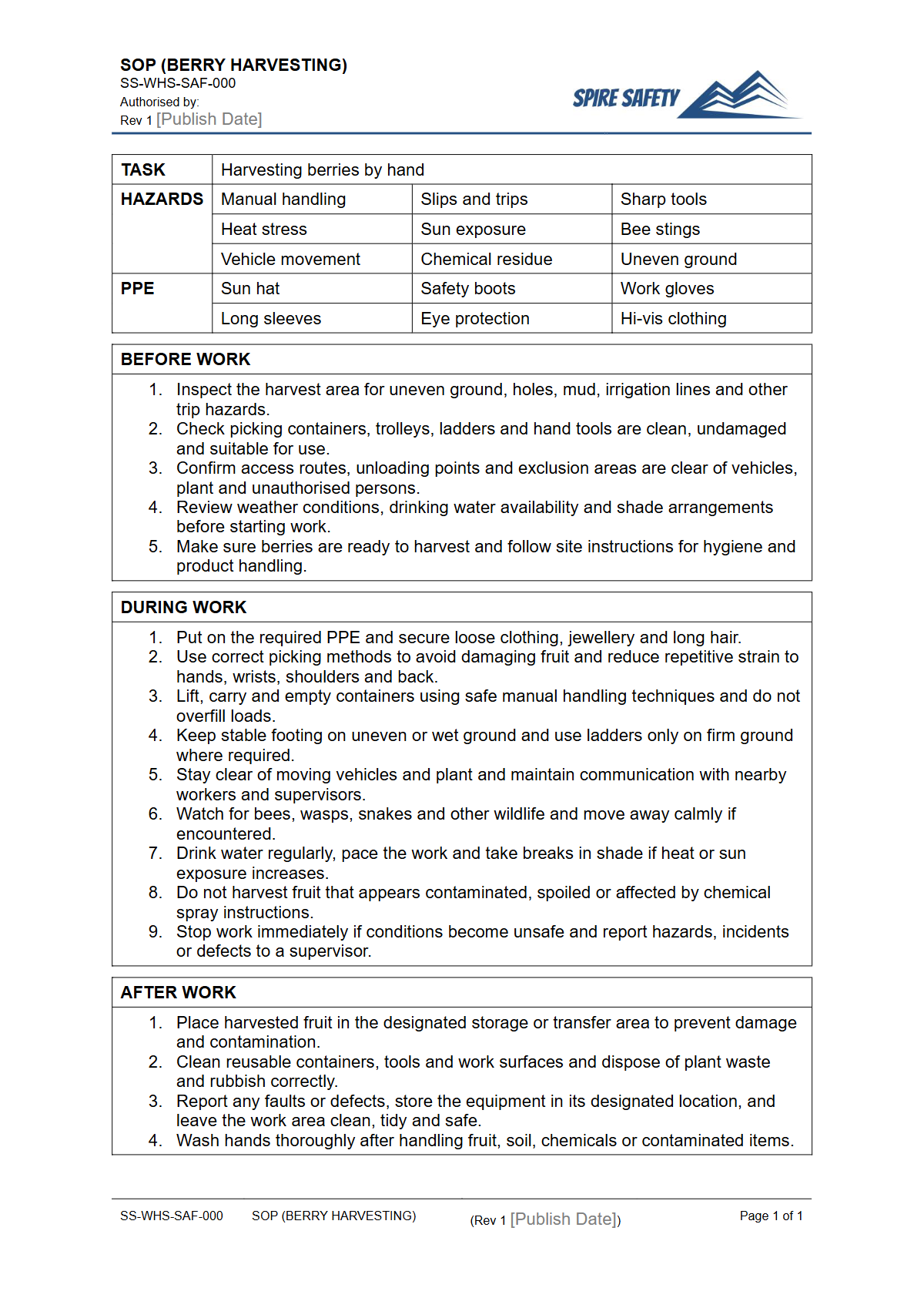
This Free Safe Operating Procedure (Berry Harvesting) Template provides a structured framework for documenting the hazards and control measures associated with harvesting berries. Berry harvesting, while seemingly straightforward, involves numerous risks including musculoskeletal injuries from repetitive movements, heat stress from sun exposure, slips and falls on uneven ground, and potential interaction with vehicles or machinery.
Using a formal Safe Operating Procedure (SOP) helps standardise the task, ensuring every worker understands the recognised safe method for completing their work. It is a fundamental tool for worker training, induction, and supervision.
Implementing documented procedures like this is a core component of effective WHS management systems. A well-drafted SOP demonstrates a commitment to managing risks and fulfilling the primary duty of care under Australian WHS legislation. It translates risk assessment findings into practical, step-by-step instructions that guide worker behaviour and minimise exposure to harm.
Video walkthrough
How to use the Free Safe Operating Procedure (Berry Harvesting) Template
This resource is provided as a starting point in both DOCX and PDF formats. It is essential to adapt it to the specific context of your farm or operation.
Generic procedures are insufficient; you must identify the unique hazards present in your work environment, such as the specific type of berry, the terrain, the equipment used, and the skill level of your workforce.
Please be aware: This is a template and is not a complete Safe Operating Procedure. You must consult with your workers and customise this document to reflect the specific hazards, equipment, and environment of your workplace.
We cannot guarantee its suitability for your specific circumstances.
To effectively use this template:
- Download the DOCX file and open it for editing.
- Conduct a risk assessment for berry harvesting tasks in consultation with your workers.
- Modify the SOP to include site-specific hazards, such as unique ground conditions, specific pests, or the use of specialised equipment. Where other plant is used, such as for moving pallets of harvested fruit, a specific telehandler SOP may be required.
- Clearly document the required personal protective equipment (PPE), such as wide-brimmed hats, sunscreen, gloves, and appropriate footwear.
- Outline the step-by-step process for the task, from pre-start checks to clean-up and waste disposal.
- Include emergency procedures for common agricultural incidents like heatstroke, dehydration, snake or spider bites, and first aid response.
- Have the final document reviewed and approved by a competent person before implementation.
- Use the finalised SOP as a basis for training all relevant workers.
When to use a Safe Operating Procedure
A Safe Operating Procedure for berry harvesting should be developed and implemented before any workers begin the task. It serves as a critical document during new worker inductions and for periodic refresher training to reinforce safe work habits.
The SOP should also be reviewed and potentially updated following any incident or near-miss, when new equipment or harvesting techniques are introduced, or if legislative requirements change. Regular reviews ensure the document remains relevant and effective.
If you require assistance with implementing review cycles or safety systems, advice from WHS consulting professionals can provide valuable structure.
Who should use this document
This template is designed for use by Persons Conducting a Business or Undertaking (PCBUs), farm managers, orchard supervisors, and WHS advisors in the agricultural sector. These individuals are responsible for creating, implementing, and enforcing safe work systems.
While managers and supervisors author the document, the finalised SOP is a tool for everyone. All workers involved in berry harvesting must be trained on its contents and be able to access it for reference. It ensures consistency in training and sets clear expectations for safe performance, whether a worker is picking berries, sorting fruit, or operating vehicles nearby, which may require a separate body truck SOP. If harvesting involves working at heights from platforms or ladders, you may also need a step ladder SOP. You can find more templates like this in our free WHS resources library.
Common mistakes
Common mistakes to avoid
- Using a generic template without customising it for specific farm conditions and equipment.
- Failing to consult with the workers who actually perform the task during its development.
- Not providing adequate training on the finalised SOP before work commences.
- Forgetting to include site-specific emergency procedures for incidents like heatstroke or snake bites.
Legal references
Legal considerations
The following legal requirements may be relevant to this type of work.
- Work Health and Safety Act (Harmonised) — Provides the primary duties for protecting workers and other people from work health and safety risks.
- Work Health and Safety Regulations (Harmonised) — Sets out requirements supporting the management of workplace hazards and risks.
The following codes may be relevant to this type of work.
- Managing WHS Risks Code of Practice — Provides practical guidance on identifying hazards, assessing risks and applying effective controls.
- Work Health and Safety Consultation, Cooperation and Coordination Code of Practice — Provides practical guidance on consulting workers and coordinating with other duty holders.
- Managing the Work Environment and Facilities Code of Practice — Provides practical guidance on safe work environments, workplace facilities and related controls.
Did you know
Manual Handling Risk
Musculoskeletal disorders arising from repetitive lifting, bending, and reaching are among the most common and costly injuries in the Australian agriculture sector.
UV Exposure
Australia has one of the highest rates of skin cancer in the world. Agricultural workers are at a significantly higher risk due to prolonged periods of sun exposure during their work.
FAQ
Frequently asked questions
01What are the main hazards involved in berry harvesting?
02Is a Safe Operating Procedure legally required for berry harvesting in Australia?
03How often should a berry harvesting SOP be reviewed?
04Who should be involved in developing a SOP for berry harvesting?
Share this resource
Free Safe Operating Procedure (Berry Harvesting) Template
Browse Categories
How To Use It
- 1Download and open in Word or PDF.
- 2Replace the placeholders with your business details.
- 3Get it reviewed by a WHS specialist before rollout.
Need it customised?
Our WHS consultants can adapt this template to your site, run a gap analysis, or audit what you already have in place.
Book a Free Consultation WHS consulting servicesor call 1300 156 382
Related templates
- Free Safe Operating Procedure (Bilge Cleaning) Template
- Free Safe Operating Procedure (Bin Lift Area Setup) Template
- Free Safe Operating Procedure (Bin Wash Station) Template
- Free Safe Operating Procedure (Biohazard Spill Cleanup) Template
- Free Safe Operating Procedure (Biosafety Cabinet) Template
- Free Safe Operating Procedure (Biosolids Handling) Template