
Free Safe Operating Procedure (Bench Shears) Template
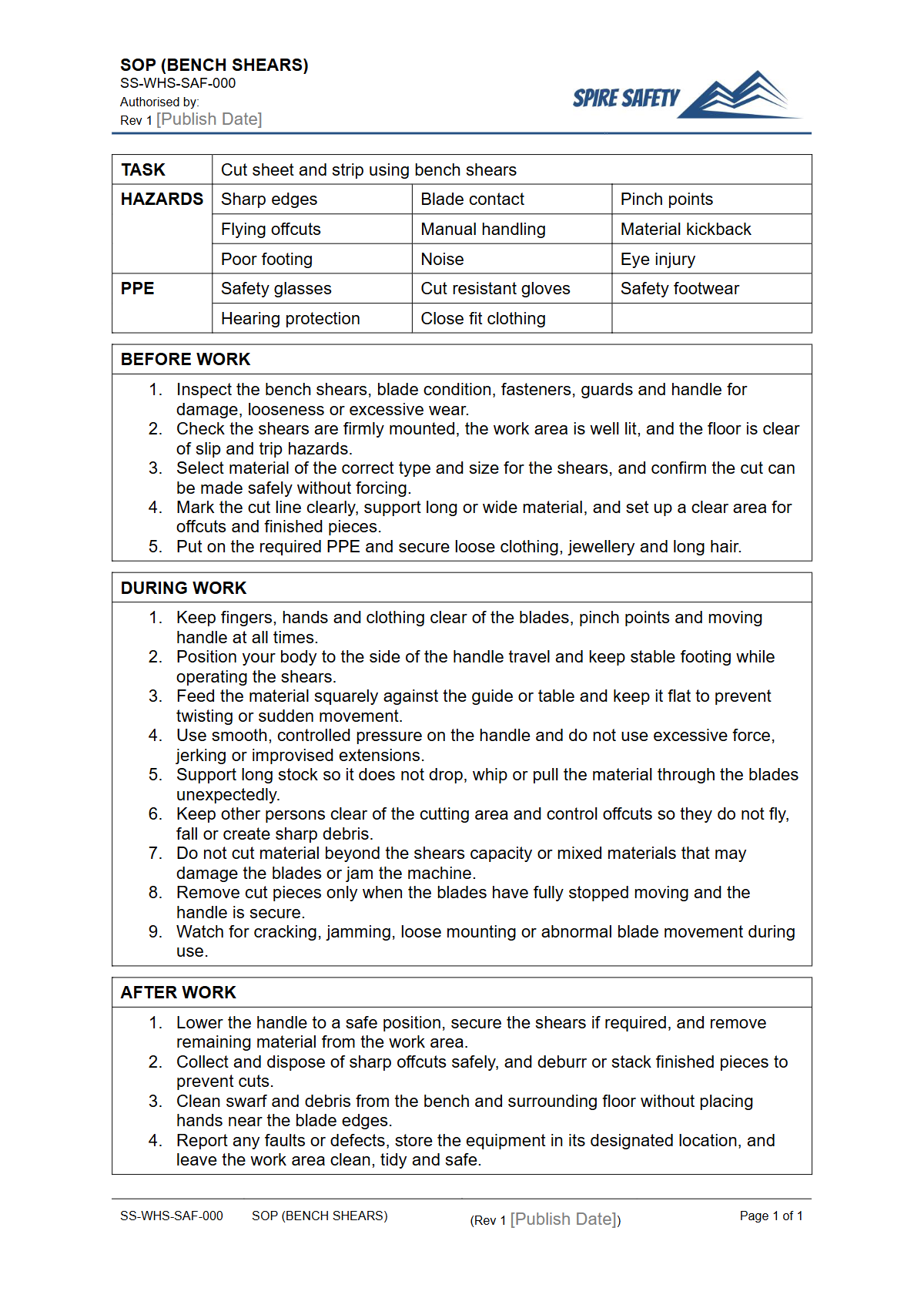
Download our free Safe Operating Procedure (SOP) for bench shears. This template helps you outline safe work steps and control measures for cutting sheet metal.
Free Safe Operating Procedure (Bench Shears) Template
DOCX • 126 KB + PDF
Updated Oct 2026
No signup required
Purpose of the Free Safe Operating Procedure (Bench Shears) Template
Operating workshop equipment like manual bench shears presents significant risks, including severe cuts, amputation, and crushing injuries. This Free Safe Operating Procedure (Bench Shears) Template provides a structured framework for documenting the step-by-step process for using this equipment safely.
A well-developed SOP is a critical control measure, helping Persons Conducting a Business or Undertaking (PCBUs) fulfil their primary duty of care under Australian WHS laws.
By clearly defining pre-operational checks, safe operating steps, required Personal Protective Equipment (PPE), and emergency procedures, this document helps standardise safe work practices. It serves as a vital tool for worker induction, training, and ongoing competency management, forming a key component of a robust safety management system.
Using a clear SOP helps minimise operator error and ensures that all workers understand the established safety protocols for handling sheet metal and operating the shears.
How to use the Free Safe Operating Procedure (Bench Shears) Template
This template is provided in both DOCX and PDF formats for your convenience. The DOCX file is fully editable, allowing you to tailor the content to your specific operational needs.
To use the template effectively, you should conduct a site-specific risk assessment for your bench shears to identify all relevant hazards and determine appropriate control measures. These details should then be incorporated into the document.
Important: This is a template only. It has been developed as a guide aligned with the model WHS framework.
You must customise it to reflect the specific equipment, materials, work environment, and control measures relevant to your workplace. We are not liable for any incidents that may arise from the use of this document.
For best results, SOPs should be developed in consultation with the workers who will be using them. For other metal cutting processes, you may also find our FREE Plasma Cutter SOP (Safe Operating Procedure) Template a useful reference.
Video walkthrough
When to use a Bench Shears SOP
A Safe Operating Procedure for bench shears should be a core part of your operational safety documentation. It must be used during the induction and training of any new worker who will be required to operate the equipment.
It serves as a practical checklist for competency assessments and as a reference document for experienced operators to refresh their knowledge of safe practices.
The SOP should also be readily accessible in the work area for quick reference. Furthermore, it is a key document to review during safety inspections, after an incident or near miss occurs, or when changes are made to the equipment or work process.
Regular reviews ensure the procedure remains relevant and effective, which is a critical part of any WHS compliance auditing program.
Who should use this SOP template
This template is designed for use by anyone responsible for workplace safety in environments where bench shears are used. This includes workshop managers, supervisors, team leaders, and WHS professionals in sectors such as metal fabrication, engineering, manufacturing, and trade schools.
Workers themselves should be familiar with the document, as it outlines the expected safe behaviours and procedures they must follow.
An SOP is a fundamental building block of a compliant and effective safety system. It doesn't exist in isolation but should be integrated into your broader WHS management systems. It works alongside risk assessments, training records, and maintenance logs to create a comprehensive approach to managing plant safety.
For organisations using a variety of workshop equipment, it's good practice to have standardised procedures for all high-risk plant. You might also need similar documents for other tools, such as the one outlined in our Free Bench Grinder SOP (Safe Operating Procedure) Template.
Likewise, workshops involved in sheet metal forming will benefit from clear procedures for associated machinery. Our Free Brake Press SOP (Safe Operating Procedure) Template provides a structured guide for that specific task.
You can explore our entire collection of procedural documents in our free WHS resources library to build a comprehensive safety portfolio for your operations.
Common mistakes
Common mistakes to avoid
- Using a generic template without customising it for the specific machine and tasks.
- Failing to adequately train workers on the finalised SOP and confirm their understanding.
- Not enforcing the use of the specified Personal Protective Equipment (PPE).
- Neglecting regular inspection and maintenance of the shears, particularly blade sharpness and guarding.
Legal references
Legal considerations
The following legal requirements may be relevant to this type of work.
- Work Health and Safety Act (Harmonised) — Provides the primary duties for protecting workers and other people from work health and safety risks.
- Work Health and Safety Regulations (Harmonised) — Sets out requirements supporting the management of workplace hazards and risks.
The following codes may be relevant to this type of work.
- Managing WHS Risks Code of Practice — Provides practical guidance on identifying hazards, assessing risks and applying effective controls.
- Work Health and Safety Consultation, Cooperation and Coordination Code of Practice — Provides practical guidance on consulting workers and coordinating with other duty holders.
- Managing the Work Environment and Facilities Code of Practice — Provides practical guidance on safe work environments, workplace facilities and related controls.
Did you know
A Common Injury Source
Hand and finger injuries are among the most common workplace injuries in the manufacturing and fabrication sectors, frequently caused by interactions with cutting and shearing machinery.
FAQ
Frequently asked questions
01What are the main hazards of using bench shears?
02Is a Safe Operating Procedure a legal requirement in Australia?
03How often should an SOP for bench shears be reviewed?
04What PPE is required for operating bench shears?
Share this resource
Free Safe Operating Procedure (Bench Shears) Template
Browse Categories
How To Use It
- 1Download and open in Word or PDF.
- 2Replace the placeholders with your business details.
- 3Get it reviewed by a WHS specialist before rollout.
Need it customised?
Our WHS consultants can adapt this template to your site, run a gap analysis, or audit what you already have in place.
Book a Free Consultation WHS consulting servicesor call 1300 156 382
Related templates
- Free Safe Operating Procedure (Bench Vice) Template
- Free Safe Operating Procedure (Bending Machine) Template
- Free Safe Operating Procedure (Berry Harvesting) Template
- Free Safe Operating Procedure (Bilge Cleaning) Template
- Free Safe Operating Procedure (Bin Lift Area Setup) Template
- Free Safe Operating Procedure (Bin Wash Station) Template